Sunday, June 12, 2022

Keep Running Up That Hill

 So it would seem that the Kids These Days have discovered Kate Bush - and I couldn't be more pleased.

In contrast to the impression that some of the memes going around might give you, there were a lot of us who appreciated her in the late 1980s and early 1990s. Personally, I tended to be late to every party, and I came to this one indirectly. I first remember hearing Kate Bush's voice in a 1990s PSA about teenaged runaways that featured her part from the Peter Gabriel duet, "Don't Give Up":


From there, friends pointed me to Running Up That Hill, and I bought a copy of her "greatest hits" album, The Whole Story, which featured most of the songs on this list.

Running Up That Hill only made it to number 30 on the Billboard Hot 100 in 1985, which most people dismiss as a poor showing (oh, you 1980s kids didn't appreciate what you had!) but even a major talent like Elvis Costello didn't achieve that kind of success until 1989 when Veronica made it to number 19.

And consider the competition that year - whether you think they "deserve" it or not, you recognize most of these songs or the performers:

Top Songs of 1985
  • Wake Me Up Before You Go-Go. Wham!
  • I Want to Know What Love Is. Foreigner.
  • I Feel for You. Chaka Khan.
  • Out of Touch. Hall & Oates.
  • Everybody Wants to Rule the World. Tears for Fears.
  • Money for Nothing. Dire Straits.
  • Crazy for You. Madonna.
  • Take on Me. a-ha.
And I don't think it's a coincidence that the Stranger Things kids appeared in the video for that last one when Weezer remade it recently. (Weezer remade "Everybody Wants to Rule the World," too, for that album.)


My point is that it's easy to forget how beloved certain songs and artists were, especially over time. As big as I was into what was being called "New Wave" at the time, all of that was overwhelmed by the surge in Alternative music that R.E.M. was about to usher in - and the Grunge sound that Nirvana, Soundgarden, Pearl Jam, and the like were going to introduce a few years after that. Success is always relative, and very fluid.

 And as much as I loved the weird things that Kate Bush was doing with her music, I admit that I loved other artists more - Peter Gabriel's So album, which featured Don't Give Up was one that I played an order of magnitude more often than I played The Whole Story. There is probably a whole essay's worth of baggage to examine about how we allow male artists to overshadow the women they work side by side with and depend on...

...but for now, I'll just be happy for Kate Bush, and I hope that you all dig into her entire catalog. I also recommend that if you're looking for more artists like her, you won't rely on your favorite app's algorithm. As great as Peter Gabriel and Talking Heads are, if you're looking for weird and wonderful women doing great work from that general late 80s/early 90s era, you could do a lot worse than these:

Aimee Mann - 
(with Til Tuesday) Voices Carry
(from her 2017 album Mental Illness) Goose Snow Cone
Debbie Harry -
(as Blondie) Heart of Glass
(duet with Iggy Pop) Well Did You Evah?
Laurie Anderson - 
(with Peter Gabriel, also from So) This is the Picture (Excellent Birds)
her 2021 NPR Tiny Desk Concert (so deliciously weird!!!)
Suzanne Vega - 
Siouxsie and the Banshees -


I've forgotten more - feel free to drop links to your favorites in the comments!

Thursday, June 2, 2022

Why Abortion Isn't Murder

 I'm writing to you now from this liminal time in America before the release of a U.S. Supreme Court decision that will likely determine that fundamental individual human rights not enumerated in the U.S. Constitution are not protected from laws made by the States. When they release their decision, 13 U.S. States already have "trigger laws" in place to ban abortions, and another 13 are very likely to pass new bans. 26 out of 50 - more than half of the country - will ban something that a steady majority of the country believes should be legal.

About a dozen years ago, a former Facebook friend asked on his wall, "Has anyone ever changed their mind about an issue as important as abortion?" I answered "yes." Because when I was 12, in 1984, I was a die-hard, pro-life, Reagan Republican kid who believed what I had been told about abortion - both overtly by pro-life voices on my radio (like Dr. James Dobson and his Focus on the Family show) and tacitly by my family and church (who didn't like talking about it at all). But five years later, when I was 17, I had reason to begin questioning the things I had always had such rock-solid faith in.

(I wrote about that process in "Why I Am A None" a few years back if you want to explore that journey.) 

But, when I told my Facebook friend about my change of mind, he asked what made me "switch sides" - and I told him, I had learned enough about the issue to realize that the decisions about it should be left to the people involved - the pregnant person, their doctor, and anyone the pregnant person chooses to be involved. He said, in clear frustration, "But you just re-framed the question!" and unfriended me soon after.

I understand why he was frustrated. I didn't address his central, overriding concern. He, like 12-year-old me, and like the minority of Americans who feel strongly that abortion should be banned, believes that abortion is the murder of a child. 

It isn't. But he believes it is - and while I wouldn't expect anyone to take a journey that took me many years to complete in a moment, I feel like I owe him and the many people who hold onto that idea an accounting of the facts, evidence, and reasoning that led me to this conclusion. I'll start with the one that is least important to me, but most important to most of those in the minority:

God says it isn't

You can, of course, believe whatever you choose to believe. It's a free country (or so I'm told). If you want to believe that the Bible tells you to oppose the practice of abortion, you are free to believe that - but it's not true.

You can "do your own research" and find all kinds of people arguing strenuously that many verses talk about the value of life as a general concept - I found several such articles on the Focus on the Family website. Here I was, thinking that an organization as ardently in favor of banning abortion would have the strongest Biblical evidence and analysis available. Here's what I found with a brief search:

Reading the verses they cited literally, those scriptures say nothing at all about abortion - at best, they claim that certain prophets were destined "from the womb" to be important. Reading these verses literally, by the way, you will note that the text explicitly charges us to care for orphans and widows, providing them material support and looking out for their health. They make a much more powerful case for mandating health care and public housing than they do for a ban on abortion.

I'm not alone in arriving at the conclusion that the Biblical view on abortion does not define it as "murder". In 1979, Billy Graham's magazine, Christianity Today, edited by Harold Lindsell, champion of “inerrancy” and author of The Battle for the Bible, published an article by a professor from Dallas Theological Seminary which criticized the Roman Catholic position on abortion as unbiblical. That article said:

God does not regard the fetus as a soul, no matter how far gestation has progressed. The Law plainly exacts: “If a man kills any human life he will be put to death” (Lev. 24:17). But according to Exodus 21:22-24, the destruction of the fetus is not a capital offense. … Clearly, then, in contrast to the mother, the fetus is not reckoned as a soul.

That isn't just one niche position, either. That's an interpretation that has some scholarly weight behind it (see "the Episcopal perspective" in this academic article). It wasn't until the early 1980s that evangelical churches began shifting their positions on this - you can read more about that from The Slacktivist, if you like. He also explains why that view shifted, if you're interested in seeing how the question was reframed before I came on the scene and joined the narrative.

Like I said, you can choose to ignore all of this and hold onto your belief. But know that if you do, you should know that I've read your book, and I know that you're either simply wrong or lying about what it says.

Our Definitions Don't Match

I'm going to proceed as if my first point did not convince you. I will assume that you went to those Focus on the Family links and found their assertions about the sanctity of life to be very convincing. "If a man kills any human life..." etc. "Thou shalt not kill." And an abortion ends a life, therefore... Clearly, you must feel that the interpretation of "when life begins" has shifted since 1979, and I have two problems with that.

First, I have observed a definite mismatch between the numbers of different things that aren't abortions and the number of things that pro-life apologists count as abortions. Depending on your source (and how radical the organization behind the data is) abortion is frequently described as a "holocaust" with millions of victims. 

The favorite talking point for anti-abortion arguments is the "late term abortion" or so-called "partial birth abortion," which fuels the grisly image of actual babies being killed by callused women and doctors for the sake of "convenience." And when you allow them to do so, people will conflate every one of the "millions" of abortions with those relatively rare "late term" cases. 

It's hard to pin down actual numbers, but you may have seen this in the viral exchange between Transportation Secretary Pete Buttigieg and Chris Wallace:

"These aren't hypotheticals — there are 6,000 women a year who get an abortion in the third trimester," Wallace said.

"That's right, representing less than one percent of cases a year," Buttigieg replied. 

That tracks with the generally accepted statistics that put the number of abortions from year to year at around 600,000 - but it's much harder to get information about what counts as "an abortion". The legal defintion is super broad:

Abortion is defined as the termination of pregnancy by various methods, including medical surgery, before the fetus is able to sustain independent life.

And that's where the grey area gets very large. Because "various methods" can be literally anything, and "before the fetus is able to sustain independent life" is up for debate, depending on the state of medical technology and the health of the fetus in question. Considering that as many as 43% of women report first trimester miscarriages, and that a large number of those would require medical surgery that would certainly be counted as "getting an abortion," it's a very bad faith argument to judge all of those unique situations as if they were all morally the same. As Sec. Buttigieg pointed out, by definition, mothers that far along in their pregnancy have decided to have a baby, and are expecting to give birth. The curve balls that biology can throw at someone are legion, and it is ghoulish and cruel to characterize the women who have to make the choice that late in the game as "murderers". 

The vast majority of abortions do not fall into that narrow window, however, and it is also ghoulish and cruel to pretend that they do. Women who take birth control (even the so-called "abortifacient drugs") are not committing murders.

But maybe you still reject Pete Buttigieg's reasoning about how you should think about those 6,000 third trimester abortions, and you assume that all of the fetuses involved would have survived and thrived if only they had been given the chance. Maybe you want to call it murder to choose the mother's life over that of the child:

Trading lives isn't compulsory

It is not murder for me to refuse to donate an organ, or even something as simple as my blood, even though lives may depend on it. In the United States, your bodily autonomy is protected even after you die, meaning that unless you have identified yourself as an organ donor, no one can take any part of you - even if it means saving someone else's life.

That is true, even if your reasons for not saving that person's life are frivolous and shallow. Saying "I don't want to donate my blood to save hurrican victims in Florida because I can't stand their football team" makes you sound like a supreme jerk - but it does not make you a murderer.

In the same way, a woman who finds herself pregnant who does not want to be should not be compelled to "donate" her body to that fetus. And that is not murder.

So what?

Yeah. I guess that's the big question.

I doubt these arguments will convince anyone to change their mind - particularly in the heat of an internet battle. Oh, well.

But, maybe you're less of a die-hard "believer" and more of a thoughtful bystander. Maybe you've run across this line of reasoning for the first time, and it has given you food for thought.

My hope is that if you don't become an activist, organizing and fighting to preserve individual rights to privacy and sound medical advice during pregnancy, you will at least be aware that the people claiming the moral high ground do not actually have it. Be aware that this issue is about morality and justice, but just not the way it is advertised.

And maybe, at some point, you'll spread the word to someone else.


Friday, September 10, 2021

Why, Yes, I Do Remember

 Twenty years ago this particular September morning, I was taking my five-year-old to school, and half-listening as the KUPD "Morning Sickness" crew laughed about an undocumented immigrant man who was working in a bottling factory and lost his "pee-pee" after getting it stuck in a bottle. News of the Weird. And then they started talking about airplanes flying into the World Trade Center in New York, and I remember being disgusted enough to change the station. "That is just not funny," I might have said out loud.

I don't remember.

I do remember the horror of that day unfolding, and of the following weeks. My brother-in-law was an airman at McGuire Air Force Base at the time, and his unit went to the City to help during the emergency. We found out later that he was one of the people on the ground when the second tower fell, far enough away that he was able to cover his mouth and nose and direct people fleeing the area into a place with shelter.  I had only been out of the Air Force for a few months myself, and I was cynically paying attention to what Defense Secretary Rumsfeld and Vice President Cheney were saying. Among all of the angry politicians speaking about a response, they were the ones who sounded gleeful to me. I remember Rumsfeld making statements tying Iraq's Saddam Hussein to the attacks early on - perhaps as early as September 15?

I don't recall.

I do recall being asked by a friend, "How could anyone hate America so much?" and being foolish enough to give her an answer. This was someone who had introduced herself to me by saying her name and these words: "I'm a conservative, and Democrats are e-vull!" in 1990. I should have known better. I should have mouthed some platitude or said "I don't know." Why did I tell her the truth?

I have no memory of anything at all.

But that's not true. I remember what I told her. I don't have the exact text, because I allowed that email account to lapse years ago, but it's basically the same answer I would give today if someone bothered to ask me. (That's probably why no one does ask.) I said:

"Why are you surprised? I just came back to the U.S. last year after spending three years in England. They're our very best friends, internationally, and they hate us! They think we're fat and obnoxious and using up all the oil. Most other countries think we take too much and control too much and use our wealth and power to get our way. We abuse the International institutions that we established, and use them to drive up all the prices, and drive down all the wages. We have a huge, insatiable domestic market for the drugs they can sell us, but we use that as an excuse to kill them in secret wars to keep them from making a living wage outside of our control. It's a wonder more people haven't attacked us before now."

She, of course, was horrified and said, "Why do you hate America?" We spoke less and less frequently during the Bush Administration.

So, yes, I remember the date. I remember the tragedy - and it was a tragedy. But I remember it as the beginning of my country turning away from the agreed-upon ideals that we had at least claimed to cherish since my grandparents' generation - of democracy, of trying to build a more just and more equitable society. That was when I remember thinking that I was seeing the seeds of a future America full of angry fascists being planted, that nothing good could come from the "with us or against us" mentality.

And I was right about that.

That particular friendship was broken after that conversation, but it died altogether in 2009 - after that friend went on Twitter to say that the Obamas deserved the guillotine, and I called her out for it. Her husband - an active duty NCO in the Army at the time - told me I was a douchecanoe and that his wife was the sweetest person in the world. I laughed at "douchecanoe" and pointed out that anyone calling for the guillotine of an elected U.S. official (his boss, no less) was probably disqualified from any "sweetest person" accolades.

I lost other friends along the way. One called me a traitor after the 2008 election when I told him who I had voted for. He died unexpectedly of a heart attack a couple of years later, without ever talking to me again. It happens, I guess.

And every year, starting about mid-August, those passive-aggressive "you said you'd never forget" memes start showing up. And I don't say anything, because I guess I learned something about being honest with people who are finally paying attention and questioning the "why" behind certain events. I don't say anything because what's the point? 

I just scroll by, and wonder if there was ever anything I could have said that would have gotten through to them? I don't think so. I have tried to warn people. I can't prove it, but I'm pretty sure I told that ex-friend who died in 2012 that I was worried about his party electing a proto-fascist demagogue (I might have even used an extreme example of a certain corrupt NYC real estate mobster) and he laughed at me and said there were checks and balances to keep that from happening.

I know I cautioned people when Sarah Palin and her ilk started making sport of words like "empathy" that it was a bad look to turn positive human values into targets for derision, and I was told to lighten up and learn to take a joke. (Me. The guy who is never ever funny.) Of course, when I do joke, they don't seem to like that either.

So I keep my mouth shut and scroll on, never sure if the people posting the ugly memes are aware that they're targeting me...aware that I do remember, but that I remember it differently than they seem to do.

Or have they simply forgotten?


Thursday, August 22, 2019

The View From Within

Over the summer, I took HIST 441 - History of German, 1871-1945, with Professor Zajicek at Towson University. Our term paper assignment was pretty broad, but I chose to focus on how the average German citizen viewed the ascendancy of the Nazi party. I included my Bibliography at the end, but the footnotes were removed when I copied this over.
I have edited the text to fix some grammatical errors and unclear statements, and I added illustrations and links to Wikipedia articles to make up for referring to material covered in the course that the average reader might not be as familiar with. The original version received an A.  -T

What did the rise of the Nazi state look like to the ordinary German citizen? How did the people at the center of extreme events view themselves, and what did they see in the Nazis that made them accept or ignore the direction the party was taking the country? Average citizens had no privileged insight into what modern historians know now about the weak leadership and chaotic condition of the German government under the Nazi leadership, but there were critics of the regime and an active resistance at work to expose their misdeeds. What factors made it possible for Germans to ignore those warning signs and choose to put the Nazi Party in charge of their government?

Richard Hamilton’s 2003 case study of the electoral results and newspaper content in the Schleswig-Holstein capital of Kiel leading up to Hitler’s electoral victory offers an indirect view of what the German voters saw during the rise in Nazi power. That city’s three newspapers consisted of a Socialist paper with low circulation, and two other papers which were both owned by the same person: one which took generally centrist positions and one which openly supported the Nazis. The trends suggest that weak circulation and a tepid defense of what were seen as establishment liberal policies from the socialist paper could not address the full-throated attacks on socialism from the Nazi paper, or even from the right-leaning centrist paper. The results of the election demonstrate an electorate divided sharply between left and right positions, however, with Protestant farmers showing the strongest support of the Nazis in that area.

Electoral behavior does not suggest active party membership, however. Just as universal suffrage does not equate with universal participation, the reasons people have for voting the way they do are not necessarily harnessed to logic or an informed viewpoint; as Hamilton points out, most people learn their political tendencies from family, and those tendencies “are reinforced by relatives, friends, neighbors, co-workers, and others in the local community.” People not directly associated with the government or the military did not see themselves as “political,” and as studies conducted immediately after World War II demonstrated, average Germans did not feel personally responsible for atrocities which they blamed on the Nazi party or the SS.

While a correlation existed between higher levels of support for the Nazi party in more heavily Protestant areas and lower support in Catholic areas, the Catholics were not necessarily motivated to outright political opposition. Menke explains how the doctrine of “accidentalism” played a part in suppressing a more assertive resistance from Catholic Germans. The pope redefined church doctrine on the rise of secular governments in the 1880s, asserting that secular governments arose to meet the needs of their citizens (in other words, they were “accidents of history”) and that the Catholic church would show no preference for one form of government over another so long as the practice of religion was unaffected. Despite this doctrine, the Center Party had formed in response to what were perceived as anti-Catholic policies during the reign of King Frederick William, and they had acted since their inception to influence government policies in Germany. When the Enabling Act of 1933, which effectively gave Hitler absolute powers, came before the Reichstag, Center Party votes were needed if it was to pass, and even though most German Catholics did not support the Nazi party, accidentalism seemed to inform their decision to allow the secular state to choose this new, dictatorial form of government.

Without the benefit of historical hindsight to balance the general enthusiasm of the crowds, the appeal of “National Community” (Volksgemeinschaft) to the German populace seems clear. The upheaval and revolution of the previous decade and a half created an appetite for unity and a sense of national purpose. For Melita Maschmann, her sense of “National Community” was something that could only be brought about by “declaring war on the class prejudices of the social stratum from which I came and that it must, above all, give protection and justice to the weak.” The official emphasis that Nazis placed on promoting health, good values, and community, with an emphasis on defending against outside influences that sought to weaken all three, made it easy for the average, non-political person to take the Nazi position at face value and to excuse the violence they saw. In those early years, it would have been nearly impossible for that average person to see anything sinister behind those wholesome values, or in the building enthusiasm for the Fuhrer responsible for defending them. Pastor Dietrich Bonhoeffer observed in 1942, “The fact that evil can take on the appearance of light, benevolence, historical necessity and social justice is simply bewildering.” But nine years earlier, people like Melita Maschmann did not think they were bewildered in any way.

You might recognize the KdF-wagon from this late 1930s
propaganda photo.
An outside observer, American journalist William Shirer, noted the “crazed expressions” of the “hysterical mob” that greeted Hitler at his appearance in Nuremberg in September of 1934. Shirer attributed this over-the-top enthusiasm of the crowds to the perception that Hitler was “restoring pageantry and colour and mysticism to the drab lives of twentieth-century Germans.” Not everyone was swept up in that fanaticism, but it would have been difficult for an average person to resist the tide, even if they didn’t share the same level of enthusiasm. Social Democrats observed how Nazis took credit for early improvements in the economy and introduced distractions like inexpensive popular entertainment and state-subsidized holidays to create the impression that they were leveling social divisions. The Strength through Joy (KdF) program was a tool for maintaining that popular enthusiasm, even as goods became scarcer and the early economic successes evaporated. As Upton Sinclair stated so succinctly, "It is difficult to get a man to understand something, when his salary depends upon his not understanding it!"

Social Democratic Party leaders in exile were also in a position to receive reports on how the infamous Night of Long Knives was viewed by the population. On June 30, 1934, Hitler’s SS troops murdered Sturmabteilung (SA) leader Ernst Rohm and his followers, earning Hitler approval and sympathy from his supporters. To justify the slaughter, Hitler slandered the victims as homosexuals who were living high on their government salaries, and those who supported Hitler saw the event as proof that he wanted order and decency, and was willing to sacrifice his “best friends” for the good of the country. As shocking as the act was, it was easier for the average person to make these kinds of excuses in those early years.

A significant change took place over the decade that followed, as the promise of a party struggling against the establishment gave way to the reality of a party that represented the establishment. Reports on the attitudes of youths joining the party shifted drastically from exuberant enthusiasm in the early years to a cynical sense of necessity. One report quoted an initiate as saying, "I don't care in the least whether I'm admitted to the Party or not; it's all rubbish"'. By 1943, the SS had to recognize that public trust in German leadership had begun to erode, admitting that “The attempt from time to time to disguise the true picture when the situation was serious or to play down ominous military developments…have [sic] largely undermined trust in the press and radio which previously existed.” 

These attitudes reflect a belated realization among average people that they had been misled, but at what point could they have made a different choice? They chose leaders who promised to restore their dignity, to defend their personal economic interests, and to wipe away the depressing events of the previous generation. They saw the alternatives as weak, venal politicians, monarchs, and menacing revolutionaries and they weren’t wrong about that. Perhaps they should have recognized the threat to their power over their government presented by the Enabling Act, or by the trend towards authoritarianism championed by President von Hindenburg in the early 1930s. There is an undeniable appeal in the idea that more informed or more principled people would make better choices in a given situation, or that events drive people towards inevitable conclusions. But the choices made by German citizens during the rise of the Nazi party seemed reasonable to them at the time. The majority did not support the Nazis early on, and behavior that seems drastic and violent to modern people was either rationalized as necessary or was attributed to others.

Bibliography 


  • Bonhoeffer, Dietrich. "“Who Can Resist Temptation?” (December 1942)." In Nazism, 1919-1945, Vol. 4: The German Home Front in World War II. , edited by Jeremy Noakes, 594-96. Exeter: German History in Documents & Images, 1998. 
  • Detlev, J. K. Peukert. "Reports on the Sources of Workin-Class Support for the Nazis and the Limits to Opposition, 1935-1939." In The Nazi State and German Society: A Brief History with Documents, by Robert Moeller, 53-56. Bedford St. Martins, 1987. 
  • Hamilton, Richard F. "The Rise of Nazism: A Case Study and Review of Interpretations: Kiel, 1928-1933." German Studies Review 26, no. 1, 2003: 43-62. Janowitz, Morris. "German Reactions to Nazi Atrocities." American Journal of Sociology 52, no. 2, 1946: 141-46. 
  • Maschmann, Melita. "A German Teenager's Response to the Nazi Takeover in January 1933." In The Nazi State and German Society: A Brief History with Documents, edited by Robert Moeller, translated by Geoffrey Strachan, 47-48. London: Abelard-Schuman, 1963. 
  • Menke, Martin R. "Misunderstood Civic Duty: The Center Party and the Enabling Act." Journal of Church and State 51 (2), 2009: 236-64. 
  • Security Service (SS). "SD Report on the Attitude of Young People towards the Nazi Party (August 12, 1943)." In Nazism, 1919-1945, Vol. 4: The German Home Front in World War II., edited by Jeremy Noakes. Washington, D.C.: German Historical Institute, 1998. 
  • Security Service (SS). "SD Report to the Party Chancellery on “Basic Questions Regarding the Mood and Attitude of the German People” (November 29, 1943)." In Nazism, 1919-1945, Vol. 4: The German Home Front in World War II., edited by Jeremy Noakes. Washington, D.C.: German Historical Institute, 1998. 
  • Shirer, William. "Description of the Nazi Party Rally in Nuremburg, September 4-5, 1934." In The Nazi State and German Society, by Robert Moeller, 59-61. Boston: Little Brown, 1941. 
  • Sinclair, Upton. I, Candidate for Governor: And How I Got Licked. University of California Press, 1994. 
  • SOPADE. "Reports on Working-Class Attitudes toward the Murder of SA Leader Ernst Rohm 1934-1935." In The Nazi State: A Brief History with Documents, by Robert Moeller, 78-79. New Haven: Yale University Press, 1987.

Friday, February 15, 2019

The Tragedy of Bill Cosby

By the time The Cosby Show premiered in 1984, I was already a huge fan of Bill Cosby from his comedy albums. I don't remember when I was introduced to those records, but I remember that I had a cassette with some of his most famous bits so I might have been ten or eleven. The timing of my fandom doesn't matter; what matters is the fact that my parents saw Cosby as being "safe" for their young son.

There is a conversation (still ongoing) in our culture about what can and what can't be said, and it's an important conversation. What makes it important is that it revolves around a Great Truth. Neils Bohr is credited with saying, "The opposite of a truth is a lie; the opposite of a Great Truth is also true." Bill Cosby's side of that Great Truth - articulated by Eddie Murphy years later in this clip which is full of "filth, flarn, filth" - was informed by the point of view of a man who was deeply invested in educating and lifting up children.


It was Cosby's pedigree as an educator, and his attitude as a parent, and his aversion to "blue" language in his comedy that made my parents determine that it was safe for me, as their pre-teen son, to listen to his records and watch his TV show.

Of course, there were a lot of other things about Cosby and his show that made my parents feel safe. There was a minimum of what they might think of as activism in Cosby's world. There were plenty of those moments where Cosby's TV wife, Claire Huxtable, would give The Look to someone - but the targets were easy TV-villains. (And woe to the TV-villain who drew the Claire Huxtable side-eye!)


On the positive side of Cosby's ledger, his work and his "safeness" gave me an entry point to a lot of things I still love and appreciate; jazz, smart black women, and "safe" comedy about families. (I have to admit that I see a lot of Cosby's approach in the way I told the stories in my own book.)

Tragically, though, his conviction on sexual assualt charges last year throws a lot of cold water over the positive side of his legacy. While it would be a lie to say his crimes undo the good work he did over the years, it would be a Great Truth to point out that his story illustrates the flaw in the way we all approach the cultural conversation about what is and isn't "safe."

For me, the realization that Cosby wasn't perfect came years ago; and along with it came the realization that my family (myself included) treating him as "one of the good ones" was born out of the racism we did not want to admit to. In fact, the incident that precipitated that realization was the so-called "pound cake speech" he gave in 2004; the same year that the sexual assault Cosby was convicted of took place.

I'm not going to re-litigate the fallout from that speech here, but I came away from it with an understanding that the values that made this man seem "safe" to my white, middle-class family in the 1980s did not translate to the kind of respect and compassion that actually makes someone respectable. Finding out fifteen years later that the man giving that speech was drugging and raping women at the same time just drives home the point: we weren't judging him on the content of his character; we were judging him on his ability to perform his role as one of the good ones.

And of course, one of the good ones means one of us.
Just dwell for a minute on who "us" includes and why.
Which brings us back around to the conversation about what can and what can't be said.

Bill Cosby's old comedy routines still feel important and relevant to me, because, as a kid, I felt like they conveyed my father's humanity to me in a way that I might have otherwise missed. By the time I became a truly rebellious teenager, Cosby's caricatures of himself and of his own father had permeated my psyche, allowing me to realize that my father felt just as lost and clueless in the world as I did. We weren't adversaries when he was trying to steer me into adulthood - we were traveling companions, lost on the same road.

Cosby's "safeness," though, created a gateway from which I could understand the edgier, dirtier comedians, like Eddie Murphy and Richard Pryor. If you didn't watch the Eddie Murphy clip above, he does a pretty decent impersonation of both Cosby and Pryor, rather brilliantly highlighting (and mocking) his own style along the way. My parents would probably disapprove of my taking advantage of that gateway, but I learned some important things from comparing these three comedians.

Listening to Richard Pryor made me extremely uncomfortable--it still does. That didn't come from his frequent cursing or his absurd and psychedelic storytelling as much as it came from his approach to describing his own dark view of the world. The sublime discomfort I experienced hearing Richard Pryor forced me to use critical thinking to sort out why the things he was saying were the opposite of Great Truths. That habit of critical thinking made me more selective about Cosby's work than I had been, so by the time his tragic flaws came to light, I had already stopped viewing him as a heroic figure.

And I have to say that while listening to Eddie Murphy made me giggle...his work ultimately didn't hold any long term value for me. If anything demonstrates the emptiness of deriving cheap laughs from curse words, gross jokes, and debasing those around you (thinking of his "bush bitch" routine for one example), it's the career of Eddie Murphy.

So where does that put me in this great national conversation? I don't think it makes sense to tell anyone to simply stop talking. I look at the things that they say, and how the superficially "dirty" things are rarely as damaging or long-lasting as the underlying bad ideas. I look at how events have panned out (how heroes are built up and fall) and I also don't think it makes sense to keep repeating the bad ideas.

I guess the answer is to be open to listening, seek out a diversity of voices, be critical in how you deal with what you hear, and be flexible enough to allow that you will probably have to change your mind and admit you were wrong somewhere along the line.

Of course, after reading this, if you feel like you need a few minutes with a good comedian, I can recommend W. Kamau Bell - I can't guarantee he's "safe" for you, but he'll challenge you.

Monday, February 11, 2019

Now I Know Her Name

Her name was Ruby Bridges.

I didn't know her name when I was a kid, but I can't count how many times I saw the stock footage of her walking down the steps of that New Orleans schoolhouse when I was growing up.

found on the
Forum of the American Journal of Education
Being a white kid growing up in an almost all-white school in suburban Phoenix, I had no idea how to process what I saw in that clip. I really couldn't grasp the anger that would drive outwardly normal people to scream and threaten a school girl. Of course, I also struggled to understand why a kid would fight so hard to be allowed to go to school.

But as crass and as dumb as I was, the lesson still sank in: you, Tad, don't have to fight and struggle for what other people have to fight and struggle for. Years later, when the viral image illustrating the difference between "equality" and "equity" was circulating, I already understood that there was a third, unpictured frame in which the biggest kid is attacking the littlest kid and knocking him off his boxes.

I had seen that happening to Ruby Bridges.

Listening to Malcolm Gladwell tell the Revisionist History version of the story behind Brown vs. Board of Education, I realized for the first time that not only did the little girl in that footage take on a burden that I had never been asked to carry, but if we were wise, she wouldn't have had to carry it, either. When it came time to desegregate our schools, the teachers should have been first - not the students. Putting them through that ordeal would have still been awful, and it would have still been a powerful image to see public servants being attacked by that same crowd, but history demanded that a child suffer through the experience instead.

But now I know her name.

Ruby is featured on Card #45 of Vol. 2: Women, from Urban Intellectuals. awesome sets of educational Black History Flashcards.

Follow that link, and you can help arm educators with these tools, and support my writing on this blog.


Friday, February 8, 2019

Me and Levar Burton

When Star Trek: The Next Generation premiered in 1987, I was a happy boy.

My first contact with Trek had come when my parents took me to see the third movie, Star Trek III: The Search For Spock. That was an odd choice for an entry point, in retrospect, but they knew I was a Star Wars fanatic, and they figured (correctly) that I might enjoy the other significant science fiction franchise while waiting for the next Star Wars movie to come out. And since our local TV station played Star Trek and Twilight Zone reruns in syndication all the time, I was able to quickly catch up on the original series... sorry, The Original Series... stories I had been missing.

By the time the Enterprise 1701-D finished its first dance across my TV screen, I was pretty firmly hooked on the new show. Of course, I didn't quite know what to make of some of those characters. The bald French guy as captain was nothing like James T. Kirk, and I didn't know quite how I felt about that android. For some reason, among all of these new characters (the fish-out-of-water Klingon; the cold-fish security officer; the geeky kid from Stand By Me), the one that seemed hardest to accept was the guy from Reading Rainbow.

Considering the fact that I was a 15-year-old band geek/sci-fi misfit myself, it's hard to explain how I could scorn Levar Burton for coming across as a nerd, but there you go. To my teen-aged way of judging things, he was someone from a "baby show" on PBS that I only watched when I was sick. He read his lines with the same intensity he brought to reading Shel Silverstein, and because his costume design hid his eyes, it felt like he had to overact to make any impression on the audience.

It seems counter-intuitive now that I would have disliked him then, but I think that 15-year-old me was responding to seeing someone on the screen who reminded me of myself: someone earnest, and awkward, and deeply, deeply excited by the idea of taking a starship to another part of the galaxy. He made me uncomfortable, in part because I had been taught not to expect those things for myself, and I blamed him for that discomfort.

Life happened, though, and Star Trek and I went through a lot of changes over the years. The show got better and my tastes matured. By the time the finale aired in 1994, Geordi La Forge had become an essential part of what Star Trek was to me. In the years since, along with the TNG movies, I came to appreciate all of the other work Levar Burton had done.

The 15-year-old me who dismissed Reading Rainbow as a "baby show" couldn't have foreseen how profoundly grateful I would be to have Levar Burton read to my own babies. Back then, I was about ten years away from caring about genealogy and family history, and from being so profoundly moved by reading Alex Haley's Roots (the mini-series version of which starred one Levar Burton). And the miracle of podcasts had yet to deliver him reading grown-up stories to me in the car on my commute.

Looking back at ST:TNG from the context of our modern times, there are a lot of things that I know now that I didn't know then. I didn't know about the backlash against "political correctness" that would come; I didn't know that the show was criticized for its "forced diversity" back then. The few whispers of that kind of talk that I did hear seemed silly, and I took for granted that a flagship TV show on a start-up network would have two black actors in lead roles. I took for granted that seeing him listed as director on subsequent series was normal.

These days, I often hear people argue about representation - on TV, in fiction, in the STEM fields - and this is frequently framed as something that is only for people who belong to marginalized groups. As if the only people who benefit from seeing black people on TV are other black people. But I find that my own experience of seeing Levar Burton in Star Trek benefited me. Without him, I don't know that I would have had a role model as passionate about the things I love and as open about his passion for those things.

When my own kids grew old enough to be interested in watching Next Generation, I discovered something else that I hadn't recognized back in the early 1990s: Geordi La Forge was kind of a badass! And that Reading Rainbow nerd is planted firmly in my podcatcher, and I can't wait for the next season of Levar Burton Reads.

Who knew?

Monday, February 4, 2019

Badass Abolitionists

When I was a kid, I had the whole set of ValueTales books - a series that paired up historical figures with a cartoon sidekick and told their life story in a way that emphasized values, like "Determination" or "Respect."

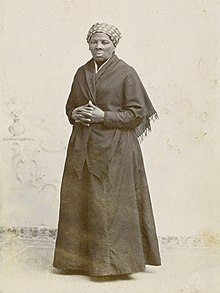
The figure they chose to highlight the value of "Helping" was Harriet Tubman. If you don't already know her story, she was an escaped slave who became a "conductor" on the Underground Railroad. After serving as a soldier, spy, cook, and nurse in the Union Army during the Civil War, she continued to fight for equal rights and for women's suffrage until her death in 1913.

Tubman, c. 1855
(Wikipedia)
Because I knew Harriet's story at an early age, I was proud and excited to learn about my own family's connection to the Underground Railroad - even though Great-Uncle George's farm was nowhere near where the famous "Moses" led her people out of the South.

Of course, I also noticed from an early age how wrong it sounded whenever someone would talk about Abraham Lincoln "giving the slaves their freedom." Nobody gave freedom to Harriet Tubman - she fought for it. As did thousands of others. Sojourner Truth, Frederick Douglas - enough amazing people to keep a blog like this going for centuries, if we wanted to tell every individual story.

The truth was that Lincoln himself was a reluctant late-comer when it came to the ending of slavery. And without the decades of hard work and resistance of people like Harriet Tubman, before and after his famous proclamation, who knows how long it would have been perpetuated?


Harriet Tubman is featured on Black History Flashcard #22, from Vol. 2: Women of Urban Intellectuals' series of educational flashcards. You can help support my writing AND the mission to give educators better tools for teaching kids about these important people from our history if you visit Urban Intellectuals and get a set (or four) of flashcards for yourself!

Vol. 2: Women also features Sojourner Truth (Flashcard #47) and 50 other amazing women of color. I'll be featuring more of my personal favorites during the month of February.


Friday, February 1, 2019

Me and Black History


In 1974, when I was barely two years old, my mother bought a record: the soundtrack to the motion picture The Sting. I grew up hearing that music, particularly the movie's theme song, The Entertainer, by Scott Joplin. I would argue that with the possible exception of B.J. Thomas's Oscar-winning recording of Raindrops Keep Falling On My Head* (from Butch Cassidy and the Sundance Kid), The Entertainer was my "first song."

When you're a kid, you don't know how significant the things in your life really are, because to a kid, every new thing is significant. I didn't know that my foundational musical experiences were being shaped by Paul Newman/Robert Redford buddy-movie soundtracks. I just knew I liked these songs, and it made my mom happy when I sang them and tried to play them on a plastic toy guitar.

As I grew up, of course, I learned what "ragtime" was. I began to study music and the history of music, and of course, I picked up on the ways the music I loved most was based on traditions and ideas that came from black people. I remember learning about the ways that black musicians - particularly blues musicians - found their music being borrowed, "sanitized," and turned into the multi-billion-dollar juggernaut that is Rock-n-Roll without getting anywhere near the recognition or financial reward that their white imitators got. I suppose that pattern came up often enough that when people talked about ragtime and the music of Scott Joplin, I just assumed that his was that same kind of story.

Since his music was associated in my mind with Paul Newman, Robert Redford, and B.J. Thomas, it was easy for me to assume that Scott Joplin had taken black music and popularized it, as others have done time and again. It just never occurred to be to be curious about who Scott Joplin was or what his story was, because his name and his music had been in my head for as long as language and memory could take root.

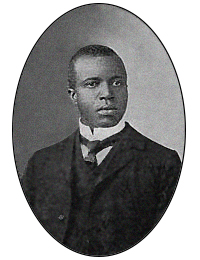
So last year, when the subject of Ragtime came up in my History of Music in the U.S. class, it was an odd sort of shock to see a picture of Scott Joplin for the first time:


Until I was in my forties, I did not know that Scott Joplin was black.

Knowing this changes nothing about how I feel about the music. In a world that was as egalitarian and democratic as ours claims to be, this demographic note would probably not register as an important detail. But for me, the fact that I made it through more than forty-five years without knowing this plain fact about one of the first composers I was exposed to was a revelation about representation and visibility.

The concept of erasure - or, as the New York Times Magazine defines it, "the practice of collective indifference that renders certain people and groups invisible" - is something I've always been half-aware of. It's that indifference that keeps people from speaking up when some guy at a party claims that the reason there aren't more female comedians is because women aren't funny. It's that indifference that allows an elected official who thinks that only white people should be credited with the success of Western civilization to be re-elected.

Countering that kind of claim is not hard to do, assuming you have the least amount of curiosity in the subject being spouted off about. If someone tried to claim that black people have made no contribution to Western Culture it wouldn't be hard for me to poke huge holes in that claim even without citing Scott Joplin, but it says something about the larger trend of our cultural experience that even someone like me - a very curious person with a history of scholarly inquiry into these matters - can fall victim to that collective indifference.

The shock I felt upon learning Joplin's ethnicity came from realizing that I had been so incurious about Scott Joplin, I effectively rendered one of my earliest cultural influences invisible. I want to reverse that trend.

To that end, I've planned out a small series of posts like this one that will talk about specific people from marginalized groups who have been important to me, personally. I'm launching this during Black History Month because this past holiday break was the first time I had a chance to work on this, and this seemed like the kind of thing that Black History Month was created for! (I'm sure it's just a coincidence that the tradition is about the same age as me.)

Some of these stories will be about people who, like Scott Joplin, affected me in my childhood; some will be about people I've only discovered because I'm actively seeking them out now. Some will be heroes, some will be villains, and some will be people I don't like. (The Venn diagram of those three groups may be different for you than they are for me.)

My agenda here is not to call anyone out or make anyone feel bad about not knowing these things. Quite the opposite: it's to show how flawed I am, and to make a public attempt to address the flaws.

More than anything else, my hope is to introduce you to something that gives me joy - the joy of being curious.

Thursday, July 12, 2018

On A Mission From God

This past semester, I took History of Music in the U.S. with Dr. David Cosper at Towson University. For your enjoyment, here is my final argument essay from that course. 


The setting is Maxwell Street, on the near West Side of Chicago, a street long known for its open-air markets and for being the birthplace of Chicago Blues. During the 1930s and 1940s, many black musicians arrived in Chicago from the segregated South and found that their traditional instruments were not loud enough to be heard over the crowd and the street noise. They began to adopt electrically amplified instruments, powered by extension cords provided by local business owners keen on attracting the business of people coming to hear the blues music being played on their street (Smith).

The scene shows an older black man with an electric guitar and a deep, powerful voice, performing with his band for an admiring crowd. Two white men, one tall and one stout, both wearing black suits, black hats, and dark sunglasses, stop and watch for a moment. The tall one says simply, “Yep,” before exchanging a nod with the singer and moving on with his brother into the restaurant behind them.

The white men were Jake and Elwood Blues, the Blues Brothers, played by John Belushi and Dan Aykroyd in the 1980 film of that name. The guitar player leading the street band (billed as the “Maxwell Street Musicians”) was John Lee Hooker, who made his name in the 1950s and 1960s by developing his own style of boogie-woogie rhythm based on the country Delta Blues he grew up with.

The scene consists almost entirely of Hooker’s performance and runs less than 3 minutes within a two and a quarter hour long movie. The dialogue is both minimal and completely unnecessary to the plot of the film, but that moment encapsulates the intended spirit of The Blues Brothers. Aykroyd, whose love of blues music was described as “somewhere between encyclopedic and monomaniacal,” wrote the movie, and introduced the music to Belushi, with whom he created the act (Vanity Fair). It was Aykroyd who said of the blues musicians who inspired him and the clubs that featured them, "I want people to fill their showrooms and bars and buy their records. That's my mission" (Newbart).

Upon its release in 1980, the film met with a now-familiar mix of criticism and enthusiasm. Critics panned some of the excessive and disorganized elements of the plot while praising some of the individual performances. Pauline Kael criticized the casting of Cab Calloway as a janitor, Aretha Franklin as a waitress in a soul food restaurant, and James Brown as a preacher who tears the church apart with his sermonizing and dancing as “some-what patronizing.” And Jim O'Neal, who founded Living Blues magazine in Chicago in 1966, said that while the movie "was one of the factors that contributed to a blues boom" in the 1980s, it also contributed to the “image of blues bands to many people [as] two white guys in hats” (Newbart).

The harshest criticism suggests that the Blues Brothers act is a form of blackface minstrelsy, in which white performers make money by mimicking black people. Adam Gussow, an English graduate student at Princeton University studying post-Civil War American culture contends that the Blues Brothers’ act played up the idea that “blues is good-time party music." Gussow says, "They were responsible for re-creating blues as that. Blues has always been partly good-time party music for the black community -- but that was for the weekend, after a week of working hard under extreme duress” (Knopper).

Defenders of the Blues Brothers tend to argue that Aykroyd’s intentions were to revive the careers of his idols, and they point to the success of the film and albums as evidence that he did so. This defense is difficult to support objectively, at best. Subjectively, Sam Moore, of Sam and Dave, said that the Blues Brothers' chart hit cover version of "Soul Man" did "not a thing" for the original performers. "If anything, believe it or not, it buried us," he said, arguing that people remember the newer version, not the 1967 original (Knopper). And while the film gave John Lee Hooker and Aretha Franklin their first appearances on the big screen, Mike Kappus, Hooker's agent at the time, said Hooker greatly appreciated the high-profile appearance, but "the impact of the movie on his career was almost nonexistent” (Newbart).

Perhaps a better way to frame a defense of the Blues Brothers would be to acknowledge the problematic history of minstrelsy, and to consider the way the individual artists and band members involved in the project were treated, how they felt about their roles, and how their characters were represented in the context of the film. It is also worth considering responses to other projects where prominent white artists hire or feature black artists.

Later in the decade, similar criticism was leveled at Sting when he hired several renowned jazz musicians to play on his first solo album: saxophonist Branford Marsalis, drummer Omar Hakim, bassist Darryl Jones and keyboardist Kenny Kirkland. Marsalis’s brother, trumpeter Wynton Marsalis, accused Branford of selling out and called Sting’s project a stain on jazz; and The Village Voice went so far as to dismiss the album as “Sting Sings With Negroes” in its review (Brogan). According to Sting, “The band made a decision to play with me, and it wasn't just because I was paying well. I think these guys are of such personal and musical stature, they wouldn't want to play with me if they didn't think it was worth doing. I don't see them as my back-up band. ...I felt it was a band.” It would seem that despite the criticism, the musicians agreed on that point. In particular, Kenny Kirkland continued to play on Sting albums until his death in 1996, indicating that he appreciated the collaborative spirit of the work.

In that light, The Blues Brothers could probably be viewed as another form of collaboration, and judged according to how the artists involved felt about it. Since the plot of the movie revolves around “getting the band back together,” it is worth noting the pedigree of the musicians in the band. The core of the rhythm section included Steve Cropper and Donald “Duck” Dunn, both alumni of the Stax record company, which was notable for being an integrated company in Memphis during the 1960s, and for producing and promoting black artists. Cropper and Dunn were members of Booker T and the MGs, as well as regular session players during the first half of Stax’s heyday (Maultsby & Burnim, 136). With Matt Murphy on guitar and Willie Hall on drums, the band was racially integrated, and firmly rooted in a Memphis sound, though with the addition of a New York horn section, and arrangements done by Paul Shaffer, the band had a distinctly upbeat, pop sensibility to it. Aykroyd described them as “a Chicago, electrified, urban blues band, fused with the Memphis Stax/Volt movement” (Kenney, 13:06).

With the band in place behind two white frontmen, the project still had plenty of room for more black performers. The four big stars featured with both speaking cameos and musical numbers backed by the Blues Brothers Band were Cab Calloway, Ray Charles, James Brown, and Aretha Franklin. All four have published autobiographies, as well as having official biographies; it is worth comparing their own thoughts with those of their biographers.

Ray Charles had already published his autobiography the year before the Blues Brothers began filming. His legacy was well-established, and he only briefly referenced the film in the 1992 re-issue of the autobiography. However, his biographer, Michael Lydon, described the 1980s as a low point in which “his invisibility as complete as it would get” (341). The film shoot was an “enjoyable few days” on the South Side of Chicago, in which Aykroyd and Belushi put Charles at ease and romped through his musical number. As the blind proprietor of a music shop who stops a shoplifter with a well-placed pistol round, Ray is portrayed as savvy and in control of his establishment, but generous enough to extend credit to the band so they can pay for their instruments. A fair assessment of the experience might be to say that Charles enjoyed this appearance as important, but considered it a small part of the resurgence of his career that he would stage over the following decade.

James Brown and his biographer agree that his career was also at a low point in 1979 when Brown decided to sue his record company and stage a comeback. Brown concisely stated his opinion about the film and the filmmakers: “People who criticized John and Danny were confused. They didn’t understand that the Blue Brothers were actors pretending to be R&B performers. I know Danny and John themselves weren’t confused about it, and you could tell from the respect they gave the real R&B performers on the movie that they knew what they were doing. They were there for every take I did, and they treated me fantastic” (256).

Brown’s biographer, R.J. Smith, was less generous, quoting Pauline Kael’s line about the casting being “some-what patronizing,” and elaborating that “The script left you wondering if they understood the culture they professed to admire” (328). He also quoted Brown’s bandmates regarding their impressions of the change in their audience that came with the boost from appearing in The Blues Brothers. Trumpet player Hollie Farris noted that “Whites knew who he was, but then they saw him in that movie and decided they wanted to see more of him.” He further commented that “in 1975, it was ninety-nine percent black audiences. And then it started to change, and before you knew it, it was mostly white.” Guitarist Ron Laster joined Brown’s band in 1979, and after playing for a crowd of 54 at New York’s Beacon Theater before the film’s release, he noted that after the film came out, “We would destroy these places because they were so packed, and the girls so close to you. We used to love it, I said love it” (330).

Aretha Franklin was pleased with her role, as were the critics. According to Franklin’s autobiography, she “was relaxed and ready to go. [She] played the part of a loving but agitated wife whose husband is about to abandon her for the Blues Brothers band” (182). Pauline Kael said of Franklin’s performance that “she’s so completely there and so funny as she sings ‘Think’ that she transcends the film’s incompetence.” There was even talk of her being considered for a “Best Supporting Actress” Academy Award nomination (Berg 184).

This talk of an Academy Award may seem far-fetched in the context of a project that is essentially a two-hour Saturday Night Live sketch, but it is worth noting that Franklin’s role seems to call back to one of the original themes of blues music: the woman who is abandoned by her man to fend for herself. Rather than wilting or breaking down, Franklin is shown as strong and able to fend for herself. It is also significant that she is the owner of the restaurant that Matt works in, even if the film’s critics tend to reduce her role there to that of “a waitress” and describe the place as “a greasy coffee shop” or a “hash house.” While it would be wrong to claim that her character breaks with any common stereotypes, the subtexts in the script and her performance combine to present her as a real black woman in a position of relative power and respect in her community. And despite making a firm plea to keep Matt at home with her, she demonstrates both independence and tolerance after he leaves. Later in the film, when the children of the orphanage are deployed by Curtis to hand out signs advertising the show, she rolls her eyes but takes the poster.

Curtis, played by Cab Calloway, is the most interesting character of the four to examine when considering The Blues Brothers as a modern example of “blackface minstrelsy.” From Calloway’s first appearance onscreen, it is clear that Aykroyd is trying to establish some legitimacy for his character by showing Curtis in the same black suit and hat that Jake and Elwood wear. Elwood explicitly says to Curtis that “you and the penguin [the nun who runs the orphanage] are the only family we got, and you’re the only one who was ever good to us” and reminisces about hearing Elmore James records as a kid growing up in the orphanage. It is clear both that Elwood truly reveres his elder influences and that Aykroyd reveres his, and wants to claim their mantle of authenticity.

Calloway, even more so than Ray Charles, had already had a long and storied career. His autobiography was published in 1976, and he described himself as being in “semi-retirement,” stating, “I’m still an active entertainer, but I pick my spots” (244). Calloway had a closer relationship than anyone involved in the Blues Brothers to actual minstrelsy, having originally become a star during the Cotton Club era of the 1920s and 1930s. By 1979, his career had followed the trends to the point that he was performing a disco version of his classic “Minnie the Moocher.” The astounding reception of his classic performance of that song in The Blues Brothers convinced him to abandon the disco version. That success may have had something to do with Calloway’s statement that “The Blues Brothers is the best role I’ve ever had” (Shypton 174).

Yet, as a professional black performer for more than five decades, it is impossible to suggest that Calloway did not recognize the built-in insult of his role in the film. Quoting David Denby in New York Magazine, Calloway’s biography says, “These vaudeville musicals...often featured jazz musicians or black singers and dancers who would never get to star in a movie of their own. ...things haven’t changed that much in 45 years... The great old Cab Calloway...sings “Minnie The Moocher” in white tie and tails, in front of a huge audience, killing time for an impatient crowd while the boys are being chased by the police. Calloway’s smile— the seal of a great entertainer’s joy in giving pleasure— shows up Aykroyd and Belushi’s sullen “cool” for the sophomoric thing it is. Yet what an insulting context for Calloway’s triumph— as a fill-in!” (Shypton 176).

The question this raises is whether Calloway considered what Aykroyd was doing to be respectful or not. Does the fact that he went along with it somehow signify that Calloway considered the project to be one that promoted black artists instead of exploiting them? It may be impossible to say that in an absolute way, but it is certain that Calloway was a pragmatist when it came to race and his career. “I’ve always accepted the fact that I’m Negro. I don’t know anything else. I’ve been kicked in my ass all my life because of it, and, hell, I’ve come through it and become a star. Everybody has got to endure a certain amount of ass kicking to make it. People will step on you as you move along and there’s no way to avoid it. The only difference between a black and a white entertainer is that my ass has been kicked a little more and a lot harder because it’s black.” In the end, whether he was too classy, too kind, or too grateful, Calloway would probably never openly criticize the project--and that says a lot about the perceived power differential between even a beloved black entertainer and the white, mainstream of Hollywood.

Perhaps the best defense of the movie is to compare the black and white characters overall. In general, black people who appear in the movie, whether as characters or extras, are “normal.” They have jobs, they are part of their community, and even when they get pulled into a dance number, they are part of an average, every day, integrated Chicago. Representation of minor characters can be seen in the recurring Chicago police officers with speaking roles who are played by both black and white actors. And as mentioned before, Franklin, Charles, and Calloway are all normal people with real jobs, just trying to get by.

By contrast, it is the white characters who are played for laughs, as silly villains or faceless and violent rubes. The country band that Jake and Elwood hoodwink (The Good Ole Boys) and the Illinois Nazis are played for foils, often coming to violently over-the-top ends. The Blues Brothers themselves are not exactly held up as role models, despite the supposed nobility of their mission. Their interactions with the wealthy (white) patrons of the fancy restaurant are played as a low rent class rebellion against the snooty well-to-do.

It seems clear that Aykroyd and Belushi had the best of intentions, and that they succeeded in creating a platform through which a few of the black artists they admired could--and did--reach a broader audience. None of the criticism leveled at them seems to offer a better way to attempt a project like this that would avoid the problematic history of minstrelsy. But perhaps the best we can hope for is that individuals like Aykroyd will continue to pay the most honest homage possible to their roots and that whether those roots are a black or white cultural treasure, we will recognize them as human treasures.

-------------------------

Sources:

  • 2013. "Soul Men The Making Of The Blues Brothers." Vanity Fair, January 01. 72. NewsBank, EBSCOhost (accessed April 6, 2018).
  • Bego, Mark, Aretha Franklin: the Queen of Soul, Da Capo Press, 2001. 
  • Belushi, John, and Dan Aykroyd. Briefcase Full of Blues. The Blues Brothers. Atlantic, 1978, CD. 
  • Blues Brothers. Directed by John Landis. Produced by Robert K. Weiss. By Dan Aykroyd and John Landis. Performed by John Belushi and Dan Aykroyd. United States: Universal Studios, 1980. DVD. 25th Anniversary Edition 
  • Brogan, Daniel. "Branford Marsalis Feels The Zing And The Sting Of Instant Pop." Tribunedigital-chicagotribune. September 05, 1985. Accessed April 06, 2018. http://articles.chicagotribune.com/1985-09-05/features/8502280144_1_branford-marsalis-wynton-marsalis-live-aid. 
  • Brown, James (1933-2006) with Bruce Tucker, James Brown, the godfather of soul; New York : Thunder’s Mouth Press, c1990. 
  • Calloway, Cab, (1907-1994)  and Bryant Rollins. Of Minnie the Moocher & me; with ill. selected and edited by John Shearer; New York : Crowell, c1976. 
  • Charles, Ray (1930-2004) with David Ritz, Brother Ray: Ray Charles’ own story, Da Capo Press, 1978/1992. 
  • Feather, Leonard. "A Fired-up Branford Marsalis Foresees Fun." Los Angeles Times. December 14, 1986. Accessed April 06, 2018. http://articles.latimes.com/1986-12-14/entertainment/ca-2742_1_branford-marsalis. 
  • Franklin, Aretha, with David Ritz. Aretha : from these roots; New York : Villard, c1999. 
  • Kael, Pauline. 1980. "The Blues Brothers." The New Yorker, 1980. 95. Biography in Context, EBSCOhost (accessed April 6, 2018). 
  • KNOPPER, STEVE. 1996. "Impact of "Blues Brothers' debated." The Tampa Tribune, April 03. 6. NewsBank - Archives, EBSCOhost (accessed April 6, 2018). 
  • Lydon, Michael; Ray Charles : man and music, New York : Routledge, 2004. 
  • Making of The Blues Brothers. Directed by Joseph J.M. Kenney. Performed by Dan Aykroyd and John Belushi. United States: Universal Studios Home Video, 1998. YouTube. February 25, 2017. Accessed April 6, 2018. https://youtu.be/rHMzKNR7iWc. 
  • Maultsby, Portia K., and Mellonee V. Burnim. Issues in African American Music: Power, Gender, Race, Representation. New York, NY: Routledge, 2017. 
  • Newbart, Dave. 2005. "Film fueled interest in Chicago blues scene." Chicago Sun-Times (IL), June 22. 9. NewsBank - Archives, EBSCOhost (accessed April 6, 2018). 
  • Smith, R. J. The One: The Life and Music of James Brown. New York: Gotham Books, 2012. 
  • Shipton, Alyn; Hi-de-ho: the life of Cab Calloway, Oxford [U.K.] ; New York : Oxford University Press, 2010. 
  • Smith, Tom. "A Visit To Maxwell Street." Chicago Blues Guide. Accessed May 12, 2018. http://www.chicagobluesguide.com/features/maxwell-street-visit/maxwell-street-visit-page.html. 
  • "Sting.com Discography The Dream of the Blue Turtles." Sting.com Homepage. Accessed April 06, 2018. http://www.sting.com/discography/index/album/albumId/20/tagName/studio_albums.

Saturday, June 16, 2018

Are We Thanos?

Warning: spoilers for Avengers: Infinity War are suffused throughout this post. 

I sat in the theater watching the superheroes of the Marvel Cinematic Universe lose their fight against Thanos, and I noticed dozens of parallels to America's political struggles during the rise of Donald Trump. I watched individual characters fail to stop the story's protagonist as he bulled his way toward his goal. I saw the various heroes aligned against him bickering with each other as they tried to muster their opposition; and as the movie ended, I recognized the stunned disbelief on the heroes faces as they either disappeared in a dissolving fog or bled on the ground watching their friends fall.

The reaction from the audience was stunned, as well. None of us could believe that we had just spent two and a half hours watching the villain of the story win. But as I have said many times in the weeks since, Thanos was the protagonist of this movie--it was his story from the beginning. And the seeds of his story were planted as far back as that first post-credit teaser in which he grinned back at us over his shoulder.

Those parallels are numerous. The primary challengers and Democrats who see themselves as heroes were individually knocked down or knocked out. The Hulk hid inside Bruce Banner, leaving the awkward Banner to trip over his own exoskeleton ("Pokemon go-to-the-polls"). There's even a religious-right figure in Ebony Maw, the cadaverous preacher with telekinetic powers. His lines sound like misquoted scripture, meant to lend a veneer of divinity to the deeply evil goals of the Black Order:

"Hear me and rejoice! You have had the privilege of being saved by the Great Titan. You may think this is suffering. No... it is salvation. The universal scales tip toward balance because of your sacrifice. Smile... for even in death, you have become children of Thanos."
―Ebony Maw

After the 2016 U.S. election, I hated reading all of the think pieces urging "the left" to consider listening to the people who elected Thanos... excuse me, I meant POTUS... as if a) everyone opposing him was "on the left" and b) he represented any coherent political philosophy. The reasons I had opposed him as a candidate were never addressed. It seemed not to bother anyone writing these Op-Ed and urging us to "give him a chance" that he had taken every side of every issue, and had only been consistent on the worst and most vile anti-American positions: Build a Wall, Lock Her Up, and Get That Sonofabitch Outa Here.

But after seeing Infinity War, and thinking for several weeks about how the movie echoed my sense of loss and disbelief since the rise of Donald Thanos ....er, Trump... I saw the insight that some of the writers of those many Op-Eds may have intended: we were focused on defeating the Mad Titan, and not paying enough attention to his core idea.
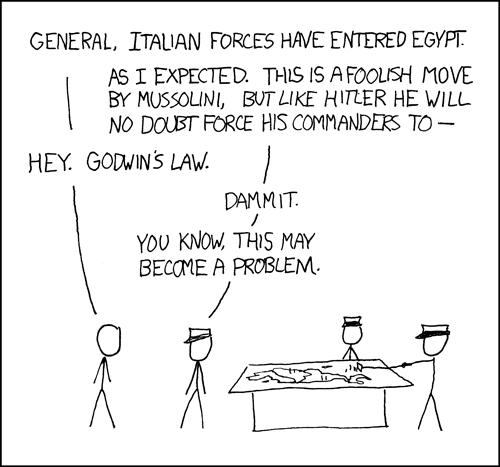
Regarding Mussolini (XKCD #261)

In America, the press and the populace have been guilty of accepting a big lie. The press calls it "balance." It is built out of false equivalence and "whataboutism."

It is this false notion that objectivity in reporting means never calling out a lie as a lie, or condemning bad ideas like racism, segregation, and human rights abuses for what they are. Americans used to be capable of pointing at the atrocities committed by Nazi Germany during World War II and stating unequivocally that those atrocities were evil. Yes, since the rise of the Internet, it has become common for people to overstate the "evil" of ideas they don't like by comparing them to Nazis - thus the coining of "Godwin's Law." But now we have seen prominent Americans who champion the ideas Hitler championed claiming that it is wrong for those of us who oppose their bad ideas to call them what they are.

The insane evil driving Thanos's story was an idea that he stated several times: "There are not enough resources to support everyone, therefore my plan is to acquire ultimate power and kill half of all life in the universe." Americans have bought into that idea, politically; not just the austerity-loving fiscal conservatives, but centrists and moderate progressives, too. "There are not enough resources to take care of everyone, so we have to make tough choices." We've seen this idea placed at the front of discussions about everything from immigration policy, student loans, and economic recovery to healthcare, military spending, and welfare.

But this past week has shown Americans the fruit that grows from planting that seed as we have learned about the human rights atrocities being committed by Immigration and Customs Enforcement at our southern border. "There are not enough resources for us to take care of everyone," we say, "and therefore we will take children from their parents and put them in cages."

Attorney General Ebony Maw... excuse me, I meant Jefferson Sessions... cited Romans 13 to justify this evil - apparently ignoring Romans 13:10, "Love does no harm to a neighbor. Therefore love is the fulfillment of the law."

The truth is that America has proven that marshaling our resources and using them to do good things is a net benefit to everyone. We literally built up our former enemies up under a Marshall Plan and turned them into two of our biggest trading partners. Meanwhile, the kind of austerity and "common sense" fiscal conservatism that is offered as a counter-balance to those economic policies fail time and again. But people keep making the argument--and keep accepting Thanos's premise that there aren't enough resources, therefore, Atrocity.

We don't have to accept that idea. We should call it out for being untrue. We should point out the flaw in the premise, and resist anyone who tries to harm others in the name of this flimsy and oft-debunked idea.

In the Marvel Universe, we have to wait until next year to see how Thanos will be defeated. That echoes with American politics, as well. We have to live with the unspooling awfulness that we have allowed to take over our government. We have to sit with the rampant corruption, the evil policies, and the chaotic destruction of the peaceful world that our grandparents built out of the ashes of the last world war.

"Oh, but you're just trying to bring down Trump," his supporters will say. "You're just obsessed with hating him, and you think he's Thanos."

No. That's not what I think. I don't think Trump is Thanos. What I do think is that anyone who has bought into a bad idea - "there aren't enough resources, therefore, the 'inferior' must die" or "'Race' is a biological fact, and only our 'race' should survive" - should be kept as far away from the Infinity Gauntlet and its colorful stones as is possible. When the 350 million of us who make up this country allow the worst third of us to wield that power, I worry that we are Thanos.

At some point, it is true that I think we will have to vote to remove Trump from office. That will either happen in the course of the 2020 election or indirectly through an impeachment for one of the many, many crimes that are being uncovered. But like the Avengers discovered, the Mad Titan shouldn't be the focus of our energy: it's the Very Bad Idea driving him and his supporters that we need to fight.

Our world is better off when the people running it are not corrupt. Our world is better off when the people running it are not treating our neighbors like criminals and our criminals like kings.


Sunday, December 3, 2017

The Year Without a President

In January, I wrote a post warning of the kind of monarchical tendencies Donald Trump had already displayed, and I pointed out that by his own standards Trump's presidency was illegitimate before he took office. Those were superficial comments on my part because aside from his behavior and demeanor (which already should have been enough to disqualify him from the job in the minds of voters), many of the deeper reasons for finding his presidency illegitimate were yet to be revealed.

Few things in this world are ever straightforward and easy to understand. To see the big picture, you have to do some homework. You have to consider several stories that seem unrelated, and which have unfolded since the early 2000s.

Below, I've provided a "reading list" of seven articles and interviews that can give you the outlines of that Big Picture. I trust that you will arrive at your own conclusions, or at least come up with your own questions about what all of this means for our country. For me, the story here is that after the fall of the Iron Curtain, America tried to befriend the former Soviet Union, and did some massive damage to the new Russian Federation in the process. Our captains of (financial) industry swooped in and essentially taught Russia how to rip itself off.

In 2001, President Bill Clinton pardoned a U.S. financier named Mark Rich on his last day in office. Rich had fled the U.S. in 1983 to avoid tax evasion charges, and Clinton's pardon allowed him to return home. If you remember that story from 2001 (as I do), you probably understand that this event was just the tip of an iceberg which came between the U.S. and Russia over the following decade. If you only remember that story because it became part of the 2016 election, you probably wrote it off as a ploy to harm Hillary Clinton's electoral chances. (And her part in this larger story is one of several reasons I have never been eager to vote for her.)

Rich, whose wife had donated nearly half a million dollars to the Clinton Presidential Library fund, was just one of many U.S. businessmen who tried to make money in Russia post-Soviet chaos. When Vladimir Putin came to power in 1999, he began a campaign of cleaning up corruption and pointed at the Clinton-era relationship with Boris Yeltsin and the later pardoning of Rich as reasons why the Russian economy at the time was doing so badly.

There is likely a lot for you to learn about Putin and Russia that is crucial to understanding today's headlines, but the way I would put it is this: Putin (and because he tells this story constantly through his state-run media apparatus, the Russian population) believes that the U.S. in general, and the Clintons in particular, humiliated Russia in the 1990s. He was a pragmatic communist before communism fell, and in the decades since, he describes himself as believing in "managed democracy," which I have learned bears a striking resemblance to organized crime. His vision throughout the 2000s was to use the booming oil market to rebuild Russia and to restore it to its rightful place of superiority in the world; and now that they have been rebuilt, to knock the U.S. from its position as the "only remaining Super Power."

In other words: Putin wants to humiliate the U.S. the way Russia was humiliated by the U.S.

Bill Browder's story is key to understanding current events because he was in Russia during Putin's early years, and his company is at the center of several of the stories playing out in the news, now. (His testimony to the U.S. Senate is below, and he has a book out called Red Notice that tells the story in greater detail.) He is the reason the U.S. passed the Magnitsky Act in 2012 - the sanctions bill which Russian lawyer Natalia Veselnitskaya tried to discuss with Donald Trump, Jr. - you might remember his famous episode over the summer in which he said she just wanted to talk about "Russian adoptions"? That was because the Russian government barred U.S. citizens from adopting Russian children in retaliation for the Magnitsky Act, and the Russians had apparently not yet figured out that the Trump people were too stupid to know anything about these issues.

But all of this is just the backdrop to the Big Picture. Here are the seven promised links for you to go and start doing your own "homework":
  1. The Vital Questions on Trump and Russia - The Guardian, by Tom McCarthy (30 Oct 2017)
  2. All the Trump Administration Ties to Russia (That We Know About) - Esquire magazine, by Jack Holmes (1 Dec 2017)
  3. Bill Browder's Testimony to the Senate Judiciary Committee - The Atlantic, by Rosie Gray (25 July 2017)
  4. Journalist Explains How Panama Papers Opened Up The World's Illicit Money Networks - NPR Fresh Air (transcript + audio) interview with Jacob Bernstein (20 Nov 2017)
  5. Paradise Papers: Offshore Trove Exposes Trump-Russia Links And Piggy Banks Of The Wealthiest 1 Percent - published by the International Consortium of Investigative Journalists (5 Nov 2017)
  6. Journalist Investigating Trump And Russia Says 'Full Picture Is One Of Collusion' - NPR Fresh Air (transcript + audio) interview with Luke Harding of the Guardian (21 Nov 2017)
  7. How Trump Walked Into Putin's Web - Luke Harding, the Guardian (15 Nov 2017)
Now, once you put all of that together, you may have some concerns. I know I do.

But consider that list of people - like Wilbur Ross, and Paul Manafort - whose names appear in multiple places in this Big Picture story. Think about how many top positions in our government the Trump Administration has left unfilled; and then think about how lucky we are that they remain empty. Think about how incompetent those who are in office are, even according to Trump supporters.

In many ways, 2017 has been a year without a president. The man in the office is possibly the least qualified we have seen in living memory and is certainly the least trustworthy to hold the responsibility of the U.S. nuclear arsenal under his control. And whether you interpret these stories to mean that he has been knowingly compromised by Vladimir Putin, or simply that he has been a useful idiot of the Russian president, it is abundantly clear that Moscow is getting what it has long wanted: a weakened and humiliated United States.