Talking to a friend last night, he said something that captures what most regular Americans are really upset about. All of the talk of politics - the Dems vs. the GOP, the liberals vs. conservatives, the Hayek vs. Keynes - all of it boils down to what people think is "fair" at a visceral level.
And this slight paraphrase is what really bothers most average people: "We're where we are because of those people who don't want to work collecting their welfare check every month."
My friend stopped short of saying who "those people" were, so I won't speculate who he meant. But when you talk about welfare, chances are you're referring to what most would think of as "poor people." At the same time, though, most of us seem unaware of the widespread corporate welfare that goes on.
You may have seen the Guide to Corporate Freeloaders that has been circling the liberal blogosphere; it's a list of the Top Ten American corporations that either paid no federal taxes, received a tax refund, and/or received bailout money from the Federal government. I thought about what my friend had said, and decided to try to figure out who is taking more from the Feds and, by extension, the rest of us.
It wasn't easy.
First, let's figure out who we're talking about, and how to compare them. I needed to figure out a) how many people were "on welfare" and b) how much they got. I got some numbers for 2009 from a USA Today article dated January 2010. They broke out three different numbers:
* 4 million on welfare (TANF)
* 37 million on food stamps (SNAP)
* 9.1 million on unemployment
It's fairly easy to look up the budgets for Temporary Assistance for Needy Families (HHS), Supplemental Nutrition Assistance Program (USDA), and Unemployment Insurance administered by the Department of Labor using my favorite tax/budget site, WhatWePayFor.com - it's a little trickier to figure out where there might be overlap between people who fall into more than one of the three. And for me, it's always hard just doing arithmetic! The first two were pretty straightforward:
Taking the amount for TANF ($17.1B)/number of people on TANF (4M): $4,275 per person for 2009
Taking the amount of SNAP for 2009 ($59.1B)/number of people on SNAP (37M): $1,597 per person for 2009
Unemployment Insurance (Dept of Labor) is harder to pin down. There are a lot of numbers involved (all numbers for 2009; M = "Mandatory" spending, D = "Discretionary" for those tracking that happy meme):
M - Unemployment Trust fund - 116.8B
M - Payments to the Unemployment Trust Fund - $17.2B
M - Federal Additional Unemployment Compensation Program, Recovery - $6.7B
D - Unemployment Trust Fund - $3.5B
M - Federal Unemployment Benefits and Allowances - $273M
D - Unemployment Trust Fund - $1.5B
M - Federal Unemployment Benefits and Allowances - $686M
So - taking the Total amount from the above 2009 numbers for Unemployment related expenses ($146.659B)/number of people on unemployment (9.1M): $16,116 per person for 2009.
That's just the poor/unemployed/etc. - the unfortunate, or the lazy depending on your bias. I'll leave it to your own determination whether they "deserve" any of that money, or whether the Government should be involved in judging them worthy or propping them up. MY task is to figure out how to compare what these people are getting to what our Corporate Freeloaders are getting.
I wanted to try to compare on a per person basis. I decided just to look at the Top Ten from Sen. Sanders's chart, because trying to figure out how many companies there are doing business in America and how much each one does/doesn't pay in taxes is too hard. I found some Census data from 2000, but couldn't think of a quick or trustworthy way to compare it to what I know from 2009. (You're free to try!)
It's important to note that even among this Top Ten list, there are companies that are paying taxes, just like you and me. There are thousands of companies doing business here, and if they're all *better* than these, I have to feel a twinge of guilt for perpetuating the "freeloaders" meme; it's probably no more accurate to assume ALL U.S. companies are as bad as this any more than it is to assume that everyone taking welfare is a freeloader who "doesn't want to work." So don't read too much into these comparisons - just recognize that we don't just pay welfare to the unemployed.
Regardless, here's what I learned from looking at the numbers I got from that Top Ten Freeloaders chart and Wikipedia (for number of employees).
Not counting the bailouts some companies received, the IRS paid a total of $6.76B to the Top Ten companies - who employed a combined 1,264,113 people in 2010. That works out to an average of $5347.62 per employee. That's a little more than what the 4 million TANF welfare recipients got. ($4,275 per person)
Here's a breakdown of each of the "Top Ten Corporate Freeloaders" - how much we taxpayers paid them per person in 2010:
Exxon - received $156M refund; Employees: 83,600 = $1866 per employee
Bank of America - received $1.9B refund; Employees: 288,000 = $6597 per employee
(remember, we're NOT counting their $1T bailout)
General Electric - received $4.1B; Employees: 287,000 = $14285 per employee
Chevron - received $19M; Employees: 62,000 = $306 per employee
Boeing - $124M refund; Employees: 160,500 = $772 per employee
Valero Energy - $157M refund; Employees: 20,313 = $7729 per employee
Goldman Sachs - paid ~$25.3M (1.1% of reported profit); Employees: 35,700 = PAID $708 per employee
(again, we're not counting the fact that they recieved an $800B bailout)
Citigroup - paid $0; Employees: 260,000 = $0 per employee
(received $2.5 Trillion bailout)
ConocoPhillips - received $451M in tax breaks; Employees: 29,700 = $15185 per employee
Carnival Cruise Lines - paid $121M (1.1% of reported profit); Employees: 37300 (3,800 - Shoreside, 33,500 - Shipboard) = PAID $3244 per employee
All things considered, I would rather see people paid to work than see them paid NOT to work; but that is hardly fair to say when people actually can't find jobs. I would rather see companies keep their jobs here than send them overseas - but it's hardly fair to claim to support a free market and then cut off competition. And it's hardly fair to talk about cutting off welfare for the unemployed when we could easily recoup these comparable amounts from the give-aways being paid to these companies - many of which were so poorly managed that we ALSO had to pay trillions in bailouts to keep them off the TANF, SNAP, and UI books.
I just wonder, is it useful to compare all of the "freeloaders" this way? Is it accurate to describe them this way? I don't know, really; I just know that everyone has a prejudice - and everyone feels like someone else is getting more of a break than they are.
Tuesday, April 19, 2011


Friday, March 11, 2011
George Ought to Help
A friend asked me to watch this video and respond to it:
There's nothing new here, but it is a nice, concise presentation of things that many people have said to me over the years, trying to defend the morality of selfishness. That isn't the politically correct way to put it, of course; they would rather frame it as the immorality of forcing individuals to participate in our larger society. In this particular video, the message is that it is immoral to force one person to help another.
In order to determine whether I agree with that message, I start with two test questions:
1. Do I agree with that statement?
2. Is that what is really happening, or is this a false analogy?
On the surface, I agree with the general statement - it really is immoral to force one person to help another. But something about it bothers me, so I need to dig a little deeper.
I still believe in the concept of Charity, so I'll always make my decisions about helping others with the assumption that I should do so, but forcing someone to behave charitably means that it is not, by definition, "charity" - if their gift does not come freely from within, then it is no longer charitable, but given grudgingly. And, as the video illustrates, you're left with a choice between two actions that seem wrong.
Of course, someone who behaves selfishly all the time is not a very good citizen, either. Refusing to help others - as George does here - usually leads to being shunned, so when you are in the position where you need help, you can clearly expect it to be refused in return. Maybe that's a risk George is willing to take. I note that we are painted a picture in which Oliver's need is pretty innocuous; it's not as if Oliver is portrayed as having been laid off when his bank sank under toxic assets, and it isn't as if his children require life-saving medical treatment. It seems rather easier to imagine George saying no to a guy who wants to send his kids to a swanky school than he would to a guy with more urgent needs. I feel a little manipulated by this.
But for the question at hand, it doesn't matter; none of that is being debated in this video. Instead, it sticks to the very clearly defined moral situation in which an individual is compelled against his will to provide financial assistance to someone else. We are intended to agree with that message, and to draw the comparison between this small scale situation and our current government, with an eye to suggesting "better" ideas about government. Those alternative ideas may offer a better way to test my first question; which brings us to the suggestions at the end of the video inviting us to consider a list of alternatives to a coercive police state forcing participation in charitable activity.
Voluntaryism, (also called voluntarism, though it doesn't necessarily have anything to do with "volunteering" for things) is a philosophy according to which all forms of human association should be voluntary as far as possible. In other words, if George doesn't want for there to be an association (here consisting of tuition money) between him and Oliver, he shouldn't be forced to be a part of it. Consequently, voluntaryism opposes the initiation of aggressive force or coercion, which leads us to the non-aggression principle.
The non-aggression principle is an ethical stance which asserts that "aggression" is inherently illegitimate. "Aggression" is defined as the "initiation" of physical force against persons or property, the threat of such, or fraud upon persons or their property. The video clearly wants you to emphasize the first part of the definition, but I want to draw your attention to the inclusion of Fraud. That will be important in a minute.
So, all of that still looks pretty good. I do agree that it is immoral to use force or the threat of force to compel someone to perform what should be a charitable act. Helping someone else should be something that is agreed to by both parties - the Helper and the "Helpee", if you will. I do wonder how should that work under "voluntaryism", actually. What is the proper mechanism for those in need to find willing helpers? What is the moral implication of leaving the vulnerable as prey to those who would exploit them? Or to religious organizations with which the vulnerable would not otherwise voluntarily associate? It seems an impartial third party would be needed in any event.
Well... maybe those are details that can be worked out by someone else.
What about that second question? Is anyone in America being forced with violence or the threat of violence to give money to help others? The video presents this as a foregone conclusion, and uses the classic, faceless authoritarian boogie-men to get that point across.
It *sounds* obvious, doesn't it? We hear about famous people going to jail for tax evasion all the time - Wesley Snipes, Willie Nelson, Spiro Agnew. And there are other stories of less famous people in the news - like this guy you've never heard of and this high dollar/high profile arrest clearly intended to make an example of someone making a defiant point. Heck, Tax Attorneys - like this guy - are all over the Internet and TV telling you to watch out.
Clearly, that is both "force" and the "threat of force" - things which I've already agreed are immoral. If the government is initiating that kind of aggression against its citizens, that is wrong! But there was another clause in that definition of non-agression: remember when I told you that Fraud would be important?
You see, it is not actually against the law to owe money to the IRS. (We could quibble over whether the IRS has a legal foundation or whether you agree that a government should have the power to tax in the first place - but that is also beyond the scope of this video.) The crime is not "keeping your money" - the crime is committing fraud by either not filing at all or by lying on your return. Maybe you think that is hair-splitting, but it is an important distinction that the makers of the video have ignored. After all, following the definitions of "voluntaryism" and "non-aggression", every tax payer either explicitly or tacitly agrees to remain a citizen year after year, and only the fraud violating that voluntary agreement is punished - consequences agreed upon through due process, and enforced with due process.
The point is that the "initiation" of the "aggression" is NOT happening by the action of the U.S. Government - it is happening when the citizen violates an agreement into which he voluntarily entered.
Okay, but what about that animated picture where the money is sucked out of George's pocket against his will and given to Oliver's family? Why should the majority be able to force the rest of us to "redistribute our wealth"? I did not agree to allow that to happen!
There are two bitter pills that the would be anarchist or libertarian has to swallow here: one is "representative government" and the other is the concept of "fungibility".
Obviously, there is a lot of room for argument about what our elected officials are allowed to do. This very conversation is evidence of that, and it is why we have agreed to a Constitution spelling out the rules they have to play by. That document was written with the intention of allowing room for interpretation in order to protect both the will of the majority and the rights of the minority, which is why the framers used words like "due process" and "reasonable" all over the place. But at the end of the day, that Constitution every citizen has at least tacitly agreed to support and abide by gives your elected Congress the power to decide how and when to tax and spend.
(If you think those rules should change or be interpreted differently, you are welcome to enter into all kinds of "voluntary associations" to try and get that done, by the way.)
And that is where "fungibility" comes in. Because money is fungible, the chain between George and Oliver is broken. There is no way to determine whether the money paying for Oliver's childrens' tuition is George's, any more than it is possible to tell how much of the money going to maintain the stretch of I-95 George uses to get to work came from Oliver's taxes. When you look at the breakdowns of the U.S. Federal budget on display at sites like What We Pay For, and you get all bent out of shape over the $3.50 thatthe U.S. Government ripped from your pocket under threat of force you voluntarily rendered to your duly authorized government to support the Corporation for Public Broadcasting... it isn't necessarily your $3.50 that was handed over to them.
So no: I don't think that the analogy presented in this video is correct. Using the concepts of "voluntaryism" and "non-aggression" as the basis for answering the question, I have to say that there is nothing here to object to.
(And if you're trying to stay out of trouble with the IRS, here is some advise for preventing IRS tax debt. Nothing about arming and provisioning your compound, but plenty about planning and doing the basic paperwork that you voluntarily agree to by remaining a citizen.)
There's nothing new here, but it is a nice, concise presentation of things that many people have said to me over the years, trying to defend the morality of selfishness. That isn't the politically correct way to put it, of course; they would rather frame it as the immorality of forcing individuals to participate in our larger society. In this particular video, the message is that it is immoral to force one person to help another.
In order to determine whether I agree with that message, I start with two test questions:
1. Do I agree with that statement?
2. Is that what is really happening, or is this a false analogy?
On the surface, I agree with the general statement - it really is immoral to force one person to help another. But something about it bothers me, so I need to dig a little deeper.
I still believe in the concept of Charity, so I'll always make my decisions about helping others with the assumption that I should do so, but forcing someone to behave charitably means that it is not, by definition, "charity" - if their gift does not come freely from within, then it is no longer charitable, but given grudgingly. And, as the video illustrates, you're left with a choice between two actions that seem wrong.
Of course, someone who behaves selfishly all the time is not a very good citizen, either. Refusing to help others - as George does here - usually leads to being shunned, so when you are in the position where you need help, you can clearly expect it to be refused in return. Maybe that's a risk George is willing to take. I note that we are painted a picture in which Oliver's need is pretty innocuous; it's not as if Oliver is portrayed as having been laid off when his bank sank under toxic assets, and it isn't as if his children require life-saving medical treatment. It seems rather easier to imagine George saying no to a guy who wants to send his kids to a swanky school than he would to a guy with more urgent needs. I feel a little manipulated by this.
But for the question at hand, it doesn't matter; none of that is being debated in this video. Instead, it sticks to the very clearly defined moral situation in which an individual is compelled against his will to provide financial assistance to someone else. We are intended to agree with that message, and to draw the comparison between this small scale situation and our current government, with an eye to suggesting "better" ideas about government. Those alternative ideas may offer a better way to test my first question; which brings us to the suggestions at the end of the video inviting us to consider a list of alternatives to a coercive police state forcing participation in charitable activity.
Voluntaryism, (also called voluntarism, though it doesn't necessarily have anything to do with "volunteering" for things) is a philosophy according to which all forms of human association should be voluntary as far as possible. In other words, if George doesn't want for there to be an association (here consisting of tuition money) between him and Oliver, he shouldn't be forced to be a part of it. Consequently, voluntaryism opposes the initiation of aggressive force or coercion, which leads us to the non-aggression principle.
The non-aggression principle is an ethical stance which asserts that "aggression" is inherently illegitimate. "Aggression" is defined as the "initiation" of physical force against persons or property, the threat of such, or fraud upon persons or their property. The video clearly wants you to emphasize the first part of the definition, but I want to draw your attention to the inclusion of Fraud. That will be important in a minute.
So, all of that still looks pretty good. I do agree that it is immoral to use force or the threat of force to compel someone to perform what should be a charitable act. Helping someone else should be something that is agreed to by both parties - the Helper and the "Helpee", if you will. I do wonder how should that work under "voluntaryism", actually. What is the proper mechanism for those in need to find willing helpers? What is the moral implication of leaving the vulnerable as prey to those who would exploit them? Or to religious organizations with which the vulnerable would not otherwise voluntarily associate? It seems an impartial third party would be needed in any event.
Well... maybe those are details that can be worked out by someone else.
What about that second question? Is anyone in America being forced with violence or the threat of violence to give money to help others? The video presents this as a foregone conclusion, and uses the classic, faceless authoritarian boogie-men to get that point across.
It *sounds* obvious, doesn't it? We hear about famous people going to jail for tax evasion all the time - Wesley Snipes, Willie Nelson, Spiro Agnew. And there are other stories of less famous people in the news - like this guy you've never heard of and this high dollar/high profile arrest clearly intended to make an example of someone making a defiant point. Heck, Tax Attorneys - like this guy - are all over the Internet and TV telling you to watch out.
Clearly, that is both "force" and the "threat of force" - things which I've already agreed are immoral. If the government is initiating that kind of aggression against its citizens, that is wrong! But there was another clause in that definition of non-agression: remember when I told you that Fraud would be important?
You see, it is not actually against the law to owe money to the IRS. (We could quibble over whether the IRS has a legal foundation or whether you agree that a government should have the power to tax in the first place - but that is also beyond the scope of this video.) The crime is not "keeping your money" - the crime is committing fraud by either not filing at all or by lying on your return. Maybe you think that is hair-splitting, but it is an important distinction that the makers of the video have ignored. After all, following the definitions of "voluntaryism" and "non-aggression", every tax payer either explicitly or tacitly agrees to remain a citizen year after year, and only the fraud violating that voluntary agreement is punished - consequences agreed upon through due process, and enforced with due process.
The point is that the "initiation" of the "aggression" is NOT happening by the action of the U.S. Government - it is happening when the citizen violates an agreement into which he voluntarily entered.
Okay, but what about that animated picture where the money is sucked out of George's pocket against his will and given to Oliver's family? Why should the majority be able to force the rest of us to "redistribute our wealth"? I did not agree to allow that to happen!
There are two bitter pills that the would be anarchist or libertarian has to swallow here: one is "representative government" and the other is the concept of "fungibility".
Obviously, there is a lot of room for argument about what our elected officials are allowed to do. This very conversation is evidence of that, and it is why we have agreed to a Constitution spelling out the rules they have to play by. That document was written with the intention of allowing room for interpretation in order to protect both the will of the majority and the rights of the minority, which is why the framers used words like "due process" and "reasonable" all over the place. But at the end of the day, that Constitution every citizen has at least tacitly agreed to support and abide by gives your elected Congress the power to decide how and when to tax and spend.
(If you think those rules should change or be interpreted differently, you are welcome to enter into all kinds of "voluntary associations" to try and get that done, by the way.)
And that is where "fungibility" comes in. Because money is fungible, the chain between George and Oliver is broken. There is no way to determine whether the money paying for Oliver's childrens' tuition is George's, any more than it is possible to tell how much of the money going to maintain the stretch of I-95 George uses to get to work came from Oliver's taxes. When you look at the breakdowns of the U.S. Federal budget on display at sites like What We Pay For, and you get all bent out of shape over the $3.50 that
So no: I don't think that the analogy presented in this video is correct. Using the concepts of "voluntaryism" and "non-aggression" as the basis for answering the question, I have to say that there is nothing here to object to.
(And if you're trying to stay out of trouble with the IRS, here is some advise for preventing IRS tax debt. Nothing about arming and provisioning your compound, but plenty about planning and doing the basic paperwork that you voluntarily agree to by remaining a citizen.)
Sunday, March 6, 2011
Thanks but No Thanks
I heard there were some budget cuts a'coming, so I whipped out my favorite new website, What We Pay For, to see just how much those cuts were going to save me. I plugged in my approximate income level, and took a look at the breakdown of how much of my tax bill goes for each of the things I heard mentioned in the news, on Twitter, or in conversation over the last year or so. Totally unscientific cherry-picking, I know, but here's what I found, anyway:
(Note: If you go to the site, you can see 2009, 2010, and 2011 projected figures; these are the 2010 figures.)
My Total Share of the Federal Budget: $25062.00
Cuts I heard proposed:
Corporation for Public Broadcasting: $3.52
Children's Health Insurance Fund: $94
Special Supplemental Nutrition Program for Women, Infants, and Children (WIC): $50.51
Administration for Children and Families (includes Head Start): $359.30
Savings: $507.33
Why did I pick these out? Because they all benefited my family at some point in the last decade. When I got out of the Air Force in 2001, the job market was miserable. It took years for my wife and I to both find jobs that would allow us to pay down the debt to creditors and family that we accumulated during my time in service and that horrible transition. We had no choice but to lean on these programs, and our goal all along was to get on our feet as quickly as possible.
I owe these programs, and whatever bogus studies you can pull out showing them to be "ineffective", the fact that they helped me and my family means that they were not, and are not, ineffective. Inefficient, maybe - but that means adjusting rules and oversight, not cutting programs that keep people like us from falling too deep in the hole to recover.
Somehow, cutting this $507 off my bill doesn't seem like a good deal.
Here's a good chunk of my bill, too:
Dept. of Defense Procurement: $936.18
(Under that is: Aircraft Procurement, Air Force: $94.98)
Defense Health Program (includes TriCare): $212.45
Family Housing: $15.79
Military Personnel: $1088.56
(Under that: Military Personnel, Air Force: $194.45)
Again, I'm just cherry-picking stuff that I can relate to; I find it interesting that I'm still paying for TriCare, and that I pay slightly less than 1% of an airman's salary every year. Too bad there's no easy way to see what we pay for the contractors who were supposed to replace these airmen as the military was "streamlined" over the last decade.
These are also - mostly - things that I don't mind paying for, because I feel like I'm paying something back. Most of these expenses are things that benefited me while I was a servicemember - most. But unlike with the social programs, it's what you can't see in the Defense budget that bothers me.
We've all heard horror stories about procurement - whether we paid attention or not. Some problems are famous (like the development of the Joint Strike Fighter), and some are elusive. In the name of security, it's hard to pin down how much of the Navy's hostage computer network falls under this Procurement pot, so we can't even figure out how much of that $936 might be going to HP for sub-standard equipment and service.
In fact, because of loose rules regarding oversight of defense contractors, we may never know how much has been wasted. We do know that this is not a new trend.
I don't know where I picked it up, but I sometimes refer to my taxes as "paying my dues to be an American." I'm not exaggerating - I needed these programs, and I want to make sure they are there for others who will need them. Considering what we got out of WIC alone, we have a lot of "repayment" to do - if the Congress will allow us to continue to do so.
Saturday, January 29, 2011
What's Not to Like?
I had a lot going on this week, so I'm finally getting around to digesting the State of the Union. I enjoyed watching the speech; I like President Obama, and I felt like he was able to go back to the themes of bipartisanship that he campaigned on. The last two years were, predictably, about 1) bringing the economic collapse to a screeching halt, and 2) letting the opposition get their "I hope he fails" antics out of their system. Both sides learned a lot - I hope - and since the Tucson shooting coinciding with the beginning of the new Congress, there is a sense that the next two years will be about *actual* cooperation.
We shall see.
But my positive feelings aside, there were some things that I heard in this year's State of the Union that made me sigh. Here's a short list:
1. Bio Fools. I am keenly interested in seeing our energy policy move away from fossil fuels and toward decentralized renewable sources. As a consumer, I don't want to be dependent on a large, expensive infrastructure to deliver the power I need, and I don't want that power to come from sources outside of my control. I am mildly concerned about mankind's impact on the environment, but to be honest, I am more concerned with removing the alleged free market's ability to make decisions for me.
That said, there are energy policy ideas which I do not like that this President seems too willing to support. Bio-fuels, so-called "Clean Coal" and nuclear generation are where I feel he misleads himself. Bio-fuels/ethanol/corn-based alternatives are turning out to be a very poor replacement for petroleum-based fuels, according to environmentalists and scientists, and has an impact on farm subsidies and food supply, as well.
The case against "Clean Coal" is strong, too. It is an expensive attempt to sell environmentalists on the continued use of regular old coal, but ignores the problems of extraction and the expensive infrastructure of high-powered transmission lines needed for delivery.
I would personally like to see Nuclear power develop into the cleaner, safer source that the next generation of nuclear generation technologies promises to be, but even more than the still-young solar industry, this is a technology which is "not there yet."
2. Why Speed Trains? I would love to see public transit take off in this country. I would, as a free market consumer, LOVE to have a real choice between car and a system of reliable, timely buses, trains, etc. I pay so much in financing, fuel, maintenance, and insurance, I am certain that a competitive and profitable business of getting people from here to there within any metropolitan area could be built.
Highways are far and away the deadliest way to travel, according to the Bureau of Transportation Statistics. Congestion is increasingly costly (see Texas Transportation Institute stats). Compare fuel consumption (and see issue #1), too, while you're at it. It's pretty clear that our "free choice" to drive ourselves everywhere is not only an illusion of choice, but it is also a pretty poor one.
But are high speed trains the place to start building that? How am I supposed to get to one from my house? What about getting to and from the grocery store? Perhaps the self-driving Google car will make this a moot point? If so, then perhaps the President was right to include Google in the company of the Wright Brothers, after all?
3. The Feeble Response. Rep. Paul Ryan's response was a crucial part of the State of the Union. He had an opportunity to really make the GOP case that they have ideas and can compete with the President's agenda. But there was no "there" there. Never mind the factual inaccuracies; all he tried to do was restate the memes of "spending discipline" and "limited government" without explaining in concrete terms what either meme means.
Since the President talked about the debt and spending in some depth, and listed specific ideas for dealing with the issues, the GOP needed to address his ideas with specific ideas of their own. Instead, Rep. Ryan reiterated the tired rhetoric of the last two years - the stimulus failed (which is not necessarily the case), health care reform should be repealed (which is not necessarily a good plan or the right battle), and "unshackling business" will lead to new jobs and growth (for which there is no real evidence).
I would have liked to see Rep. Ryan come out in support of something truly innovative, like the FairTax legislation (now proposed by Sen. Chambliss). Or perhaps he could have talked about ways to make Social Security solvent without leaving those who paid into it their whole lives out in the cold? I don't know - I'm not a Republican, so I don't know what I should expect them to come up with.
At the least, perhaps they could publicly distance themselves from the odious talking heads and pundits lying to America in their name on Fox News and Talk Radio? (Just a thought.)
Let's see what happens this year.
Sunday, January 9, 2011
The Solution Is BORING!
Making things better is difficult and boring work. Breaking things is easier. The natural tendency to pick the easier path can be called "entropy". Our most important job - assuming we want to live in a safe, beneficial civilization - is to fight that entropy, and that means working on improving ourselves and keeping to the moral codes that society is built on.
We all need to apply this advice to ourselves, and to how we relate to others - whether they are people we know and talk to, or people we watch via the various media.
Assume good intent. It's always easy to find "evidence" to "prove" that someone else wants to take that easy entropic path - and it's impossible to deny that we all feel the urge to break everything down and start from scratch. But it is vital that we not act on that "proof". Act as though everyone really is working toward the same goal - never give them the excuse they need to decide that cooperation is pointless.
Don't settle for shortcuts or shorthand. What do phrases like "special interests" mean? How often are "some people" or "many people" accused of some action? How often are "most people" attributed with certain thoughts or beliefs? We all use these shortcuts because "everyone knows" what we're talking about - but it's too easy to fool ourselves into making assumptions that aren't true.
Don't confuse attitude with substance. The other side will ALWAYS seem smug to you, especially when they are right about something. The attitude of either party about their "correctness" does not affect that "correctness" in any way.
Don't act out of destructive frustration. Calling it "revolution" just jazzes it up. We all need to act out of a sense of constructive cooperation. We all want the same things - freedom, prosperity, happiness - and those are not limited commodities. NOBODY has the whole solution - that's why we form groups and argue. Argument itself, like cultivation or home maintenance, is necessary, difficult, and often messy work.
I hope that I'm helping. I trust that is your intention, too.
Saturday, November 27, 2010
Was It Worth the Hype?
When it started, we thought we could help by providing some common sense and facts. We couldn't.
After it caught on and flooded the internet, we thought our friends would at least pay more than lip service to respect and listen to us. Most did, but many didn't.
Now that the initial shock is over, a lot of people are asking, "That's it? What was that all about?" We tried to tell you. The whole TSA Pat Down Conflagration is not worth getting your panties in a bunch.
This was hardest on my lovely TSA bride. This girl is no wilting flower, and she can take a joke. Heck, if you visit her blog, you see that she can dish the satire as well as anyone.
But after the "scope or grope" jokes wore thin, and the exchanges turned mean-spirited, we both got a little angry. One alleged friend exploded his Facebook feed with every scandalous allegation of TSA wrong-doing he could find - repeatedly suggesting that the new screening procedures amounted to government mandated child molestation. When asked to tone it down and look at the facts behind the stream of half-baked conspiracy, he claimed that HE was the one being demonized! He never said that Kate was part of the problem... just anyone working for TSA who followed their new, evil procedures. How dare we question the facts HE was finding, and try to tell him to accept the skewed TSA propaganda!
The good news is that reactions to the media were not all this extreme. We live in a complex world, and people do tend to be nuanced in their behavior, even if it seems they are behaving as a herd. And I'm happy to concede that this is not a simple issue. In fact, that's my main argument in favor of taking a step back and trying a bit harder to avoid oversimplifying it.
You can't blame any one group or organization for the situation we're in - except maybe for the actual terrorists. Since they recruit from all over, you can't profile on race - and even if you did, how would you profile terrorists? Even if you were to only target Muslims, as some have been demanding, how would you identify them visually? Never mind that racial profiling simply won't make you safe.
Unfortunately, you can't just swear off flying - our so-called free market doesn't have any reasonable choices (of trains, buses, or cars) available to allow that. The trains don't go all the way, the buses are crowded with people you don't want to travel with, and the cars don't drive themselves (at least not yet).
What DO I suggest? Before you fly - before you buy your ticket - visit www.TSA.gov and look at what the actual regulations are. Look at the list of prohibited items, and DON'T BRING THEM. You don't need knives, shampoo, chainsaws, or gallon jugs of cologne in the cabin of an aircraft, so put those things in your checked bags. Trying to save money on luggage charges? Mail those things to yourself in advance, or break down and buy them at WalMart when you arrive at your destination.
These are not "intrusive government mandates" - these are common sense tips that would be true regardless of security procedure.
And what about the "naughty pictures" and the sexual harassment allegations? Those things are ALREADY against the rules. TSA officers ought to know better, and if you see any of that going on, or if it happens to you, report it.
My challenge for you: look behind the stories that you see. Follow up for yourself on the "Don't Touch My Junk" guy (John Tyner) in San Diego, and answer this question: did anyone involved, whether Tyner or the TSA, *actually* get into trouble? Was anyone convicted of a crime or served a reprimand of any kind? What about all of the child molestation allegations? Did anyone get charged with anything? If no, then is there anything happening that you should be upset about, and if yes, then isn't justice being served?
You're right to be on your toes. Stay vigilant. Watch your children closely, especially in any public place. And when there is any kind of authority figure involved, remember to be respectful, listen to and follow reasonable directions, and most importantly - STAY CALM.
Because when you let the hype send you in looking for a fight, you're more likely to cause one.
Meanwhile, how did the big travel week turn out? There was supposed to be a big "Opt Out Day" protest; my lovely bride was braced for a lot of smug jerks to come through and drop their trousers, trying to get on TV. Instead, the passengers were better prepared, more polite, and easier to deal with than usual. Many came through and thanked the TSA officers for the job they do. Some asked, "Is that the pat down I've been hearing about on TV? What's the big deal?"
For all of the muckraking, shouting, and yellow journalism, the public actually came through. And there is a lesson there, too, I think.
Saturday, November 13, 2010
Bleep Your Tad Says
I did a "good dad thing" the other day, and let my 8-year-old daughter put eyeliner and lip gloss on my face while I pretended to sleep. She thought it was a hoot, and then I "woke up" and chased her and her brothers around the house planting big, watermelon-scented Dad lips on their cheeks and foreheads.
Therapy is expensive, and this is my way of making sure it will be fun.
After the running around and laughing was over, and I had washed my face, the little girl asked me if I had ever worn makeup before, and I told her about being in theater in high school. I don't know how much got across from 38-year-old mouth to 8-year-old ear, but I told her a little about the science behind makeup; how the bright lights of the stage wash out your features, and how the makeup emphasizes them so the audience can see your face.
It wasn't a long conversation, or a deep one, but it got me thinking about how much I hated wearing makeup on the stage, and how ironic it is that so many people use it in everyday life to "enhance" their image. There is a puzzling dance around the issue of what is real and what is fake when you use something artificial to emphasize only your best features; is it honest to cover up your faults that way, or is it necessary to counteract the effects of too much scrutiny?
Anyway, I was still thinking about the theater later when Flamingo and I sat down to watch some TV. We watch a lot of shows together, but rarely on the actual broadcast television - we prefer to catch up later on DVD or streaming Netflix (how's that for product placement?). This night was different because of Twitter.
I can't explain why, but I use Twitter quite a lot. (If you're reading this on my Blogger site, you can see my feed up to the left.) Even though I tweet and follow lots of friends, political figures, and sci-fi-related actors and actresses, I really can't tell you what value it brings to my life or what I have to offer in return. It has just become Part of My World. (Please, Disney, don't sue me.)
A lot of the stuff I follow on Twitter makes me laugh. Case in point: Wil Wheaton, whom you might remember from Star Trek: Next Generation, Stand By Me, or more recently, Big Bang Theory, where he plays an Evil version of himself. He was on Big Bang Theory that night, and had been twittering all day about it in a fit of shameless self-promotion - which we forgave because we actually wanted to see the show, and because we needed the reminders. We are out of the habit of being tied to the network's schedule.
We enjoyed the show, and later @wilw's meta-tweets (where the real Wil Wheaton actually tweeted here and here what the Evil Wil Wheaton tweeted in the show).
As fate would have it, the show that follow Big Bang Theory happens to come from Twitter, too. I have followed Shit My Dad Says for a while, now, and I knew they were making a TV series out of it, but I didn't see how they could do it justice. For one thing, it's NBC, so instead of the actual name of the Twitter feed, they have to print "$#!# My Dad Says" and call it "Bleep My Dad Says" - all of which is incredibly lame and violates the fundamental beauty of having a title based on profanity in the first place. (If you haven't already read my piece in defense of profanity, I have it right here.)
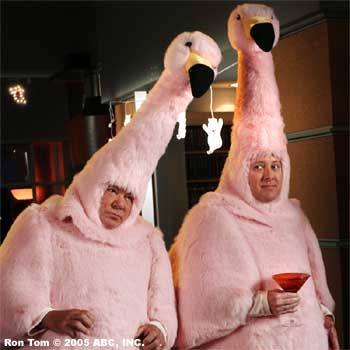
I won't lie: I hated the show. As much as I enjoy William Shatner (where do you think the nickname "Flamingo" comes from?), and as much as I appreciate Josh Halpern's story as a Geek WIN, the episode we watched embodied everything that is sad, old, and irrelevant about network television. Here they had an opportunity to tap into a built-in audience that has been steadily abandoning their medium, and they've blown it by serving up the kind of warm BLEEP that drove us away in the first place.
What would I have done differently?
Well, for one thing, I would have built the series around the central character of that twenty-something guy forced to move back in with his dad, and made it into a one-camera exploration of his life. Show the guy struggling with his problems and using Twitter as an outlet. Show the family reacting and trying to understand what the buzz is all about. Show the ways this unexpected fame changes his world.
There is a lot of risk in making a half-hour comedy like that, but it has been done well before. This show could have been Arrested Development - instead, it was Silver Spoons. I can't explain Twitter, but I can tell you that it has become popular because we-the-people are intensely interested in ourselves. Shitmydadsays became viral and popular because we are intensely amused by profanity and self-effacement. If you're going to take on the risk of buying a show built on the word "Shit", you should be willing to take on the risk of letting it be good by building on those things that made it strong in the first place.
But I realize it's hard to do that. When you're sitting in the makeup chair, you don't know what your face is going to look like to those in the audience. How much "realism" can you get away with? What should you emphasize, what should you hide? On television, all of that is decided for us, taking the point and the relevance away from us. On the internet, we decide what we want to show and what we want to see - not to mention when we want to see it.
And that is the difference between Bleep and Shit.
Therapy is expensive, and this is my way of making sure it will be fun.
After the running around and laughing was over, and I had washed my face, the little girl asked me if I had ever worn makeup before, and I told her about being in theater in high school. I don't know how much got across from 38-year-old mouth to 8-year-old ear, but I told her a little about the science behind makeup; how the bright lights of the stage wash out your features, and how the makeup emphasizes them so the audience can see your face.
It wasn't a long conversation, or a deep one, but it got me thinking about how much I hated wearing makeup on the stage, and how ironic it is that so many people use it in everyday life to "enhance" their image. There is a puzzling dance around the issue of what is real and what is fake when you use something artificial to emphasize only your best features; is it honest to cover up your faults that way, or is it necessary to counteract the effects of too much scrutiny?
Anyway, I was still thinking about the theater later when Flamingo and I sat down to watch some TV. We watch a lot of shows together, but rarely on the actual broadcast television - we prefer to catch up later on DVD or streaming Netflix (how's that for product placement?). This night was different because of Twitter.
I can't explain why, but I use Twitter quite a lot. (If you're reading this on my Blogger site, you can see my feed up to the left.) Even though I tweet and follow lots of friends, political figures, and sci-fi-related actors and actresses, I really can't tell you what value it brings to my life or what I have to offer in return. It has just become Part of My World. (Please, Disney, don't sue me.)
A lot of the stuff I follow on Twitter makes me laugh. Case in point: Wil Wheaton, whom you might remember from Star Trek: Next Generation, Stand By Me, or more recently, Big Bang Theory, where he plays an Evil version of himself. He was on Big Bang Theory that night, and had been twittering all day about it in a fit of shameless self-promotion - which we forgave because we actually wanted to see the show, and because we needed the reminders. We are out of the habit of being tied to the network's schedule.
We enjoyed the show, and later @wilw's meta-tweets (where the real Wil Wheaton actually tweeted here and here what the Evil Wil Wheaton tweeted in the show).
As fate would have it, the show that follow Big Bang Theory happens to come from Twitter, too. I have followed Shit My Dad Says for a while, now, and I knew they were making a TV series out of it, but I didn't see how they could do it justice. For one thing, it's NBC, so instead of the actual name of the Twitter feed, they have to print "$#!# My Dad Says" and call it "Bleep My Dad Says" - all of which is incredibly lame and violates the fundamental beauty of having a title based on profanity in the first place. (If you haven't already read my piece in defense of profanity, I have it right here.)
I won't lie: I hated the show. As much as I enjoy William Shatner (where do you think the nickname "Flamingo" comes from?), and as much as I appreciate Josh Halpern's story as a Geek WIN, the episode we watched embodied everything that is sad, old, and irrelevant about network television. Here they had an opportunity to tap into a built-in audience that has been steadily abandoning their medium, and they've blown it by serving up the kind of warm BLEEP that drove us away in the first place.
What would I have done differently?
Well, for one thing, I would have built the series around the central character of that twenty-something guy forced to move back in with his dad, and made it into a one-camera exploration of his life. Show the guy struggling with his problems and using Twitter as an outlet. Show the family reacting and trying to understand what the buzz is all about. Show the ways this unexpected fame changes his world.
There is a lot of risk in making a half-hour comedy like that, but it has been done well before. This show could have been Arrested Development - instead, it was Silver Spoons. I can't explain Twitter, but I can tell you that it has become popular because we-the-people are intensely interested in ourselves. Shitmydadsays became viral and popular because we are intensely amused by profanity and self-effacement. If you're going to take on the risk of buying a show built on the word "Shit", you should be willing to take on the risk of letting it be good by building on those things that made it strong in the first place.
But I realize it's hard to do that. When you're sitting in the makeup chair, you don't know what your face is going to look like to those in the audience. How much "realism" can you get away with? What should you emphasize, what should you hide? On television, all of that is decided for us, taking the point and the relevance away from us. On the internet, we decide what we want to show and what we want to see - not to mention when we want to see it.
And that is the difference between Bleep and Shit.
Subscribe to:
Posts (Atom)