So it would seem that the Kids These Days have discovered Kate Bush - and I couldn't be more pleased.
In contrast to the impression that some of the memes going around might give you, there were a lot of us who appreciated her in the late 1980s and early 1990s. Personally, I tended to be late to every party, and I came to this one indirectly. I first remember hearing Kate Bush's voice in a 1990s PSA about teenaged runaways that featured her part from the Peter Gabriel duet, "Don't Give Up":
From there, friends pointed me to Running Up That Hill, and I bought a copy of her "greatest hits" album, The Whole Story, which featured most of the songs on this list.
Running Up That Hill only made it to number 30 on the Billboard Hot 100 in 1985, which most people dismiss as a poor showing (oh, you 1980s kids didn't appreciate what you had!) but even a major talent like Elvis Costello didn't achieve that kind of success until 1989 when Veronicamade it to number 19.
And consider the competition that year - whether you think they "deserve" it or not, you recognize most of these songs or the performers:
Top Songs of 1985
Wake Me Up Before You Go-Go. Wham!
I Want to Know What Love Is. Foreigner.
I Feel for You. Chaka Khan.
Out of Touch. Hall & Oates.
Everybody Wants to Rule the World. Tears for Fears.
Money for Nothing. Dire Straits.
Crazy for You. Madonna.
Take on Me. a-ha.
And I don't think it's a coincidence that the Stranger Things kids appeared in the video for that last one when Weezer remade it recently. (Weezer remade "Everybody Wants to Rule the World," too, for that album.)
My point is that it's easy to forget how beloved certain songs and artists were, especially over time. As big as I was into what was being called "New Wave" at the time, all of that was overwhelmed by the surge in Alternative music that R.E.M. was about to usher in - and the Grunge sound that Nirvana, Soundgarden, Pearl Jam, and the like were going to introduce a few years after that. Success is always relative, and very fluid.
And as much as I loved the weird things that Kate Bush was doing with her music, I admit that I loved other artists more - Peter Gabriel's So album, which featured Don't Give Up was one that I played an order of magnitude more often than I played The Whole Story. There is probably a whole essay's worth of baggage to examine about how we allow male artists to overshadow the women they work side by side with and depend on...
...but for now, I'll just be happy for Kate Bush, and I hope that you all dig into her entire catalog. I also recommend that if you're looking for more artists like her, you won't rely on your favorite app's algorithm. As great as Peter Gabriel and Talking Heads are, if you're looking for weird and wonderful women doing great work from that general late 80s/early 90s era, you could do a lot worse than these:
In 1974, when I was barely two years old, my mother bought a record: the soundtrack to the motion picture The Sting. I grew up hearing that music, particularly the movie's theme song, The Entertainer, by Scott Joplin. I would argue that with the possible exception of B.J. Thomas's Oscar-winning recording of Raindrops Keep Falling On My Head* (from Butch Cassidy and the Sundance Kid), The Entertainer was my "first song."
When you're a kid, you don't know how significant the things in your life really are, because to a kid, every new thing is significant. I didn't know that my foundational musical experiences were being shaped by Paul Newman/Robert Redford buddy-movie soundtracks. I just knew I liked these songs, and it made my mom happy when I sang them and tried to play them on a plastic toy guitar.
As I grew up, of course, I learned what "ragtime" was. I began to study music and the history of music, and of course, I picked up on the ways the music I loved most was based on traditions and ideas that came from black people. I remember learning about the ways that black musicians - particularly blues musicians - found their music being borrowed, "sanitized," and turned into the multi-billion-dollar juggernaut that is Rock-n-Roll without getting anywhere near the recognition or financial reward that their white imitators got. I suppose that pattern came up often enough that when people talked about ragtime and the music of Scott Joplin, I just assumed that his was that same kind of story.
Since his music was associated in my mind with Paul Newman, Robert Redford, and B.J. Thomas, it was easy for me to assume that Scott Joplin had taken black music and popularized it, as others have done time and again. It just never occurred to be to be curious about who Scott Joplin was or what his story was, because his name and his music had been in my head for as long as language and memory could take root.
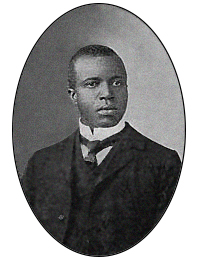
So last year, when the subject of Ragtime came up in my History of Music in the U.S. class, it was an odd sort of shock to see a picture of Scott Joplin for the first time:
Until I was in my forties, I did not know that Scott Joplin was black.
Knowing this changes nothing about how I feel about the music. In a world that was as egalitarian and democratic as ours claims to be, this demographic note would probably not register as an important detail. But for me, the fact that I made it through more than forty-five years without knowing this plain fact about one of the first composers I was exposed to was a revelation about representation and visibility.
The concept of erasure - or, as the New York Times Magazine defines it, "the practice of collective indifference that renders certain people and groups invisible" - is something I've always been half-aware of. It's that indifference that keeps people from speaking up when some guy at a party claims that the reason there aren't more female comedians is because women aren't funny. It's that indifference that allows an elected official who thinks that only white people should be credited with the success of Western civilization to be re-elected.
Countering that kind of claim is not hard to do, assuming you have the least amount of curiosity in the subject being spouted off about. If someone tried to claim that black people have made no contribution to Western Culture it wouldn't be hard for me to poke huge holes in that claim even without citing Scott Joplin, but it says something about the larger trend of our cultural experience that even someone like me - a very curious person with a history of scholarly inquiry into these matters - can fall victim to that collective indifference.
The shock I felt upon learning Joplin's ethnicity came from realizing that I had been so incurious about Scott Joplin, I effectively rendered one of my earliest cultural influences invisible. I want to reverse that trend.
To that end, I've planned out a small series of posts like this one that will talk about specific people from marginalized groups who have been important to me, personally. I'm launching this during Black History Month because this past holiday break was the first time I had a chance to work on this, and this seemed like the kind of thing that Black History Month was created for! (I'm sure it's just a coincidence that the tradition is about the same age as me.)
Some of these stories will be about people who, like Scott Joplin, affected me in my childhood; some will be about people I've only discovered because I'm actively seeking them out now. Some will be heroes, some will be villains, and some will be people I don't like. (The Venn diagram of those three groups may be different for you than they are for me.)
My agenda here is not to call anyone out or make anyone feel bad about not knowing these things. Quite the opposite: it's to show how flawed I am, and to make a public attempt to address the flaws.
More than anything else, my hope is to introduce you to something that gives me joy - the joy of being curious.
One of the first pieces of music I remember falling in love with also happened to appear in our Baptist Hymnal. And it happens to be a very appropriate Thanksgiving holiday sort of song.
The "Ode to Joy," or the Chorale from the Fourth movement of Beethoven's 9th symphony. My mom had a record with excerpts of great classical works that featured a 4 or 5-minute selection of just the chorus singing that main theme, but one of the first pieces of music I remember buying for myself was a cassette of the full symphony. Today, it is the anthem of the European Union.*
If you have not had the pleasure, here is Leonard Bernstein conducting the Wiener Philharmoniker at the Staatsoper, Vienna, in 1979:
(Lyrics are available here - that's the original German and a quality translation from the Schiller Institute; it's a PDF, though.
Lyrics by Henry Van Dyke - which appeared in my Hymnal - are available here.)
Not being a German speaker when I was a boy, all I knew about this song at first was that it was a hymn of praise to God. You may have heard this verse at some point:
Joyful, joyful, we adore thee,
God of glory, Lord of love;
Hearts unfold like flowers before thee,
Opening to the sun above.
Melt the clouds of sin and sadness;
Drive the dark of doubt away;
Giver of immortal gladness,
Fill us with the light of day!
That's very pretty, and I know I sang those words with gusto on the rare occasions our music director picked this song. For all I knew, when I listened to the passionate, loud, and joyful German version on my mom's record, they were singing the same thing.
As you'll see in a moment, they weren't.
Where the Van Dyke verse sings flowery couplets to a God being praised, the words by Friedrich Schiller take a subtly different approach - one with a decidedly Deist flavor:
Joy, thou beauteous godly lightning,
Daughter of Elysium,
Fire drunken we are ent’ring
Heavenly, thy holy home!
Thy enchantments bind together,
What did custom stern divide,
Every man becomes a brother,
Where thy gentle wings abide.
and
Joy is drunk by every being
From kind nature’s flowing breasts,
Every evil, every good thing
For her rosy footprint quests.
Gave she us both vines and kisses,
In the face of death a friend,
To the worm were given blisses
And the Cherubs God attend.
Notice that instead of singing specifically to the Christian God, these verses are directed to the embodiment of Joy. Where God is mentioned, He is certainly being praised, but throughout, the Creator is referred to in a less Christian way:
Be embrac’d, ye millions yonder!
Take this kiss throughout the world!
Brothers—o’er the stars unfurl’d
Must reside a loving Father
and
He who in the great ring dwelleth,
Homage pays to sympathy!
To the stars above leads she,
Where on high the Unknown reigneth
This way of speaking about the "Unknown" reigning "on high" is not unheard of in the Christian tradition, but it is central to the thinking of Age of Enlightenment figures who thought of themselves as "natural philosophers," and who we now recognize as the early scientists. Benjamin Franklin and Thomas Jefferson, and before them, John Locke and Voltaire, were all prominent Deist writers, who looked at science - or natural philosophy - as the way to discovering this Creator.
Today, atheists try to claim many of these thinkers, but while those people certainly were no great fans of churches, they still saw room in the vast mysteries of the unknown for a Creator. Some of them were more skeptical of His Divine Existence, but most of them took the approach that humans couldn't possibly understand a being that could set all of nature in motion, and determined that the only divinity lay in divining and defining the laws of the universe. By unveiling the mysteries wherever they could, their experiments and their scientific methods slowly pushed that veil back; and wherever they found materialistic explanations for previously mysterious phenomena, supernatural or Divine explanations were no longer satisfactory or necessary.
Personally, knowing the original poem that Beethoven set to music makes me feel closer to him than the flowery and conflicted words that were passed off in our hymnal. I have no reason to believe that Beethoven himself was a Deist, but he certainly belonged to the Age of Enlightenment, and the story of how he composed this piece despite losing his hearing and battling mental illness is a testament to a mind that remained relentlessly rational.
In contrast, the last verse of the Van Dyke version seems to run counter to the original, and to itself:
Mortals join the mighty chorus,
Which the morning stars began;
Father love is reigning ov'er us,
Brother love binds man to man.
Ever signing, march we onward,
Victors in the midst of strife;
Joyful music leads us sunward
In the triumph song of life.
That is stirring, but it seems to send a conflicted message. In one breath, we sing about brother love binding man to man, and in the next, we sing about Victors in joyful triumph. The implication is that even in harmony, there is inherent conflict - and the "good" is defined by the victor.
I much prefer the ending of the Schilling verses:
Rescue from the tyrant’s fetters,
Mercy to the villain e’en,
Hope within the dying hours,
Pardon at the guillotine!
E’en the dead shall live in heaven!
Brothers, drink and all agree,
Every sin shall be forgiven,
Hell forever cease to be.
A serene departing hour!
Pleasant sleep beneath the pall!
Brothers—gentle words for all
Doth the Judge of mortals utter!
There is still talk there of an afterlife, but instead of sorting souls into good and evil, and torturing one group forever, that afterlife is built out of pardons and making peace. As a humanist, that's a goal I can get behind, even if I don't literally believe in a soul or a supernatural afterlife. As people of faith, I would hope we could agree on that as some common ground.
I don't believe there is a Judge of mortals, but if there is, I hope he will take into account the fact that we materialists have done the best we can with the scant clues available to us. Either way, I expect to rest easily in my own afterlife - either singing Ode to Joy, or no longer existing at all.
Glory, glory, hallelujah
My teacher hit me with a ruler
I hid behind her door with a loaded .44
And the teacher don't teach no more!
Well... that's wrong, but on at least some level, it's so very, very right. Because this song is all about claiming that God is on the side of the Union Army, and He is fixin' to smite whoever stands in opposition to it!
The real words to the hymn were written by Julia Ward Howe, a famous abolitionist and suffragette, and were published in the Atlantic Monthly in February 1862, and they do not skimp on imagery that would have been readily recognized by the soldiers in the battlefield of the day.
I have seen him in the watch fires of a hundred circling camps,
They have builded him an altar in the evening dews and damps;
I can read his righteous sentence by the dim and flaring lamps;
His day is marching on.
What stands out to my Atheist Ear today is the almost complete lack of mention of the cause these men were fighting for. One would expect a morally compelling argument against slavery, or at least some indication of why this bellicose God is passing His "righteous sentence" in the text. But there is only one mention of the word "slave" in the song at all:
He is coming like the glory of the morning on the wave,
He is wisdom to the mighty, he is honor to the brave;
So the world shall be his footstool, and the soul of wrong his slave.
Our God is marching on.
That line doesn't even condemn the practice of slavery; if anything, it shows God making "the soul of wrong his slave" - a scene in which the Supreme Being is enslaving another. That disturbs me, because here we have the Armies of the Union and Confederacy squaring off over the largest issue that has ever divided this country - and still does today - and the abolitionist who wrote this song didn't feel moved to point out that slavery was the great moral wrong over which they were fighting? The Sin which God would have been punishing?
Oh, wait - there is a small mention here, in the verse before that - and you may recall hearing this line before: "As he died to make men holy, let us die to make men free." I guess that hints that the soldiers are fighting so they can free others, but it isn't any different than the language we use to describe the freedoms that our soldiers have died for in any of our wars. There is nothing specifically about the cause of setting the slaves free. I am left with an uneasy feeling that maybe I've been projecting my own feelings about slavery and human rights and dignity onto these words and the events they describe.
As I write this on the 11th of November, people are celebrating Veterans Day by thanking people like me for our service in their Facebook feeds and on Twitter, and they are doing so in the same week that our country elected someone who was openly supported by white supremacists, including the Ku Klux Klan. This is the tail end of a year in which the #BlackLivesMatter movement arose to protest the repeated killing of unarmed black men by police, and was roundly branded a "terrorist organization."
Just last year, nine members of a black Charleston, South Carolina, church congregation were shot by a white supremacist, but the outrage that swept the nation centered more on controversy over removing the Confederate flag from the State House than on the lives lost. The Confederate flag - the flag of the men who killed and died for the right to own other human beings as property - was still flown by the official government of a U.S. state over their state house in 2016.
Perhaps if our Union soldiers had been singing about the actual moral cause they were supposedly fighting for instead of singing about what a tough bastard their god was, the morality of that Union victory might have sunk in.
Then again, looking at the recent choices made by my countrymen, I suspect not.
I'm still proud that all of the family I have traced so far were on the side of the Union, but that pride is tempered by knowing that they probably weren't much different from their Southern neighbors when it came to the idea of living side by side with former slaves, or treating them with anything less than patronizing contempt. The takeaway for me is that I still need to do something to make up for what they failed to accomplish.
At the very least, we need some new lyrics.
Mine eyes have seen the shooting of my brothers in the streets
And my sisters won't be safe until they're seen as more than meat
They can't breathe, but dare they struggle they face permanent defeat
Yet they're still marching on.
There's no glory in oppression.
Won't we ever learn this lesson?
Our enemy is our division,
Stop fighting, get along.
I have been wracking my brains all month, trying to think of the ultimate "Halloween hymn" to talk about today, and it hit me: for all that Halloween has been (literally) demonized by evangelical Christians, the actual Christian holiday - All Hallows' Day, or All Saints' Day - already has an almost universally recognized theme:
This version is by two of the most New Orleans-ian of New Orleans artists: Dirty Dozen Brass Band with a guest appearance by Trombone Shorty. The video is a bit sea-sickness-inducing, but the audio isn't bad, and the band is phenomenal under any conditions.
As a kid, I picked up on unspoken levels of discomfort whenever this song was brought up in my rural, white, evangelical church or around my family. On one hand, this song expresses the same sentiment as "I'll Fly Away" does:
O when the saints go marching in, O when the saints go marching in, O Lord, I want to be in that number when the saints go marching in.
As a Southern Baptist kid, I noticed that two lines of questions would lead to uncomfortable conversations: "What exactly are 'saints' supposed to be?" and "This song is so exciting; why don't we sing it more often?"
According to what I was taught by adults in my Southern Baptist church, "Saints" refers to anyone who has accepted Jesus as their savior. It's just a word for those who are Saved in the Baptist sense of the word. What I didn't learn until years later was that the catholic churches had developed their own mythology around the idea of "saints" which Baptists considered to be non-Biblical, and therefore, evil.
(As an atheist, whenever I run across the stories about these Catholic saints, I marvel at what horrible people they were, and at the way their horribleness was turned into mythology... but that's fodder for another series of posts.)
In high school, I began dating a girl who was Catholic, and I got to learn all over again from my church how Baptists are supposed to feel about Catholics - while at the same time I had my girlfriend as a resource for sorting out Baptist myth from Catholic reality. Baptists told me that Catholics prayed to dead people; my girlfriend explained about the Catholic concept of "intercessory prayer." Baptists told me that Catholic "saints" were not usually Saved, and therefore were actually un-redeemed and not truly Christian - which meant they were, in fact, following Satan. My girlfriend balked at that twisted logic coming from people who reject orthodoxy.
And yes, there were Bible verses about false prophets produced as "clobber texts" on both sides, which were meant to prove that one side or the other was Right(eous), but only served to confuse the issue. Looking back at all of this controversy as an atheist, I recognize that I was stuck in an impossible position between groups that were in violent disagreement over bullshit.
Each side believed they were right, and by maintaining their disagreement, they were making themselves part of a tradition that dated back to the First Century, and a schism that developed between the earliest Christians; a schism between those who believe in orthodoxy, and those who believe in personal revelation. In other words, it was the religious equivalent of arguing over the superiority of Star Wars vs. Star Trek - and no one wins an argument like that.
As to my other question - "Why don't we sing this exciting song more often?" - that turns out to have a very simple explanation that no one wants to admit out loud: Race.
The very similar song, "I'll Fly Away," was written by a man named Albert E. Brumley in 1929. It was one of those songs recorded by dozens of groups and performed frequently on the AM radio stations which grew up across the Dust Bowl in the 1930s. In contrast, "When the Saints..." was not credited to a composer; instead, it was included in our Baptist Hymnals as a Negro spiritual.
Of course, as written, there is nothing in the text of "When the Saints..." that is overtly controversial. "When the sun refuse to shine/I want to be in that number" and "When they crown Him Lord of all/I want to be in that number" are essentially the other two verses of the song. The implicit core desire expressed by the lyrics are a yearning to be included. I think that was the source of discomfort that no one wanted to discuss, because the origin of the Southern Baptists is rooted firmly in exclusion. They split from their Northern brothers before the Civil War in a disagreement over whether black pastors could be ordained as missionaries.
Growing up in a post-Civil Rights era version of the Southern Baptist church, I was surrounded by adults who had not yet figured out where their traditional beliefs fit in America's new political reality. And hearing "When the Saints Go Marching In" apparently reminded them, even if it was on a remote, subconscious level, that they belonged to a community built on excluding fellow saints... saints who wanted nothing more than to be included in that number.
By their nature, Baptists occupy an uncomfortable eschatology. (They try to believe literally in what the most allegorical of books says about the End of Times; so that leads to a lot of cognitive dissonance.) The core of their belief system is inherently prone to heresy, which they can't combat, because they consider personal revelation and conscience to be the basis of spiritual salvation. That means that their own core beliefs don't allow for an "authority" in the church to determine who is or is not a "real, true Christian." They do claim to follow the literal, inerrant text of the Bible, but as I pointed out above, that doesn't allow them to authoritatively resolve even the most central and basic arguments stemming back to the earliest Christian churches. And that means that they have no foundational, scriptural basis for excluding anyone who claims to have come to their faith through personal revelation.
In other words, anyone who says they are a saint, is a saint. That causes a problem for Baptists who don't want to count someone as a saint. Rather than deal with the discomfort of including people they have long worked to exclude, they have a history of projecting their discomfort on the music itself.
"When the Saints..." is a very deeply black song. Being a negro spiritual, it was forged in a community of oral history by people who were being deprived of inclusion in humanity itself. As simple as the text is, it speaks very powerfully of people who want a promise fulfilled - the promise that if they work hard and follow the rules, they will someday be free. It's morbid to consider now how many of them only had death to look forward to. And whether white evangelicals want to admit it or not, this song is a painful reminder of their historic role in maintaining the system that put those people into that forge.
Sadly, I've seen how the discomfort from that painful reminder gets transformed into a reason to continue to exclude. They don't want to be called racists... but they can't seem to square inclusion with the things they do and teach.
White evangelical culture has a long history of demonizing black culture - and pretending that this has nothing to do with race. Consider the example of Sketch Erickson, as the Slacktivist describes here. Then watch that Dirty Dozen/Trombone Shorty performance again, and connect the cultural dots. I think now that the awkward relationship my church family had with this particular song had a lot to do with where they drew their personal line between what is divine and what is not.
And demonizing is what Halloween is all about, isn't it?
This was always the most uncomfortable time of year for my church community. On one hand, you have the unavoidable historic fact that All Hallows' Eve is a Christian feast day... for the wrong kinds of Christians. On the other hand, you have the celebration of evil spirits being glorified in the secular culture, especially when it uses that historically black music.
As modern Americans, we weren't supposed to believe in evil spirits anymore, which always added to the confusion. (I'm still confused by the logic that Christians use that, "There are real witches ... real because they believe in magic, even though I don't, because magic isn't real.")
So our churches would attempt to reclaim the holiday by refusing to have Halloween celebrations, and instead have Harvest Night, or some similarly innocuous sounding alternative... which accidentally imitated the pagan festivals they were trying to distance themselves from in the first place.
As an atheist adult, I look at this holiday with a mix of amusement and pity. I feel bad for the people who work themselves into a frenzy over the "Satanic" nature of the holiday - which seems pointless, considering there is no Satan. And I feel some sense of schadenfreude that the people who are most worked up over the whole thing are battling demons of their own making.
But mostly, I feel like dwelling on the afterlife is a huge waste of time and energy - especially if we can't swallow our pride and address the schisms that we've created for ourselves out of all of these misinterpreted myths.
(Apologies for the mix-up in posting earlier; and apologies if you didn't see this one coming, but...)
Those who have read my book know my personal connection to this song, and the violent act it drove me to commit. Here is the full 13:47 minute experience for those of you who may have missed it:
And if you'll promise to go read the much improved version in the book, I'll share this excerpt from the original blog post recounting the 6th grade field trip in which this song was my downfall:
One of the girls in my class was the daughter of an extremely wealthy construction mogul in the area, and he sponsored a field trip to his house for our class, complete with a fleet of limousines for the students. Looking back, this makes no sense; I have no idea what the educational value was in tramping about on his huge estate looking at his antique car collection and his enormous pool. But, there we were, and on the way back to the school, someone discovered the radio. There were several of us in the car: my friends Robert and Scott, and the class bully, Todd. Upon discovering the controls for the radio, they promptly tuned in a Top 40 station. I protested... arguments flew... and I accused them all of loving Satan. This may be where the break-down in civility occurred. Somehow I ended up pinned to the back seat by Scott, while Robert cranked the volume. "I love this song," he crowed. It was "Thriller". You have to understand that in my mind "Thriller" represented everything that was wrong with our society at that time. It was about zombies (the undead, a tool of Satan), it encouraged dancing (think "Church Lady"), and worst of all: Michael Jackson was a Jehovah's Witness!!! Yeah, lame. But I was so mad that I leaned up and bit a chunk out of Scott's sternum. In retrospect, it was extremely stupid, and for so many reasons. But until it happened, I didn't realize what a completely unreasoning dogmatic prick I was growing into. Receiving four swats from the principal of the school (I pleaded with him that I was defending the faith while he tried valiantly not to laugh at me) was a wake-up call.
That wake up call I referred to was the beginning of many years of growing realization that the people who were filling my head with their religious dogma, trying to keep me on the so-called straight and narrow, didn't really believe all of the things they told me.
Sure, they said I should gird my loins with the Sword of Righteousness... but if you actually try to cut anyone with a sword, you will be the one who is wrong. If I follow through and violently defend what I have been told is a core tenet of my faith, I will be in the wrong.
Think about the implications of this, not just for a confused middle school kid who thinks he's standing up for his beliefs in a silly scuffle, but for people who do much more serious things in the name of their faith. People like Eric Rudolph, or Shelley Shannon and Scott Roeder - people motivated to commit infamously violent acts, which church communities like mine frantically denounced after they occurred. I see those people following what they see as the logical, defensible action demanded by what they believe is right.
I can't blame their church for their choices, any more than I can blame my church for the bite on my friend Scott's chest - but I also didn't arrive in that limo on that day fresh out of the ether, with no influences and no teaching.
The lesson I eventually derived from this experience was that I couldn't trust people who tried to tell me that without their message of "peace" I would have no moral compass. I couldn't rely on the Bible as a rule book, because that's not what it is. I learned to listen to my own conscience, and eventually tested my own moral code, keeping only the parts which were sound.
It would be too easy to claim that learning this is what made me an atheist - but that's not actually true. If anything, it made me a Baptist in the tradition of Roger Williams (you know, the guy so opposed to organized religion that as soon as he founded the First Baptist Church*, he left it because his conscience wouldn't let him stay in an organized religion). Biting Scott because of a Michael Jackson song forced me to re-examine my conscience, and put that in the center of my moral code.
Of course, following my conscience meant always being honest with myself, and following evidence instead of wishful thinking, no matter how uncomfortable it made me or those who cared about me. That's why I eventually had to admit to being an atheist. But the way I see it, my intentions are the same as the people who unwittingly set me on the the path that lead to violence. They didn't intend that, and I learned the lesson.
In the end, we all have to struggle to find our way, keep our head, and do the right thing. As the song says:
'Cause it's a thriller, thriller night And no one's gonna save you from the beast about to strike You know it's thriller, thriller night You're fighting for your life inside a, killer, thriller tonight, yeah
*Fun fact: I'm descended from one of the original members of that church. See my post on Mightier Acorns about him!
I really wanted to show you something that would convey to you just how bad we evangelical Christians thought things were in the 1980s when it came to the occult. I remember the figures on our local Family Life Radio station excoriating the popular trends of horror films and heavy metal music, and I remember hearing parodies and take-downs that I thought (at the time) were really sticking it to those heathens.
But for today's post, this is the best I could find:
(Lyrics are... probably available somewhere. I'll let you Google this one if you really want to.)
I'm truly sorry for that, but it was honestly the best video I could find to represent what I wanted to talk about today. And by "best," I mean that it's almost listenable.
That was Carman, one of those artists I thought was pretty cool and entertaining in the mid-1980s. He apparently went on to re-imagine Buffy the Vampire Slayer as a wild west showdown. He made several videos like this in the early 1990s, and they tend to be longer and less entertaining. I guess a career is a career.
But I remember there were a lot of smaller-time artists out there doing similar things at the time. I can't remember their names, and clearly, they aren't easy to find on YouTube. But what I wanted to talk about was the way they went so over the top in portraying their Enemy.
There is no denying that a lot of the things that rural Christian communities like mine saw coming out of pop culture in the late-1970s and early-1980s were terrifying. John Carpenter's Halloween, the Exorcist, and the slasher movies they inspired; Black Sabbath, Judas Priest, and the increasingly cacophonous and increasingly depraved bands they inspired seemed to confirm that demons and Dark Powers had taken over our land, and were intent on convincing kids (like me!) to ignore their upbringing and sin, sin, sin.
Unfortunately for their message, the people behind the Satanic Panic went too far in building up the Enemy. What do I mean by that?
First, a lot of the panic was based on lies. A man named Mike Warnke was one of the more famous, but there were several people who made a living touring the country and telling stories of their lives as "high priests" in Satanic cults. They described awful rituals, murders, baby-killing, and rapes occurring, and then spoke about how Jesus had saved them, and told them to spread the word. Spoiler alert, Mike Warnke, and those like him, turned out to be frauds.
But not only were these people lying about things that Christians find scary, the truth is that those scary things - like demons and the Devil, and Hell - don't actually exist. I don't just say that as an atheist who does not believe in the supernatural - I also say that as a former Christian who is quite familiar with the Bible. The very concept of Hell, as these people teach it, is not Biblical.
As the Slacktivist said a few years ago, after controversy flared up over a book by Rob Bell:
"Dante teaches this. Jack Chick teaches this. Iron Maiden and countless B movies teach this. But the Bible does not. The doctrine of Hell can be, with only partial success, taken from Dante and Chick and Iron Maiden and grafted onto the Bible. But it cannot be derived from the Bible... "The Hebrew scriptures offer no support for Team Hell. None. The pages of the Old Testament mention “sheol,” or “the grave,” but not Hell...The gospel as Paul preached it, as he described it in his epistles, does not include the doctrine of Hell." (from Team Hell gets loud)
The point is that none of these supernatural beings exist, either in reality, or in the scriptures that those perpetuating the Satanic Panic claim to follow.
So why were evangelical Christians like me motivated to buy into the lurid stories we were being told? Why did we want to believe those stories were true? For the answer to that, I'll refer you to another incredible Slacktivist essay, this one about the Anti-Kitten-Burning Coalition. (Spoiler: it comes from a deep need to feel superior to others that becomes more important that combating actual evil.)
At the end of the day, it's important to remember that the vast majority of Christians want to help make the world better. They see the problems that come from drug use, alcoholism, poverty, and crime, and they want to share what they think is a simple solution. If only solving real problems were as easy as shooting a demon with a magic pistol.
But, since you put up with that Carman video, I thought I'd share this gem: it's Steve Taylor's live performance from 1984 of his song criticizing Bob Jones University and its racist policies. Enjoy!
Back when I was an evangelical kid growing up in the 1980s, there was a general reaction among evangelicals against modern rock music - in particular "heavy metal," and bands that played up their anti-establishment, anti-Christian identities. After the drug- and sex-fueled hedonism of the 1970s, and bitter losses in the culture wars, our evangelical communities considered the descent into chaos to be self-evident.
But they believed they did have ample evidence.
Ozzy Osbourne's 1980 solo record, The Blizzard of Ozz, was an easy target for those looking to find evil in the culture of rock. Give a listen to his hit Crazy Train, and see how many elements of evil you can spot in it:
Since we didn't have music video culture quite yet, the only visual we would have had to go by would have been the album cover, seen above. Ozzy, holding a crucifix, and surrounded by smoke, a skull, and crawling towards the camera. We had all heard about his antics as a member of Black Sabbath - an evil sounding band if ever there was one - and about his gruesome adventures on stage. (Like much of the stuff we were told during the "Satanic Panic" of the 1980s, we would have done well to have had Snopes to clear up those rumors!)
And since Ozzy is notorious for being incomprehensible, we can probably forgive the upright fathers of the elder councils for not looking too deeply into the words of his songs - just listen to the evil on display in the music. The menacing bass; the creepy guitar glissando at the beginning; and the wailing vocals - those can't be wholesome!
Then there is the prominent bit of understandable vocal from the second verse:
I've listened to preachers I've listened to fools I've watched all the dropouts Who make their own rules
That first couplet sounds insulting enough, perhaps we can render a verdict. Of course, if one approached the lyrics without the baggage of Ozzy and the motivated reasoning required to interpret this song as "evil," one could quite reasonably arrive at a different conclusion.
Crazy But that's how it goes Millions of people Living as foes Maybe It's not too late To learn how to love And forget how to hate
A deep analysis is not required to see that this song has little or nothing to do with the supernatural, or with Satan, or any of the things typically associated with heavy metal tropes. It's really an anti-war song inspired by the growing realization that human being were pointing enough atomic weaponry at each other to destroy the planet several times over.
And while I know better - having lived through this period - it should be easy to connect the plea for sanity and peace in Crazy Train to the same sentiment that many of us who were being told to fear this music felt. Instead, we chose to pretend that Ozzy was celebrating insanity and exhorting us to go off the rails.
We have seen that same cycle play out several times, now. The shock rock of the 1980s gave way to punk, and saw a resurgence in the 1990s with bands like Marilyn Manson. There is always someone out there hoping to provoke a backlash, and ride to success on the Streisand Effect. And there is always someone out there looking for a reason to be afraid of them.
It usually pays to look at what they're saying before you judge them, rather than how they are saying it.
Nickel Creek included this song poking a bit of fun at the followers Harold Camping, who believed that Jesus would return on May 21, 2011, on their 2014 album, A Dotted Line:
While it may seem a bit cruel - not to mention shooting fish in a barrel easy - to poke fun at people like the late Mr. Camping, it's worth remembering that there is such a thing as Being Wrong.
Too many people throw dumb ideas around that are painfully, obviously, and predictably wrong; and yet, they somehow defend themselves from criticism by claiming that you can't prove them wrong. Their sincerely held beliefs trump all of the facts, evidence, and rational reasoning you might bring to bear. Sometimes they wrap themselves in "different ways of knowing" or cast doubt on your credibility, ignoring everything - even previous errors of their own - for the sake of insisting that they have some mystical foreknowledge that you don't have.
Well, I've never been so sure
And I've never led no one astray
'Cept in the fall of '94
But Hallelujah, the 21st of May
They laughed while Noah built his boat
Then cried when came the rain
They mock me now but I will float on the 21st of May
They mock me now but I will float on the 21st of May
It's all harmless enough when they are just selling pamphlets and putting up billboards, but there are deeper, more insidious ways that people are wrong. They ignore evidence to cast doubt on the safety of vaccines, they ignore the body of science on global warming, and insist that economic austerity is necessary to "fix" our economy - all subjects on which the vast, overwhelming body of study contradicts them.
Still, people like me have a responsibility to remain civil. We can't force people to see reason; we can only explain it, sometimes repeatedly, and hope it sinks in. And yes, sometimes, we poke a bit too much fun at them, making them hunker down in their miserable wrongness and ignore us even harder.
Still, there remains the undeniable fact that the only appropriate response to ridiculous ideas is to ridicule them.
(If you haven't seen this, by the way, you owe yourself 20 minutes to see them perform four songs on their NPR Music Tiny Desk Concert - 21st of May is the 3rd song.)
I know what today is, and that's why I picked this song.
In 1989, I was just stepping out of my sheltered Southern Baptist upbringing and beginning to explore pop culture and pop radio. My girl friends were still listening almost exclusively to the Dirty Dancing soundtrack; the Beach Boys "Kokomo" was everywhere; and a song called "Veronica" by some odd Englishman named Elvis made such an impression on me that I was willing to leave my radio tuned to our local Top 40 station, which insisted on playing such awful fare as "Pour Some Sugar On Me" and "Sweet Child o' Mine," in hopes that I could hear it again.
Then out of nowhere, a relatively unknown a cappella genius released a joyful, silly ditty that conquered the world for a few weeks.
(Lyrics are here - but you probably know them note for note.)
By itself, this song probably wouldn't count as being religious in nature, but Bobby McFerrin has always been associated in my mind with faith. He made a few casual references to "the Good Book," in his music and in interviews; he composed and performed Psalm 23 on his 1990 album Medicine Music; and his most recent album, 2013's Spirityouall consisted of arrangements of spirituals and traditional Americana, as well as "original songs which explore Bobby’s everyday search for grace, wisdom, and freedom."
McFerrin's spiritual character would have been important to me in 1989, because I was in the process of figuring out which secular pop culture phenomena were "acceptable" and which were not. I couldn't find anything particularly objectionable about Don't Worry Be Happy, even using the hyper-critical standards for judging pop culture I learned from my pastors and grandfather. I ended up buying Simple Pleasures and carried it around for years, playing it in my car or putting it on when I went to sleep.
Like most absurdly popular one-hit acts, Don't Worry Be Happy hit a saturation point, and became a joke for the hipper members of the cognoscenti. It became an easy punchline for late night hosts, and a cultural reference which, with an eyeroll, could show how sophisticated the speaker was. A lot of people "got over it" and McFerrin's career might have been declared "over" as well. Except that it wasn't. He kept making music, taking on interesting projects with jazz and classical greats, and he built a reputation among musicians as a true genius with a childlike sense of wonder to match his impressive vocal range and control.
As an adult, and as a young parent, I sometimes found it difficult to share music and stories from my childhood with my little children. Like I discussed last week, the hymns I grew up with seemed too wrapped up with ideas that I had not only rejected, but which seemed loaded with awful baggage. I didn't want my children to have their earliest memories tied to ideas that I felt I had outgrown and regretted.
I also had difficulty relating to the new choices welling up from the children's entertainment industry - I loathed Barney and the Wiggles, I was uneasy with the acid trip that was Teletubbies, and I struggled to find much depth in the songs that they were learning in school. I made my own "mixed tape" CDs for the car, and combined songs the kids liked with some of my own favorites - songs like Don't Worry Be Happy - which seemed to go over pretty well. We all survived our long car trips to and from our home base when we were stationed in the UK, at least.
The September 11 attacks on America affected my family deeply, though thankfully, indirectly (described in The Impact on My Faith). It was that period of my life, in the years after 9/11, that I really started thinking about the songs and tradition I had grown up in, and applying some critical thought to what I had been taught to believe from birth. As I did, many of the old hymns and songs I had loved growing up became problematic for me, because the things they say have been exposed as ugly and corrosive. But one of the earliest songs in my memory that had no baggage and still held up as an unabashed statement of joy in the face of adversity was... Don't Worry Be Happy.
I was somewhat embarrassed by this. I didn't want to be the guy telling 9/11 victims, "Hey, in every life we have some trouble... but when you worry, you make it double!" I didn't want to admit that my philosophical answer to It Is Well With My Soul has a music video featuring three clowns hopping around acting silly. But when things get dark, I have to admit that humming to-koo-koo, to-koo-koo and tapping out a rhythm on my sternum brings in a welcome bit of light.
When my son began to struggle in school, and we began to suspect that he was on the autism spectrum, we looked for ways to reach him and help him deal with the frustration and anger that was building up. He was too young to have a logical, rational discussion. We couldn't just talk him through his troubles. This was doubly difficult for me, because I try to confront problems rationally and head on, and because he had already formed a barrier against me - for some reason, he had decided to focus his rage on me, so I couldn't even get near him when he was in trouble.
We needed to draw him out of himself and make him care about something, so we got him a hermit crab. We knew he loved animals, and that he found it easier to relate to them than to people. Our hope was that if something depended on him, he would take care of it, and this would help him see his own worth and teach him to be responsible for something outside of himself.
He loved that crab. He named it Dedrick, and he kept Dedrick's terrarium spotlessly clean and well stocked with water and food. It wasn't a magic wand that suddenly made everything better, but he did start to make progress and he came out of the dark place he had been making for himself. He even grudgingly started sharing more time with me, proudly showing off the new shell he had picked out for his crab or talking about research he had done online.
I still couldn't relate to him the way I could to my other kids. He wasn't openly hostile any more, but he was still guarded. I sometimes felt like he would never let me in, and I would never be able to repair whatever was wrong. I felt like I had nothing to offer him. But one day, my wife came and got me. She excitedly took my hand, and indicated I should be quiet. She took me to where the boy and his crab were sitting in a sunny corner of the living room. Dedrick was exploring a freshly cleaned cage, and my son - the boy who didn't even like to talk around me - was singing.
For long time readers of this blog, or fans of the book, you might recognize this song from my post, Going to Pet the Rabbits. (A much better, edited version appears in my book, which you can find on Amazon.)
To quote myself:
Being a memorial service...Amazing Grace and It Is Well With My Soul were featured. The first verse of the latter one is particularly appropriate, and I was struck today by how Zen it is:
When peace like a river, attendeth my way, When sorrows like sea billows roll; Whatever my lot, Thou hast taught me to say, It is well, it is well, with my soul.
- by Horatio Spafford
That part, at least, is a universal comfort; attaining peace in the tempest is a skill that everyone should learn - and the elemental imagery of the water here is striking. As I listened, I thought about how important that Idea was to me growing up, and how I've held onto it. That, at least, was something good and honest that could help my friend grieve, I thought.
But there is a lot more going on in this song than the first verse. Here's a modern version of the full song you might enjoy (with some historical background included):
As a kid, I thought this song was beautiful, and because I was a music nerd who spent most of his time by himself, the chorus is one that I would hum to myself on a continuous loop, putting a swell into the harmony parts, or improvising alternate melodies to complement the one composed by Philip Bliss. The music captured my mind, and the words of the chorus made it a song that I could still treasure after I stopped being a Christian, because they were and are comforting:
It is well, (it is well) With my soul, (with my soul) It is well, it is well, with my soul
Psychologically, the first verse and chorus use a combination of stirring imagery and call-and-response repetition to create a calming effect. And if, like me, you don't believe in the mystical idea of a soul, you can certainly appreciate the poetic sense of self here. The sentiment is a common one in human tradition; the ladies in my church would often say, "Let go, and let God," and as I noted in my introduction, there is resonance here with the Zen tradition of letting go of concerns about the physical world.
Of course, the other verses of this song are very clearly rooted in Christian theology - and those roots are more disturbing to me now that I am an adult. They say, "Though Satan should buffet..." you'll be okay because "Christ has regarded my helpless estate/And hath shed His own blood for my soul" - a common theme based in the ancient concept of ritual sacrifice. In the same vein (pun intended), "My sin, not in part but the whole/Is nailed to the cross, and I bear it no more" - again, building on the idea that because Jesus was tortured to death to "pay for" your sins, you won't have to suffer a worse fate later.
There is a lot to unpack in there.
Being a kid raised in a Christian tradition, most of these concepts were taught to me from the earliest moments of my life. Songs, including this one, are tied into my first memories, so that even though as a toddler I certainly had no grasp of what "sin" was supposed to mean, I remember the hearing the songs and the music drags what I know now about the words into the memories and impressions I have of my earliest days. This has the effect of making things I was taught feel like they were always part of my make-up.
This is not magic; neurologists are continually adding to what we know about how the brain works, and studying the way our memories are constantly recreated and overwritten. (This RadioLab episode on Memory and Forgetting talks a lot about the science behind that.) Using that mechanism of re-writing memories, music acts as a vehicle for carrying ideas "back in time" so to speak, so that even ideas that I learned about later (probably as I approached double digits, and became self-aware and self-conscious) my brain naturally recalled the music and retroactively tied the words to that memory.
Knowing this about how the mind works means that things placed into my earliest memories are things that I find disturbing now. Take sin just as a general concept. The Christian ideas about sin are not uniform. No matter how I define the term here in this tiny blog post, I won't be using "the" definition of it that all Christians use. In fact, one of the main reasons that there are so many different kinds of Christian is that they each have a unique set of ideas about what sin is, and what one must do about their sins.
The simplified version of the concept that I was raised to believe was that sin is what occurs when you "miss the mark" - you, as an individual, must make moral decisions all the time, and when you make the wrong decision, that is a sin. Building off of that idea, you, as an individual, will make a lot of poor choices in your life. Every poor choice you make adds to your suffering and the suffering of others. (Don't call that karma, though, because we don't go for that mystical Eastern stuff!) So, once you reach an age where you become aware of all of the countless mistakes you've made, how do you fix them?
That's where the idea of Christ's sacrifice enters the picture. Building on those ancient traditions of ritual sacrifice, and playing to the very common human desire to restore "balance" to things, the story about Jesus being crucified is meant to give everyone a way to restore that balance. Again, every different kind of Christian will have a different explanation for how that is supposed to work. But thanks to the magic of poetry, every one of them can project their explanation onto a song.
If you watched the video, you have already read the story behind the writing of "It Is Well With My Soul," but if you skipped the video, here is the gist: Horatio Spafford was a prominent Chicago lawyer with a large family. He and his wife were close friends of the evangelist Dwight L. Moody. The Spaffords lost most of their wealth in the Great Chicago Fire of 1871, lost their son to scarlet fever, and then in 1873, lost their four daughters at sea when the ship they were on collided with another ship.
Spafford wrote this song as his own ship passed the spot in the ocean where his daughters died, on his way to England to retrieve his wife.
His story reminds me of another story. The Story of Job, in which Satan wagers that a man named Job will stay loyal to God even if God allows Satan to kill his family, destroy his wealth, and ruin his health. (Spoiler Alert: Job fails, because he yells at God. This is his only sin, at least in the version of the story I was taught.)
Spafford would have been well familiar with the story of Job. There's a pretty good chance that he was thinking about that story when he decided to pen this song. I don't know what Spafford's sins might have been - he was a lawyer, so that's one, amirite? - but the beauty of a concept as loosely defined as sin is that it applies to any mistake you make. So he was certainly contemplating all of the reasons why God might have decided to take away everything he had while he was on that ship and in that place. If I had been in his place, the song I might have been composing might have been a bit angrier, especially if I thought that the only reason I was suffering was because a sadistic God had placed a wager on me, to see how I would hold up.
But Spafford penned a song of praise, instead.
If you're a believer, and you want to be inspired by that, then by all means, please stop reading and go about your day. But if you are like me, you may recognize something else in Spafford's decision, and you won't find this inspiring at all.
Because Spafford's reaction strikes me as being identical to the reaction of an abuse victim. When an abuser victimizes a spouse or a child, they do a number of things. They convince the victim that they deserve the punishment they are receiving. They convince the victim that the only way to prevent further abuse is to appease the abuser. They convince the victim that only the abuser can make them better. And even if an outside observer can get to the victim and try to convince them to leave, they rarely do, because they've bought into that narrative built by the abuser.
I went forward in my church at age 11, and followed the Southern Baptist pathway to salvation. I was convinced that all of my sins were piling up already, and I had been told from birth that they were all my fault. I deserved to suffer for them; and the only way to escape my punishment would be to be Saved.
My Christian friends and family not only believe this, but they find it beautiful. They don't see the abusive nature of the relationship they imagine they have with their god, and they are convinced that without him, they are worthless (at best), and capable of the most hideous sins imaginable.
For the five or six years after I was saved, I lived that life. But at some point, something broke the cycle of abuse, and I started on my path to where I am now. Along the way, I had to learn to let go of a lot of baggage, and at some points along my journey, this song soothed me, with its apparent message that it's okay to let go. If there were a God, and I was given a brain and a conscience, I would have those things even if I walked away from the abuser and the threats. And as it turned out, I was okay.
Now, to my Atheist Ear, this song sounds very different than it did when I was younger. It's a dark reminder that life is hard enough without punishing ourselves for the sake of an imaginary abuser. Sometimes, we have to ride out rough times. Sometimes, we suffer consequences for things we weren't responsible for. We certainly miss the mark when it comes to making choices - and we should own our mistakes - but we make good decisions, too, and most of us don't deserve to be punished.
When people claim there are no atheist anthems - as Steve Martin and the Steep Canyon Rangers did in our inaugural post - a quick Google search for a counterexample might lead one to this song... and fool you into thinking that you had found one.
Extreme put out their 1994 album Waiting For the Punchline when the Grunge movement was in full flower, and there is no doubt that this hurt them as far as album sales and publicity goes. Their previous album, III Sides to Every Story, had played around with the conflicts between War and Peace, and re-purposed slogans from both 60's peace movements and 90's era talk radio hawks to skewer the weaknesses of both sides. For my money, their genius at writing challenging songs that sound like they mean one thing while forcefully making the opposite point was undiminished when they made their 1994 record.
Punchline focuses heavily on religious themes, and calling out hypocrisy and criticizing the abuses and excesses of organized relition. But Extreme were never satisfied with making a straightforward statement. They prefer to mix multiple arguments up in their lyrics and let the listener come to their own conclusions - while playing coy with their own (often strong) opinions. The opening track of the album does exactly this with the notion that There Is No God.
On the surface, this song comes out fighting. It would be easy to take one listen and declare this to be an Atheist Hymn (giving the lie to Steve Martin's song from a couple of weeks ago).
The first verse is clearly attacking the kinds of charlatans who were making the news in the late 80's and 90's - people like Jim Bakker, who was convicted of mail fraud and other charges related to his televangelist ministries. People like Bakker had become an easy target, not just of the anti-religious, but also of churches like my own, which saw these sprawling, lavish "ministries" as something akin to the "money changers in the temple" who made Jesus so angry that he got a whip and drove them out. (See Matthew 21:11-13 for that story.)
So you're a self proclaimed messiah or maybe a blasphemous liar a clever hypnotic hoax a hallowed heretic coax who tells these stories so old no, never the same twice told speaking in distorted truths i see that thomas wants some proof did you come to heal the sick with one more magician's trick ye generation seeks a sign while blind keeps leading the blind
If you stopped there, that could stand as a withering critique of religion in general. This verse probably sounds a lot like what you hear from atheists on the internet. But take note of one small detail before it gets away. Most of this song is framed in "you" statements: "You're a self proclaimed messiah" and "did YOU come to heal the sick..." But there is one line that stands out as an "I" statement: "I see that Thomas wants some proof."
That's important for two reasons. First, it signals very subtly that the listener and the singer aren't interpreting these words from the same point of view. The listener is primed to sympathize with one view ("there is no god") or the other ("who tells these stories so old...speaking in distorted truths"), but there is a third point of view here: that of the singer. (Remember, the band's previous album was divided into "III Sides" - Yours, Mine, and The Truth.)
He's putting a lot of ideas out there, but he hasn't actually taken a "side" yet. And while he is laying out the usual case against charlatans and false prophets - or at least fallible humans - he isn't necessarily owning those arguments. He's also distancing himself from the critique by referring to someone as "Thomas." If you're not familiar with your Bible, this is a clear reference to Doubting Thomas, the disciple of Jesus who refused to believe that the Messiah was back from the dead until he put his fingers in the nail holes and stuck his hand into the wound on his side. The gruesome point being that in the end, Jesus appeared to Thomas, let him touch him, and chided anyone else who insisted on that degree of proof as a fool.
To return to the song, the band goes on to establish in the chorus what seems to be a summation of the case against religion:
so you say there is no god just a clever man's charade a once upon a fairy tales fraud has god made man or man made god there is no god
Read superficially, this can be interpreted as an assertion that "there is no god" at the end of the verse. If you're a believer, you're probably past the point of caring or wanting to hear more at that point; but if you're a non-believer, you're primed to keep going. You might even be pumped and excited to see more "red meat" thrown out.
But settle down; because now that we've identified the singer hiding in the "I" statement, it becomes important to see that the whole chorus is a "you" statement. YOU say there is no god... and YOU follow that logic to its conclusion. But what does the singer really think?
The second verse seems to continue the scathing criticism, but halfway through, there is a slight twist. See if you spot it:
confused thy talk in parables accused thou walk in parallels a simple game of simon says of this month's flavor sciences today's fact, tomorrow's fiction leave the rest to superstition if knowledge comes from learning books wisdom comes from discerning looks a fool that says there is no god don't feel for that sorry sod who needs proof then he'll believe i wonder if he's been deceived there is no god
There, in the middle of what the average atheist might consider to be the crushing blow in the case against religion, the lyrics turn around on you. Pivoting on that line - wisdom comes from discerning looks - the singer delivers two couplets that seek to undo everything they have built up to this point. This verse begins by subtly shifting from describing the failings of religious hypocrisy to criticizing "this month's flavor sciences," and ending the song with the suggestion that requiring proof is foolish.
On its merits, this is a disappointing argument to make against atheism; particularly in the context of having flayed the disappointing failures of religion. The argument turns on the fact that science does not have "all of the answers" - a common criticism from religious apologists which fails to recognize "I don't know" as one of the most powerful answers that science has.
"I don't know, let's go find out," is what makes a scientific viewpoint so strong. That was the vital driving force behind the Age of Enlightenment, and the last two centuries of discovery and learning. Recognizing that we don't know everything is not foolish - it is the beginning of wisdom, and it is the reason that we take discerning looks. The flip side of that is that a person who thinks scientifically ought to be willing to change their mind if they discover new information or evidence that does a better job of describing reality.
That is what drives me to demand proof before accepting extraordinary claims. That is also what drove me to discard religion. I held out hope for many years, and looked for anyone making supernatural claims who could provide any evidence at all. Needless to say, what was offered was not sufficient. I suppose that puts me in the shoes of Doubting Thomas, as the singer criticized earlier.
But the mistake in those lines of the song lies in trying to shift the burden of proof onto the non-believer. It doesn't matter that the religious apologist has tried to distance themselves from "self-proclaimed messiahs" or "blasphemous liars," because in the end, they are still making the claim that there is a god, and what is missing from their argument is any reason to believe that there is. Instead of saying, "I don't know, let's go find out," they are saying, "I don't know for sure - but you don't either, therefore, I choose THIS - and you're a fool."
I shied away from open atheism for many years because I couldn't see past that agnostic predicament. Technically speaking, I might still be classified as "agnostic" because I admit that there is no way to prove the negative. But insisting that I'm a fool for not believing something that you can't even coherently articulate is not going to convince me that you know what you're talking about.
Looking at this song through that lens is rather disappointing. Still, twenty-plus years later, this band still rocks, and I appreciate the fact that they put together such a swaggering, sassy puzzle-box of a song. It makes me think, and it keeps me seeking... if only to someday find a real Atheist Anthem.
If ever there were a quintessential Hymn of Praise, this is it. Despite the countless doctrinal disagreements between the thousands of sects and denominations of Christianity, this song holds an appeal that they can all embrace - and every church I've visited has had it in their hymnal.
The original poem goes back to Swedish poet Carl Gustav Boberg, who wrote nine verses in 1885. It was translated into German in 1907, and countless times since then. The tune evolved to the version we recognize today by the time of its 1894 publication. Here's a version I remember seeing on TV when I was growing up:
Oh, Lord my God, when I in awesome wonder Consider all the worlds Thy hands have made I see the stars, I hear the rolling thunder Thy art throughout the universe displayed.
I admit that even as a jaded non-believing adult, I still find this very stirring. I don't believe there is a supernatural being running the cosmos, and I don't believe in the mystical notion of a soul - but allowing for the poetic framing device attributing all of this universal awe to an omnipotent being, a powerful rendering of this verse can still stir my sense of wonder and evoke all of the beauty and majesty of the worlds that we see - worlds that we are still discovering.
Since this poem was first composed, we have discovered that the stars Boberg wrote about were just the beginning. Edwin Hubble, who helped prove that the "nebulae" his telescopes revealed were actually galaxies outside of the Milky Way, was born just four years after the poem was published. We've learned so much in the century since, just from looking up with better and better eyes; and we've even begun to visit more and more of the "worlds" in our own neighborhood.
We keep learning new things all the time, and finding new ways to explore deeper, further out, and farther back. No single person can fully comprehend or appreciate our universe - that's what this song is about. Containing that feeling from that moment of being overwhelmed, and seeking a way to label all of this amazement.
Then sings my soul my Saviour God to Thee How great Thou art, how great Thou art.
To me, growing up, a performance of this song was always one of the purest and most universal expressions of that feeling. Even now, when I don't believe that any kind of supernatural being is out there, supposedly designing and controlling everything we see, I can appreciate the basic human need to praise something; to signify how impressed we are with something outside of ourselves.
Another inspiring omnipotent being
I don't believe actually exists
Of course, I also find it frustrating that people can't easily express that sense of wonder without tying it to their mythology. It's not just Christianity that does this; Islam, Judaism, all of the poly- and pan-theist faiths to one degree or another rely on an that sentiment for their existence. "If you feel that sense of wonder," they seem to argue, "that is proof of God (or gods)!"
I understand why they feel compelled to do that. It has never been easy for people to separate what they believe from reality. For many, the overwhelming feeling that I call a sense of wonder can be terrifying if there is no god there to protect them from it. They remind me of my grandmother the first time she took me to the Grand Canyon, and I rushed to the side to look down. Majesty and colossal beauty come with a certain amount of danger.
And that's how I relate to this song, now. I see it as a way for people to approach the vast, dark, amazing universe with a shield (if they need it), and express their amazement. There are many other, lesser known verses in this poem, but the best of them only serve as an excuse to return to the climactic moment of wonder.
There is certainly much to dissect, theologically, in those other verses. Some of them use the coming of Christ as a signifier of cleansing judgement; others look forward to escaping the pain and drudgery of daily life. We'll look at those ideas in other songs another day. All of them return us to the same place. But now that I don't feel saddled by the guilt that I was told to feel as a child, I can gloss past those verses if I want to. Today, I want to.
Today, I'd rather look up and marvel.
(The photo above contains a quote and image from Doctor Who, as played by Matt Smith; "The Universe is big, it's vast and complicated, and ridiculous and sometimes, very rarely, impossible things just happen and we call them miracles.")
Update: I meant to include a couple of links to some people who regularly inspire my desire to marvel: Phil Plait of Bad Astronomy (on Slate), and Ethan Siegel of Starts With A Bang (on Medium, and other places).
Be careful - they're like a gateway drug to other astronomical coolness.