I did a "good dad thing" the other day, and let my 8-year-old daughter put eyeliner and lip gloss on my face while I pretended to sleep. She thought it was a hoot, and then I "woke up" and chased her and her brothers around the house planting big, watermelon-scented Dad lips on their cheeks and foreheads.
Therapy is expensive, and this is my way of making sure it will be fun.
After the running around and laughing was over, and I had washed my face, the little girl asked me if I had ever worn makeup before, and I told her about being in theater in high school. I don't know how much got across from 38-year-old mouth to 8-year-old ear, but I told her a little about the science behind makeup; how the bright lights of the stage wash out your features, and how the makeup emphasizes them so the audience can see your face.
It wasn't a long conversation, or a deep one, but it got me thinking about how much I hated wearing makeup on the stage, and how ironic it is that so many people use it in everyday life to "enhance" their image. There is a puzzling dance around the issue of what is real and what is fake when you use something artificial to emphasize only your best features; is it honest to cover up your faults that way, or is it necessary to counteract the effects of too much scrutiny?
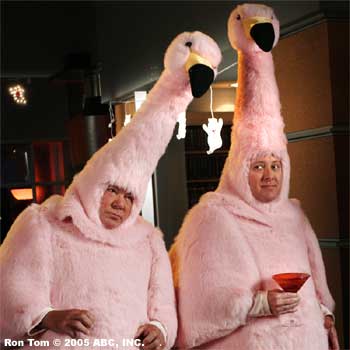
Anyway, I was still thinking about the theater later when Flamingo and I sat down to watch some TV. We watch a lot of shows together, but rarely on the actual broadcast television - we prefer to catch up later on DVD or streaming Netflix (how's that for product placement?). This night was different because of Twitter.
I can't explain why, but I use Twitter quite a lot. (If you're reading this on my Blogger site, you can see my feed up to the left.) Even though I tweet and follow lots of friends, political figures, and sci-fi-related actors and actresses, I really can't tell you what value it brings to my life or what I have to offer in return. It has just become Part of My World. (Please, Disney, don't sue me.)
A lot of the stuff I follow on Twitter makes me laugh. Case in point: Wil Wheaton, whom you might remember from Star Trek: Next Generation, Stand By Me, or more recently, Big Bang Theory, where he plays an Evil version of himself. He was on Big Bang Theory that night, and had been twittering all day about it in a fit of shameless self-promotion - which we forgave because we actually wanted to see the show, and because we needed the reminders. We are out of the habit of being tied to the network's schedule.
We enjoyed the show, and later @wilw's meta-tweets (where the real Wil Wheaton actually tweeted here and here what the Evil Wil Wheaton tweeted in the show).
As fate would have it, the show that follow Big Bang Theory happens to come from Twitter, too. I have followed Shit My Dad Says for a while, now, and I knew they were making a TV series out of it, but I didn't see how they could do it justice. For one thing, it's NBC, so instead of the actual name of the Twitter feed, they have to print "$#!# My Dad Says" and call it "Bleep My Dad Says" - all of which is incredibly lame and violates the fundamental beauty of having a title based on profanity in the first place. (If you haven't already read my piece in defense of profanity, I have it right here.)
I won't lie: I hated the show. As much as I enjoy William Shatner (where do you think the nickname "Flamingo" comes from?), and as much as I appreciate Josh Halpern's story as a Geek WIN, the episode we watched embodied everything that is sad, old, and irrelevant about network television. Here they had an opportunity to tap into a built-in audience that has been steadily abandoning their medium, and they've blown it by serving up the kind of warm BLEEP that drove us away in the first place.
What would I have done differently?
Well, for one thing, I would have built the series around the central character of that twenty-something guy forced to move back in with his dad, and made it into a one-camera exploration of his life. Show the guy struggling with his problems and using Twitter as an outlet. Show the family reacting and trying to understand what the buzz is all about. Show the ways this unexpected fame changes his world.
There is a lot of risk in making a half-hour comedy like that, but it has been done well before. This show could have been Arrested Development - instead, it was Silver Spoons. I can't explain Twitter, but I can tell you that it has become popular because we-the-people are intensely interested in ourselves. Shitmydadsays became viral and popular because we are intensely amused by profanity and self-effacement. If you're going to take on the risk of buying a show built on the word "Shit", you should be willing to take on the risk of letting it be good by building on those things that made it strong in the first place.
But I realize it's hard to do that. When you're sitting in the makeup chair, you don't know what your face is going to look like to those in the audience. How much "realism" can you get away with? What should you emphasize, what should you hide? On television, all of that is decided for us, taking the point and the relevance away from us. On the internet, we decide what we want to show and what we want to see - not to mention when we want to see it.
And that is the difference between Bleep and Shit.
When Bill Watterson retired from writing the Calvin & Hobbes comic strip on December 31, 1995, I was just one of the millions of people who were heartbroken.
In his biography of Watterson, "Looking for Calvin and Hobbes: The Unconventional Story of Bill Watterson and his Revolutionary Comic Strip", Nevin Martell tells us what we already knew: I was not alone in that state. But in reading this book, I discovered something that hadn't ever occurred to me before about Watterson's retirement. This discovery hit me between the eyes as I read about Watterson's life, and saw the interviews recounted by Martell; it wasn't just a discovery about Watterson, or about myself, but about all of us.
What I discovered was what Bill Watterson tried to tell us, both before and after he left us behind and went off to do whatever it is that he's doing now.
Chances are that you found Calvin and Hobbes to be a deeply resonant piece of American art. It wasn't just funny, or "sweet", or merely entertaining - it was important to us. His biographer moans about how difficult it is to "track down" the elusive artist, but Watterson's work gave us everything he wanted to say to us about himself, and we loved it. This comic strip is one of the few things that people say they love that they truly DO feel love for. It's one of those few things that we can all instantly picture or can retell to our friends. I've been an office worker my entire adult life, and of all the comic strips hung on walls or doors, Calvin & Hobbes is the only one I have seen in *every* office (even some where such personalizations were strictly forbidden).
And this is as true in 2010 as it was in 1995... all without much in the way of promotion or marketing.
A lot of people may remember Watterson's position on licensing; for those who don't, I can tell you that Mr. Martell does a great job of conveying it through Watterson's words, and through the words of his publishing syndicate. I know I have always felt a little disappointed that there is no C&H merch to be had anywhere; no key chains, no magnets, no plush toys or plastic figurines. And even before picking up this book, I knew as well as anyone that there were literally millions of dollars to be made from such licensing.
A comic strip "Garfield", by comparison, makes literally Billions of dollars from sales, licensing, endorsements, movies ... the list goes on. Martell talks a bit about that, too, to give us an idea of the level of industry that can be generated around a strip, and to give us an idea of the amount of pressure on Watterson to take this path. All of the "big name" strips have some level of this going on... But when was the last time you bothered reading a Garfield comic strip? Or any of the Brand Name strips, really. Did you laugh? Smile? Remember anything about it after putting it back down?
Watterson tried to tell us how he felt about all of this, and he was nearly universally criticized for it. He told us through interviews, in the strip itself, and in one of the rare speaking appearances he made before going into self-imposed exile. Whether the criticism came from other comics writers snubbed by his words, or from would-be marketers wishing he'd let Calvin hawk cereal or allow Hobbes's face on a line of kid's underwear, or even from casual fans like myself who thought they'd look witty and cool with Calvin's class photo pictures on a t-shirt - no one really understood that Watterson had a very clear idea of the gift he wanted to give to us. More importantly (and more to the point of posting this blog): no one understood what he wanted in return.
Bill Watterson only wanted to write his comic strip, and be successful enough at it to support his family.
But, you will argue, why couldn't he do that AND give permission so we could have all the stuff, too? The answer to this is the epiphany I had reading this book. I have written before about how the internet is changing our economy, and have spoken privately to my friends about the ways in which I feel our hyper-marketing "free" market system destroys the very things we find to be of value.
Some of you have heard me talk anecdotally about how hard it is for us to find products that we can all eat (due to allergies) or fruit juices that have actual fruit in them. There are multiple movies and books available to describe the ways the food industry corrupts the products we try to buy in the name of efficiency and "broad appeal". And we all know how often (and awfully) it happens in the entertainment business - do I need to queue up some Disney sequels or the Star Wars Christmas Special?
It was Watterson's personal and professional integrity and his complete focus on and control over his strip that made it what it was. And he was right that industrializing it would have destroyed it.
Our obsessions with celebrity are not news. The desire of industry to exploit that obsession is not news. Even the story of someone trying to avoid the corrosive influence of fame and money is not news. Kurt Cobain put a shotgun in his mouth in 1994 for the same reasons that Bill Watterson cited when he walked away from his world renowned comic strip, and many of us shrugged and said, he's just another spoiled rock star. So where's the "so what" in this? What's the big lesson?
The lesson is that it can be done. Watterson did exactly what he wanted to do with his life: he gave us 10 years of top-notch art, in daily 3-panel and weekly 9-panel installments. He changed us; he affected us; and, as friends often do, he moved on to do something else.
Bill Watterson achieved the real American dream. He did it with class and grace, said thank you, and then walked away. He never exploited us, nor has he allowed anyone else to do so. And when the world sat at his feet begging him to take millions of dollars more to keep going - he knew that doing so would be a lie and a cheat. It wasn't what he wanted to do, and I have no doubt that if I sat at my desk sticking pens into my Hobbes(tm) pencil sharpener, I would not be any happier than I am when I find a copy of "Something Under the Bed Is Drooling" tucked under my kid's pillow.
There are two ways to lose your dream. One is to try and fail; the other is to succeed so wildly that you destroy everything you wanted in the process. I'm glad that Bill Watterson got his dream; and I'm grateful for the 3,160 dreams that we got from him.
A few weeks ago, a Facebook friend described George W. Bush to me as "a decent man you just happen to disagree with politically."
I would tend to describe just about anyone in our elected government that way - though their "decency" may be a fragile thing at times. But her dismissal of the very real problems that I had (and still have) with the Bush Administration bothered me, and I wanted to find a way to address them without being snarky or simply argumentative. Contrary to the picture some of my friends like to paint of me, I never "hated" George W. Bush. I think it's important to remind people of that, but it's hard to separate my strong disagreement with the things he did from the man himself.
Today, that same friend posted this video, which gave me something direct to address:
Since Mr. Bush laid out the points that he seems to think are most important, and capture the best snapshot of his terms in office, I'd like to address them - Point by point:
Quitting drinking at age 40 - this is, of course, an admirable thing to do. It shows a strength of character, and he clearly relied on his strong relationship with his wife and his faith in Jesus to make this change and make it stick. From where I sit, I can see that he essentially replaced the crutch of alcohol with the crutch of his relgion.
That's fine in and of itself - I'm a big proponent of letting damaged people use the tools they need to use to overcome their shortcomings. I also disagree with those who say that a President should not wear his faith on his sleeve the way Mr. Bush often did; if it is truly a part of you, your faith should not be something you hide or avoid mentioning. My only "disagreement" with Mr. Bush's religion is that it is not right for me, and there are other Points where it affected his Decisions in ways that it should not have done.
Running for President - When Mr. Bush ran for President, I was a tired, shift-working burnout serving in the USAF in England. As a distant ex-pat grappling with how I felt about Libertarianism, and wearied by years of anti-Clinton rhetoric, I wasn't ready to vote for the Republican party's theory of "reducing government", but I figured that it would either be a) successful, and therefore worthy of consideration, or b) a failure which might prod the country in a more Centrist direction.
Later, I read about Karl Rove's underhanded tactics (told from John McCain's POV in David Foster Wallace's "Up, Simba" essay), and the cutthroat dishonesty that Mr. Bush engaged in to get the GOP nomination; it was an illuminating discovery, but by then, of course, the damage was done. None of it was, technically, "illegal", but it was dodgy, and I recognized enough of the same in 2004 to be doubly angry at our so-called "two party" system.
But you can't deny that the American populace finds the idea of an affable "good ol' boy" to be appealing, and W. was thoroughly qualified to play that part.
Selecting senior staff - I allowed myself to be optimistic in 2001 when Gen. Colin Powell was added to the Bush team. Never mind that he was one voice among a dozen others that included already-discredited former Defense Secretaries Donald Rumsfeld and Dick Cheney (an essay for another day, I'm afraid). Never mind that Karl Rove was already known as "Bush's Brain" and that Grover Norquist - the man who said "My goal is to cut government...down to the size where we can drown it in the bathtub. " - was planning the destruction of the American government from within.
Education reform - "No Child Left Behind" is often touted as the Bush Administration's one success. Holding teachers accountable for their students' performance and breaking the Unions' death grip on any reform effort are both admirable goals, in my opinion. But as a single "success" it is hardly compelling.
Over the years, I have asked everyone I find who liked and supported Mr. Bush to tell me what else he accomplished. So far, no one has come up with an answer.
Stem Cell research - This is not a debate I enjoy. Finding a legal precedent for the beginning of human life is emotionally wrenching, and the impact of the decision on other lives is horrifying, no matter which way it falls. The only thing in this debate - like the debate over the legality of abortion - which seems certain is that the law must either trust individual doctors and women to make the right decision in each case, or must arbitrarily decide in advance what that "right decision" is, and find a way to intrusively enforce it.
It's a lose-lose situation.
9/11 - There was a moment after the attacks when all Americans were on the same page, and felt the same way. For me, that ended on 9/15/2001, when Defense Secretary Rumsfeld announced (without any evidence) that he intended to get revenge on Saddam Hussein for the attacks. I can't find a reference to that speech, but CBS dug up notes that were more revealing in 2002.
The following points Mr. Bush mentioned in his video all stem from bad decisions made at the urging of his most trusted advisors. Going into combat was debatably the correct move in Afghanistan, but not in Iraq. The lasting debacle that is Homeland Security is a testament to the kind of "big government" that Mr. Bush was elected to bring down, and while in the context of "winning" (an idea that was never defined or given a tangible goal) in Iraq the Troop Surge was the right decision, it would not have been necessary if not for the earlier mistake of invading Iraq in the first place.
Re-election - 2004 was a frustrating time for me. Everything I had seen the Bush Administration do to that point told me that the next four years would be equally, if not more awful. And yet, when the Democrats handed us the turd sandwich that was John Kerry, and the American people failed to demand a third option that wasn't on the menu, I began grasping for hope. In the debates, Kerry dismantled Bush point by point, while perversely making him look like the better candidate; Bush spoke of love for each other and our fellow man, and actually gave me a glimmer of hope that his second term would be marked by humility and compassion.
It wasn't.
Tax cut plan - When we got our check - which my lovely bride still refers to as our "Dirty Bush money" - we had to ask: where does this money come from? Did it come out of the welfare checks that would have gone to the "welfare queens" that conservatives hate so? Nope; they're still ahead of us in line at the grocery store buying foods we can't afford. Did it come from subsidies that we shouldn't be paying for "oil exploration" or for small farmers - like ConAgra?
Apparently it came from all of those places where you don't see spending happening; roads, bridges, schools, state and local services, and infrastructure.
At least we got a big screen TV out of the deal, right?
Global AIDS initiative - This really does seem to be a success; at least the 1.7 million Africans benefiting from it might think so. What I find interesting is that no one seems to think of it when they talk about Mr. Bush's successes. Obviously, his opponents wouldn't want to admit that it's a Good Thing(tm)... but it's worth wondering why his supporters wouldn't tout it more loudly.
Unless it simply goes against everything they believe in; tax dollars going to save the lives of brown people in foreign lands without any discernable profit to the U.S.
Mr. Bush: I applaud you for this success.
Then there are the areas where Mr. Bush regrets his failings:
Social Security - I've written and spoken many times about how I agreed with Mr. Bush's approach to this, and how it bears a more rational look from all sides.
Immigration - This, too, is often overlooked as part of the Bush Administration's plans. A real Comprehensive Immigration Reform which would welcome those who want to become a legitimate part of our Dream, and find ways to secure our border against criminals, thugs, and smugglers is still needed. I still hope that we'll be able to look past our racist and nationalistic instincts, and past our petty desire for some kind of "justice" against those who have committed a relatively minor crime, and come up with a solution.
Katrina - This was a difficult issue for everyone. On the one hand, the U.S. President doesn't control the weather, and obviously can't be expected to anticipate every emergency that crops up. Personally, I ignored a lot of the criticism of the immediate response from the White House because so much of it seemed to come from political animosity and misdirected fear; at the same time, there were a lot of bad things that happened or didn't happen because the government was unable to perform its mission.
I saw Katrina as a symptom of the success of Grover Norquist's goal to reduce the government to something that could be drowned in a bathtub. New Orleans showed us that a bathtub is the least of our worries. If we don't invest in public infrastructure, and ensure that the organizations that oversee its maintenance are kept up to date and efficiently managed, we could all end up in a similar situation. There is no way to know in advance whether it will be a hurricane, an earthquake, wildfires, or some other disaster. Global Climate Change scientists have been warning for decades that storms and weather patterns will become more severe AND more unpredictable. Without good government, we will be unprotected.
Katrina did not show me that the Bush Administration was "bad"; it showed me that good government is important.
"...Putting ideology aside" during 2008 economic crisis - This is a point where I agree with Mr. Bush. I agree with him wholeheartedly that the ideology he espoused did not have the answers needed to protect us from the economic crisis. He may not be willing to admit it - his GOP successors certainly don't - but the ideology of "unregulated financial products" that he championed throughout his presidency caused the crisis, just as clearly as uncontrolled speculation caused the 1929 crash.
Thanks to Annie for posting Mr. Bush's video. I intend to read his book, and if moved to do so, may write about it. But I am grateful that Mr. Bush was able to lay out the points that are important to him. It gave me what I have long needed to help define his presidency, and to rationally describe my reaction to it.
I promised I would write about Ron Paul's economics approach, but I'm having a hard time finding the angle I'm looking for. It seems we don't have the vocabulary yet to express where I think we are in the evolution of economics. I've written before about this new kind of "free market" that we seem to be developing:
Instead of manufacturing, sales and service are our bread and butter. Marketing, transportation, and information; these are what the U.S. really thrives on, now. Look at our most successful companies, like Google. They "manufacture" a product which they give away for free, and yet their value has continued to rise...
Anyone with a ~$500 set-up can record, polish, and release an album of songs, and can set up a shop online to sell (or give away) their recordings... [several artists] have offered free downloads of their music, and toured "on demand", making money from shows that were sold out before they were booked, and from selling CDs and DVDs online - again, directly to their niche market.
In a way, we have become more purely Capitalist... and at the same time, with the means of production (almost) freely available to everyone, we have also become more purely Communist (without the purges and bread lines). So what gives? What do we call ourselves in an age where you make a profit from giving your stuff away?
Even money isn't really the "coin of the realm" any more. What is money, after all, but a digital record on a computer of a value that has been mutually agreed upon? What was our last decade of supposed "wealth creation" but a gigantic inflation of that value, which failed when enough of us stopped trusting that it was real?
The coin of the realm - the thing that drives our lives and determines our worth to each other - is information. Not just any information, but information that can be trusted. If you think about it, trust is the only thing that has any real value any more; if you don't believe you will get a return on your investment or be rewarded with a safe and comfortable retirement, you won't invest and you won't remain loyal to one company. If you don't believe that your government will protect you and the world in which you make your livelihood, you won't support it.
I don't claim to be very knowledgeable about economics. I understand a lot of the same "basic common sense" things that most of you understand: supply & demand, and interest, and return on investment. But I also understand that there are a lot of concepts that seem to work counter-intuitively. Insurance seems like a bad idea, gambling on whether the money I give to the company will ever benefit me; yet it's the only investment we made that survived the collapse last year. It's tempting to believe Dr. Paul's claim that getting rid of the intrusive and ineffective government will improve our lives, and yet without the government, all of our "free and unfettered" businesses would have dissolved along with their imaginary wealth, taking the rest of us with them.
But again, I don't think we have the vocabulary to describe what is really happening to our world. We talk about Government and Markets, Corporations and Individuals, "special interests" and "activist groups" as if they are not all the same thing: groups of people trying to get by, get along, or get one over. We all fit into those same groups in some fashion, and no matter how innocent or virtuous we try to pretend we are, we all try to balance our own welfare and that of our fellow humans according to whatever beliefs we identify with most strongly. (Some of us even include non-humans in that balance.)
Dr. Paul spends a lot of time trying to identify with a group of people we Americans call our "Founding Fathers." In passages too numerous and generic to quote here, he calls upon all of us to trust in their mutual vision for this country. He calls on us to protect our freedom and liberty, as those founders would have done. Freedom from what to do what, he would leave up to you to figure out, which plays into the American conceit that as long as you leave me alone, whatever you do is your choice. But these Founding Fathers didn't have a unified approach to things, either.
As Sarah Vowell discusses in her exploration of the Puritans who founded Massachusetts Bay Colony, The Wordy Shipmates, there were a lot of contradictions involved in the founding of our country. The Puritans were a people who believed strongly in personal integrity, industry (in the original sense), and morality - but also in self-sacrifice and the common good. Check out this passage describing a government built on their ideals:
"The body politic is formed by a voluntary association of individuals: it is a social compact, by which the whole people covenants with each citizen, and each citizen with the whole people, that all shall be governed by certain laws for the common good."
That passage is an enigmatic encapsulation of what America is all about. It sums up exactly what I was trying to describe in my earlier post on government, and depending on how you read him, that social compact is either the summation or antithesis of Dr. Paul's entire life of public service. Any American running for public office builds on that idea, whether advancing it or demonizing it. It unifies and divides us, all in one sentence, and that self-contradiction is what makes our country so beautiful and frustrating all at once.
It was written by John Adams in the Constitution of the Commonwealth of Massachusetts.
Reading Dr. Paul's book, I can appreciate his criticism of our government. We've drifted away from John Adams's ideal, whether from the idea of "voluntary association" or from the idea of "common good" - our systems and institutions have been corrupted by the worst impulses of the free market. But I don't trust his solution: to remove Government from the equation.
When you have a government that looks like the one Adams described, it is the extension of the will of the people it governs to operate in everyone's best interests. The reason we don't have that is because of apathy and neglect from the voting public; the participants who ought to be controlling the government. Dr. Paul should be calling for more involvement IN government, not freedom FROM government.
That is where the Founding Fathers agreed. They wanted to claim more direct control over their own lives and affairs, not throw away control altogether. Our government is supposed to be an extension of our own self-control; it is supposed to reflect our will and our desire for integrity, industry, and personal responsibility. I suspect that the reason we are all so unhappy with it is that it is doing just that.
As for economic theories, I think the new coin of the realm - information and trust - will move us in the direction we need to go. In that sense, Dr. Paul is right; no government body can dictate that trust or earn it through corruption or political wrangling. But that will mean we need figure out better ways to determine who and what to trust. Perhaps that will mean less Government, but it will definitely mean smarter government - and a voluntary involvement in the common good.
The Establishment is and always has been a favorite target for abuse. Right or wrong, you can pick up a lot of support for your cause by contrasting it against a big, entrenched - and decidedly un-sexy - Establishment organization (aka, "The Man".) And whether you're a 1960s radical agitator or a Tea Party Express rider, it's easy to get carried away by the romantic ideal of bringing down the Bastards, and sweeping away your problems.
It's hard to argue against that impassioned radicalism, especially when you know what you're defending isn't perfect. Not only that, but Bureaucracy is always a vote loser, and maintaining the "status quo" is always looked upon as an oppressive move.
In my adult life, I have butted my head up against the Establishment and have complained loudly about Bureaucracy many times, and I have to admit - I'm not always right. As I heard one senior manager put it recently, "Bureaucracy exists to protect Government from whacky ideas." And some of my ideas are downright whacky.
In fact, when I consider the things I want to change about the world realistically, I've been forced to accept that Bureaucracy is not a Bad Thing(tm) in and of itself. I've written before on this blog about this:
That last Great Innovation happened 125 years ago, when a little known Republican "machine" politician named Chester Arthur was sworn in as U.S. President after the assassination of James Garfield. Arthur reformed the Civil Service and basically gave us the Bureaucracy that we all complain so much about these days. At the time, it was a huge improvement, bringing all of the shady deals and corruption of the system out into the light.
So, while instant change makes for a compelling rallying cry, for ideas to be accepted, they need to be proven first... to the Establishment. In America, the problem we have is in figuring out when something is sufficiently "proven" to warrant making a change. And in accepting that the Establishment is a Representative body of us. It is certainly frustrating, especially when you always feel like the one with the "right answer", and you always feel like you're being ignored.
From the beginning of his book, Dr. Paul professes to believe in our system of government. He analyzes the Constitution throughout the book, particularly in Chapter 3, where he excoriates President Bush and the Congress for overreaching their authorities in regards to the 2003 Invasion of Iraq. In other chapters he refers to the possibly unconstitutional body of laws regarding free trade and international organizations - laws which few people seem to understand. His observations are compelling, and I appreciate his point of view on issues and events which have disturbed me in recent years.
But what bothers me about Dr. Paul's approach is the pervasive assertion that our Government is innately bad; an outside influence, completely divorced from what the constituents want. He pays lip service to our system of government, but either implies - or states outright - that the laws we have in place are illegal, according to the Constitution, and imposed on us by unspecified Others we have no control over. It's a popular idea, often shared by whomever is in the current minority party or by groups which feel marginalized - and of course, by radicals looking to bring down the Establishment.
There are a few areas where I feel Dr. Paul takes this too far. He characterizes income taxes as a kind of armed robbery - despite the 16th Amendment, which specifically authorizes them. Regarding regulation of businesses, he refers repeatedly to Government as a thing outside ourselves, causing all of the problems that our society suffers. He argues passionately for that most Libertarian of ideas, that if Government would just butt out, we "free and unfettered" individuals and businesses could take care of ourselves.
I appreciate the difficult balancing act faced by all Libertarians in finding that area between "too many laws" and "anarchy." I recognize that getting their point across is hard to do without becoming pedantic and boring. And outlining the limits that they feel our Representatives have ignored is tricky; but pretending that Government - all Government - is the culprit in the equation is misleading and dangerous.
First of all, as Dr. Paul claims to believe from the beginning of his book, our government was formed to represent us. If the government fails to do so, it is directly our fault. We are to blame, because we "own" it. The main body of the Constitution outlines the system and the process for controlling our government. It's not as if Dr. Paul doesn't understand this; he seems aware that the Government is our tool for ensuring that we don't take advantage of each other. He discusses this in several places, notably in Chapter 4 (Economic Freedom), where he quotes Thomas Jefferson, William Leggett, and Walt Whitman at length to illustrate the idea:
"...one single rule...is enough to form the starting point of all that is necessary in government; to make no more laws than those useful for preventing a man or body of men from infringing on the rights of other men." (Whitman)
Reading this book, it becomes clear that he does not believe that our representatives, operating under our authorities granted by our Constitution have made the right laws. I would tend to agree that we have allowed our government to overstep those bounds, but I fear that Dr. Paul goes further than that. Throughout these pages, he implies or states outright that our Government has been hijacked by what are generically referred to as "special interests"* - another populist meme, and an attitude which I believe takes away the burden of personal responsibility that we are all supposed to share, and turns what is supposed to be our arbitrary instrument of control over how our lives are shaped into a foreign threat.
This amplifies the most dangerous meme Dr. Paul employs: that Americans are "forced" to obey our laws - in several places he decries any regulation of business, and repudiates the requirement to pay taxes. He hearkens back to the founding fathers repeatedly, citing their dislike for taxation, apparently forgetting that the rallying cry was not "no taxation", but rather "no taxation WITHOUT REPRESENTATION."
As for the "force" involved, I have spoken to many people about this over the years. Dr. Paul echoes this approach, which characterizes the collection of taxes as money being taken away at gunpoint by an authoritarian regime. At one point he asks the favorite Libertarian question: "don't you think you are entitled to keep the money that you earn?" This is always presented as a trump card; if you don't respond with an unqualified "Yes", then you are proven to be either a fool or a dupe. I often ask in reply, "don't you think you should pay for the services provided by your government?" Guess what that makes me.
But when you face facts, every individual does have the choice to NOT pay their taxes. There are certainly consequences for this - fines, jail time, sometimes even exile - but to imply that thugs from the IRS will come and rob you at gunpoint for failing to file is just plain silly. It's an exaggeration, and one we are inclined to accept because it sounds right.
In comparison, I recall how, after enlisting and signing all of the papers, I got to Basic Military training and heard all of the dire warnings of things that would happen to me if I failed to complete it. A lot of people hated Basic, and wanted to leave, and the truth is, despite all of the contracts and documents they signed, they could have done so at any time. Sure, there were consequences, depending on how they tried to leave - climbing the fence will get you arrested; pretending to be crazy will land you in a psychiatric ward for an extended visit - but at the end of the day, despite all of the threats, no one will shoot a recruit for deciding to go home. If you're desperate enough to get out, the worst you can expect is eternal disdain from those of us who fulfilled our commitments.
Following that logic, by choosing to remain a citizen, you have "volunteered" to pay your taxes; in our country, it's more of a fee for services provided than the arbitrary, emasculating excise most people consider it to be. And we all know what happens when you don't pay your bill. That's not robbery - at least not in a free market society - so much as the rule of law.
So my contention is that the Government which we occasionally choose to ignore or vilify, does represent us. We are asked to give up time, money, and effort in exchange for things like roads, education, and military security, and if we don't want to, we have the right to petition for changes in the law. Changing rules we don't like is not an "instant" process, and a citizen has to stay involved for a long time to make changes. And while I think we should seriously consider Dr. Paul's suggestions to limit the Government's power, we cannot and should not simply ignore or throw out the Bureaucracy which we use to protect ourselves.
I don't believe that Dr. Paul has proven his assertions about Government, and as I intend to explore in the next essay, I don't believe he has proven that his proposed solutions - namely, throwing away any Government regulation, taxation, or institutions - will have the positive affects on our economy that he asserts they would have.
*Terms like "special interests" and "agenda" seem to pop up a lot in our political discourse. They ring like accusations: "They caved in to 'special interest' groups", or "they have an 'agenda'!" But it's like accusing people of having skin or breathing; of course people with a common political goal with team together to promote their "special interest"; and they won't get far without an "agenda". These words by themselves do not make a case that their intentions are either good or bad.
Dr. Ron Paul ran for President about eight years too late, in my opinion. That is to say, if you believe in libertarian ideas and would like to see someone who holds them dear in the White House, it would have been better for him to run in 2000 than in 2008.
In 2000, I was weary of the Clinton era. I was tired of the baseless lunacy of the burgeoning Right Wing Media franchise and their constant attacks on the President, and I was tired of the unprincipled sleaze of the man in the White House. I was interested in the Libertarians because they seemed to reflect the common sense, middle ground that I felt I occupied. And the prospect of a Third Party rising that would allow people like me to support the traditional "lefty" causes (ie, be "socially liberal") and the traditional "righty" ideas (ie, be "fiscally conservative") was very attractive.
Dr. Paul's 2008 campaign seemed to be trying to build on that appeal. But by 2008, I was weary of hearing politicians claim that what they wanted was common sense, only to see them fail or get into office and begin pandering to one extreme or the other. It was easy to see where Barack Obama stood, and I respected (and still respect) his willingness to take a centrist position; and his party, while far from perfect, seemed willing to back him up. It was easy to see where John McCain wanted to stand, but his party seemed determined to continue what I see as the simultaneous bloat and erosion of our Federal government - and they had a history of betraying McCain in the past (see "Up, Simba!" for David Foster Wallace's fascinating analysis of the 2000 campaign), a pattern which Palin's nomination as VP seemed to guarantee would be their future strategy, as well.
In 2000, I would have readily embraced Dr. Paul's campaign ideas, but in 2008, I saw him as a tired snake-oil salesman, trying to ensure a Republican victory using discredited memes to lure independents away from Obama's platform. I didn't see any new ideas, just a lot of complaining about the way things were; I didn't see any solutions. And when I have expressed that opinion, supporters of Dr. Paul's revolution have told me to read his book. Considering his Third Party status, and the treatment given to Third Party candidates by the press, it's entirely likely that I didn't get a complete picture of what Dr. Paul was trying to communicate to us.
So, when I opened the book, I was looking for those solutions. I was looking for a vision of what we could realistically do to move in a better direction. I expect a little "Utopian exaggeration", and I expect more than a little criticism of the status quo. But what I want to see is more than that. I want to see how we're supposed to fix things.
I want to see the plans for what we're supposed to build.
What I Found
On the surface, there is much I agree with in Dr. Paul's book. I appreciate his anti-war stance; ironically, when I made many of these same arguments, I was labeled a pacifist liberal sissy by many of my friends and family. Dr. Paul is certainly none of those things. I also applaud his rejection of the creation of laws and federal institutions which have unintended consequences or are unenforceable and needlessly burdensome on our society. I agree with his analysis that many of our government's laws and policies intended to help the unfortunate and unite our wildly different demographic groups have in some cases served to perpetuate the problems they aim to solve.
But underneath some of these ideas, I see some dangerous mistakes. Dr. Paul makes some basic assumptions about what government means and about the basis of our economy which seem rooted in the past. It's good to know our history, but to ignore the direction that mankind is headed, and the fundamental changes that technology is bringing about is a fatal flaw.
I intend to explore some specifics in the next post, but I wanted to make it clear that I did not set out to pick a fight with libertarians or with Dr. Paul's supporters. I read this book hoping to learn whatever truth it was that motivated so many to support his dark horse campaign. There is a lot here to get excited about, and I don't want to seem like I am opposed to everything said here; no one is perfect, after all, and I don't expect anyone ever will be.
However, it would be wrong and foolish to ignore what I see as glaring errors in judgment. So, now that I've spent two "introductory" posts explaining the background, and trying to head off some of the more distracting possible responses, let's explore what those errors are...
Several friends have suggested that I read Ron Paul's book "The Revolution: A Manifesto" since the beginning of his 2008 campaign. Because the campaign is long over and these are my personal opinions about the issues and the underlying philosophies, rather than the candidate, I feel confident that I'm in no danger of violating the 1939 Hatch Act by putting my thoughts about this book here.
I do feel I am in danger of being misunderstood, however, based on some of the reactions I tend to provoke. To avoid that, I'd like to address some remarks commonly made by my readers in past discussions. If you have ever said any of these things, please rest assured that I am not singling you out, as the word "commonly" should indicate that more than one person has made the same comment in different contexts. (Hard as it may be to believe, you are not my only friend.)
So, if you've ever thought or said these things while reading my past discussions, please consider these points while reading my upcoming posts. It will save us both a lot of frustration if you do.
I just think ____ are so SMUG! Whatever you fill in that blank, you're probably right. People who believe strongly in their cause tend to sound overly confident about it. I apologize if I sometimes sound condescending, but there are times when I feel pretty confident about what I'm saying, or feel it is appropriate to use humor to express that idea. It's important that you, as a reader, recognize that your perception of my attitude (or the attitude of whomever we are discussing) doesn't change the substance of the argument. Often, though, the "smug" accusation is aimed at other who are beyond my control; all I can say is, I'm not them, so don't blame me for their attitude. In any case, attitude does not equate to right OR wrong, so don't be such a crybaby and address the ideas, not their presentation.
You're BIASED! or You just think you're right and everybody else is wrong. Well, yes. Everyone is "biased"...and why would I say anything at all if I didn't think I had something worth saying? As for my biases, I think I make them pretty clear. But don't mistake my chosen role as "devil's advocate" for "taking sides"... if I'm arguing with you, I will very likely disagree or contradict you a LOT before eventually making up my mind about your ideas. Don't give up too easily, unless you already know you're full of crap. ;)
You LIBERALS believe THIS.... Don't put me in a box, and then attribute everything OTHER people say to me. If you think my ideas or my logic are flawed, then address them. But don't fool yourself into thinking "his idea sounds like this group's position, so he must be one of them..." Don't waste our time arguing with people who aren't involved in the discussion at hand.
You're a HYPOCRITE because... Sometimes, I am confusing. Sometimes, I change my mind about things. I am only human, like you.
...you claim to be "centrist", but you spend all your time attacking MY side. Sometimes I don't have time to waste slamming "the other side" just so you can feel like I devote "equal time" to "both sides". Part of that is your own fault for locking yourself into a "both sides" mindset when the truth is that there are far more than just two sides to the story. Most often, I "attack" (your word, not mine) the group that I feel should be on MY side, but has failed. I am also an opportunist; I only really pay attention to what drifts across my radar screen. Not only that, but when I take a position - such as being opposed to the 2003 Invasion of Iraq, which will be discussed later - even though there is strong opposition from both liberal and conservative ends of the spectrum, the immediate assumption is that I'm taking that position because of the liberal agenda. This is a mistake on your part, not hypocrisy on my part.
...you make arguments based on things you don't believe in. I don't think many of you have caught on to this, but I often build an argument out of ideas that I don't consider to be valid. For example, I am not a Christian, but I will cite scripture in my discussion; usually I do this because there is some religious element to the issue at hand, and I want the Christians I am speaking with to understand that there is a Biblical basis for a position that I am taking. It doesn't always matter why someone believes a particular way, but if we can agree on a position or solution, that's the outcome I'm looking for.
The most important thing to keep in mind is that, as far as I'm concerned, we are not enemies. I don't even consider most of the things we are talking about to be "political" - because politics is all about negotiating and horse trading to take these philosophies and put them into practice. I'm really only interested in the underlying philosophies, and consider all of the partisan bickering to be a distraction from that discussion.
Holy Cats... I should have known not to trust the Navy!
There is an essay contest afoot at the U.S. Naval Institute's "Get the Gauge" site. They asked contestants to submit their funniest military story, and as you know, I've specialized in those over the last dozen years (give or take).
Normally I would tell you "read them all and vote for the best", but for two factors: *There are too many stories to count, let alone read *One of them already has 99% of the 138,564 votes.
So, I ask you, my dearly beloved and devoted fans, to please spread some love around, and try to get me into third place. My story is called "Three Strikes" (and it's the first part of the Basic Training story I posted here last month).
Vote early, vote often, and spread the word!
Edit: Update! Apparently, due to a glitch in their system, the voting is going to be reset. This means there is still a chance we could hit first! So go vote... and then feel free to read other stories. ;)
This was originally posted Sunday, November 11, 2007, in what seems to have been a follow-up to Recycle Your Box.
I used to enjoy mindless patriotism and expressing unthinking adulation of my "team". That has all changed over the years, but I still like to think I'm a team player. But the question now is, what teams are we talking about?
I was a Reagan Republican all the way in 1984, mainly because of his stance on abortion, creation over evolution, and whatever other issues I was aware of at age 12. I didn't understand apartheid or terrorism, had no idea what was going on in the Middle East, and could care less about economic policies. All I needed to know was that Communists were the root of all evil, and I was as quick to snap the flag at the ass of anyone who dared to differ from my opinions as Bill O'Reilly is to shout his Neilson ratings at anyone who dares question his journalistic integrity.
When I hit high school, I discovered a wonderland of "school spirit": letter jackets, school colors, pom-poms & pennants, and loud cheering. I loved all the trappings and uniforms. I was in "hog heaven", as my mother would say. And I brooked no dissent with the idea that our school was "the best", whatever that meant; I was as in-your-face as the most repugnant fan could be. I'd argue with a fence post, if it contradicted me. My school, my church, my political party; all were superior to yours.
But eventually, I learned that there is a word for a person like this: asshole.
Life has a way of presenting difficult puzzles to us, and the puzzles I was handed made me realize that the causes I championed and the opinions I held so forcefully didn't fit in with the real world. I saw firsthand how little good extreme solutions actually do when confronted with a situation as serious as teen pregnancy. I began to learn about subtlety and gray areas, and I came to see that most of the articles of faith I held so dear were based on nothing, and weren't as important as I had been taught, anyway.
And I saw how easily people can turn something as insubstantial and silly as "team spirit" into something ugly and deadly. Let's just say that when I got around to reading "Lord of the Flies", I had faces from our varsity teams to go with each character. That's where I started learning a healthy distaste for organized groups; especially those that claimed to have the Answers.
Americans tend to see the world in false groups; groups of imaginary importance, which Kurt Vonnegut described in his novel, Cat's Cradle, as a "granfalloon". He also accurately described the attitude of the average American's world view in our WalMart-based society with a character who happens to be an American businessman traveling to a Caribbean island nation to set up a bicycle factory:
"He wasn't a terrible person and he wasn't a fool. It suited him to confront the world with a certain barn-yard clownishness, but many of the things he had to say about undisciplined mankind were not only funny but true.
The major point at which his reason and his sense of humor left him was when he approached the question of what people were really supposed to do with their time on Earth.
He believed firmly that they were meant to build bicycles for him."
So, when I came to make the decision to enlist in America's armed forces, I did so with the full understanding that I was voluntarily entering a granfalloon of mammoth proportions. While there, I met people with myriad backgrounds and a plethora of opinions, and while everyone differed on the particulars, we all pretty much agreed that the U.S. was a good place to live and work, and to raise a family. And whatever political, religious, or other "granfalloon" affiliations we might have, we were there to make sure that it stayed that way. Where we tended to differ most was the question of what the rest of the world was good for, but under the Clintons, you could always count on a kind of benevolent apathy to carry the day.
Then came 2000. The roughly 25% of Americans who cared enough to show up at the polls flaccidly chose between what they saw as the lesser of two evils. And in what was the most suspiciously close decision in our history -- I will point out that Rutherford Hayes had no relatives in the government of the state which handed him the presidency -- the Top Job was given to ... the letter "W".
I remember thinking at the time, "How bad can it be? Maybe he'll manage to do what he says he's trying to do. At worst, he'll provoke people into caring enough to vote in the future to avoid this kind of nonsense." I was wrong.
It has been much worse than anyone imagined it would be. True, we suffered a horrific attack; but it wasn't the first. If our collective heads had not been in our collective fundaments, it wouldn't have been such a surprise. I refer to both our leaders and our citizenry when I say that, by the way. Plenty of blame to throw around, as we have seen.
But the real damage it has caused is worse that the attack itself. We've suffered through years of incompetence, bravado, isolation, division, blatant corruption, and the erosion of the ideals that we were supposedly fighting for in the first place. I've watched our leaders lie to us, drive away our allies, torture people (guilt or innocence undetermined), and otherwise play right into the hands of our enemies.
They knew what Afghanistan would be like after watching the Soviets stumble there, but considered it justified if we were there to help. They knew what Iraq would be like -- Dick Cheney predicted it in 1994, almost to the letter -- and they knew that al-Qaida wanted us to go there, but they went anyway. And they knew full well that even the most limited forms of compromise on our treatment of prisoners would be a death blow to our credibility -- and they did it anyway.
And while I knew what any veteran can tell you -- that our general officers are political sycophants and that our junior officers are increasingly taught religious fervor over war-fighting substance -- the Decider kept claiming to trust them and their judgment on the ground, instead of letting "politics" micro-manage the war. It is telling that every General he has so trusted has since retired and come out publicly against the policies on the ground, which it turns out, were forced on them by the men claiming to trust their judgment.
So, what am I saying with all of this? That the government is evil? That America is bad? That everyone should vote Democrat? No. I'm not.
But I am saying that I don't support this team blindly. I don't believe that what we are doing is right, and we need change. We needed change at the top in 2004, but the Democrats gave us another crap candidate to "choose". And we need change from the bottom up, but the voting public is too ignorant and lazy to even begin talking about third parties.
I guess to continue the sports metaphors, I feel like I'm on the bench, watching the coach sacrifice every element of sportsmanship for a goal that won't win the game. I feel like the fans in the stands have only come to see blood, and could care less about the actual outcome. And I feel like every time I try to suggest the changes that might salvage something from the wreckage, I get accused of not being a team player. I'm tired of having my loyalty questioned simply for pointing out the fact that not everyone loves us, and that maybe that's not a good enough reason to kill them.
I should think by now it should be obvious to everyone in the world -- even the most hawkish and spirited American -- that we need to rethink our approach to being "the Superpower". Considering the effects of the Decider's policies on our economy, the reemergence of Russia as a robust threat, and the serious dangers of Overshoot facing our planet today, our days of being "fat, dumb, and happy" are numbered no matter what we do. It would be better to find ways to make the inevitable decline and fall a graceful one, rather than taking out as many as we can on the way down.
So, while I'm grateful for the sacrifices made by my fellow veterans, and I'm still proud of my part in all of this, past and present, it's time to stop making bad decisions based on granfalloons and team spirit.
And it's way past time to recognize that self-discipline is not just something to teach other people.
Originally posted Sunday, January 28, 2007, I wanted to remind everyone that I have LONG argued against war, and have LONG been uncomfortable with those who protest. This is something that often confuses people.
As you may or may not have noticed, depending on your media coverage of choice, there was a Peace Rally in DC on Saturday. Many thousands of people showed up to denounce the poor handling of the war, to protest the proposed surge, and to call for the impeachment of the President and his V.P.
As you may or may not have noticed, depending on whether you have read Kater's blog (my #1 friend), I didn't go.
I will admit that the main reason I didn't go with her was that I chickened out. I was afraid for the safety of my family (always a risk when leaving the house), I was worried about my legal standing (marching around with people dressed as the Devil and dangling marionette effigies of one's boss from their hands is frowned upon by most employers), and... I'm not 100% in agreement with the protesters.
That's right: I'm not willing to stand in front of Jane Fonda and cheer just yet, despite my general opposition to this war from day one. (Day one being 15 September 2001, which is when I first heard Mr. Rumsfeld trying to tie Iraq to the 9/11 tragedy, and realized that I heard a grand national railroad building up steam.)
The way I see it, I'm already doing what I can do to for the war effort on a daily basis. I won't talk about that here, but those of you who know me are welcome to invite me out for a quiet drink sometime to discuss it.
As for the "surge", my objective feeling about that is this: isn't it a little late to be second-guessing the Commander in Chief? I heard a lot of (pardon me, Mom...) assholes during the Clinton administration pulling that "I don't have to respect the man, but I will respect his office" crap, and now it's my turn. He may have failed to fulfill every promise I wanted him to keep (and kept a few I wish he hadn't made), but until he is legally removed from office, I am legally sworn to support his decisions.
Which brings us to the popular calls for impeachment. I put it to you this way: there is as much evidence to impeach as there was to invade Iraq. People like AG Gonzales may be slimy, double-talking, word-raping lawyers... but they are good lawyers, which means you won't be able to pin much on them when the dust settles.
Furthermore, it is my humble opinion that our Congress wouldn't have the intestinal fortitude to impeach a president who ate a baby on national television; all he would have to do in his defense is:
a) stonewall them with denials until they produce the tape,
b) claim that the baby was a terrorist until they can prove otherwise, and
c) use the intervening time to dig up instances of Congressional baby-eating, thus forcing them to admit that, gee, it's not that impeachable an offense after all, is it?
So, you might now be wondering, "If he feels that way, is he mad at his wife for going to the rally?" No, I'm not. I know she has agonized over the events of the last few years right along with me. I know she has supported our troops steadfastly throughout, organizing charity events through her Girl Scout troop, and generally contributing in any way she can. In other words, I know she hasn't changed her opinion with the winds of the media (when they deign to cover the real events); I know she isn't just going down to be part of some "party" atmosphere or to be near celebrities. You go ahead and list a few more of the petty barbs the pundits might sling at the protesters: they don't apply to my wife.
So yes, I support what she is doing, even if I don't feel I can join her. I maintain a firm belief that people should exercise their right to assembly, and their right to express their opinions, whether I agree with them or not.
That said, I hereby exercise my God-given right to say "I told you so" to:
* everyone who allowed the 2000 election to fall to the right, and groused about it later
* everyone who told me to shut up when I tried to warn you that this stuff would happen after 9/11
* everyone who let them string us along, promising "evidence" of WMD, but didn't make them produce it in 2002
* everyone who insists on blaming the media for the bad news, but lets the administration off the hook for the bad planning, and...
* every 3rd party member who voted either Democrat or Republican for fear of "wasting" your vote.
I'll say again, for anyone still reading: let's find a better way to pick these people. Let's not blow it again.
I wrote this after a piece called "Bad News for Those who Hate 'Liberals'", because the response to that piece was to accuse me of being a "liberal"... or worse, a Democrat. This is from Saturday, October 14, 2006, and it obviously had no effect on the general populous. The links provided in the original were outdated, so I went ahead and updated them.
I've said before that we need to give the so-called "Third parties" another look, but I know without reading any of your responses to that statement that a lot of you won't. Some of you have looked at them before and decided that they were nuts, some of you bought into the ridiculous idea that NOT voting for the Donkey or the Elephant would be the same thing as not voting, and some of you were just too lazy to bother.
Well, let's address these misguided notions, shall we?
First: Those Third Parties are all full of nuts.
Okay, maybe they are. But tell me this: would you rather have a nut willing to try some new ideas, or a crook willing only to sell you out to the highest bidder sitting in that elected office? Honestly, if you are fed up with your traditional party's inability to represent you, what is the harm in giving someone else a shot? Besides, that is exactly what our system of Checks & Balances is for! If you don't like the results, you can get rid of the nut... but you have to give them a chance first.
And hold the phone -- when you say you've "looked at them" before, do you mean that you actually visited their sites, read their platforms, or done anything more than wait for someone on FOX or CNN to make snide references to them in passing? Think about how quickly you are willing to write them off and sell yourself back to the big-money boys. I'm tired of Republicans and Democrats smugly telling us that they are the only two choices, and expecting me to run to them based on the "lesser of two evils" principle.
Second: Voting for them is like throwing away my vote, because they can't win anyway.
WRONG. Voting for a guy you don't like, who will not represent you, and who won't stand up for anything you believe in is throwing away your vote. So is being too lazy to do any research, and showing up at the polls, only to pick "D" or "R" down your whole ticket. So is simply not voting, because "they won't count me anyway". Enough of that bogus, defeatist, LAZY talk!
In 1992, Ross Perot (certified nut, and "Third Party" candidate) took 17% of the Presidential vote. Some post-ballot polls showed that some 15% of those who voted for the two major parties only voted for them because they "didn't think Perot would win". In a three-way race, that could have given him more than 35%... more than 1/3 (allowing for the usual margins of error in polls). But only if people actually cast the vote according to their conscience, and not according to some misguided notion of popularity.
And last: Again, don't be lazy. I'm a very lazy procrastinator, and yet I can come up with a list of links in five minutes to find out what I feel I need to know about the candidates. Here is a handful that you might find useful:
I'd like to point out to you that I am not 100% behind any of these people myself, and I'm not campaigning for anyone (which would be a violation of the 1939 Hatch Act). But I want my friends and readers to be educated about the possibilities. I am educating myself, too. None of the candidates have fulfilled my wildest dreams, but I have emailed a few of them, and will make up my mind based on their answers. There is nothing stopping you from doing the same. Don't be ignorant; don't be complacent.
"Do you kiss your mother with that mouth?" "No, but I [bleep] her [bleep]ing [bleep] with it!"
Profanity is an endlessly interesting subject to me, probably because my lovely bride and I are so proficient at it. Some people feel that certain words should never be spoken, and go to great lengths to purge them from the language. Unfortunately, 75% of the words in the English language have a scatological or sexual connotation attached to them, so attempting to truly "purify" our vocabulary would be utterly fruitless. And if there is one thing I hate being, it is without fruit.
There is something to be said in favor of self-control, but when taken too far, it becomes a form of dishonesty. I say we need to get away from the false prudery involved in censoring certain words. Substitution, or, as in my provocative example above, a simple absence can leave too much to the imagination. What do you suppose I censored out of there? Did you consider "perform", "danc(ing)", and "music"? Or "devour", "stunn(ing)", and "spreads"? Even if you did, people with minds already twisted by exposure to the decadent pop culture of our times might derive a naughty giggle from the connotations of "perform", or "spreads".
Tee hee hee.
So you might infer that I am going to say that it is not the words, but the thoughts behind them that are evil. Sorry to have to tell you this, but even the thoughts behind the most pure of mouth will entertain the stray bit of offensiveness. For some of us, it is necessary to entertain it and send it on its way so it doesn't lurk in the background and cause an infection. We do try to avoid polluting with our expressions and ideas where it is inappropriate; girls in my wife's scout troop are occasionally mystified by her outbursts of "F-f-f-french fries!!" or "Creamed Corn on a stick!!" After all, we do try to cushion the fall into reality that young minds must all eventually make.
Fair enough; but still, why do we blame the words? Why must we edit ourselves so superficially, leading to situations and statements which are potentially just as offensive as the vulgarity itself?
Sometimes the words in question have a religious nature to them. Stubbing your toe may cause you to cry out the name of your god of choice, as if calling upon his (or her) name condemns them for allowing misfortune to befall your tiniest of digits. Most people in my experience have tried to use a "euphemism", such as "gosh" or "jeez" to cover up their lack of self control, apparently to avoid offending any passing clergy or deities. "Gosh, that hurt," or "Jeez, I should have moved that chair." I personally prefer to invoke the names of less familiar gods, which avoids offending the majority of the local population and brings a bit of culture into the neighborhood.
No one has yet complained when I have had occasion to cry out, "Four arms of Vishnu, that hurt!" or "By the eye of Odin, I wish I hadn't stepped on that!"
Often we use strong words to express aggression toward each other. Anger may inspire you to propose intriguing-but-impossible physical acts for the focus of your anger to perform. I suggest that it's better to let the words flow rather than express it physically. As in: "[Bleep] you, clown!" That could provide some awkward moments in the Big Top, my friend.
I have known people who preferred to substitute other words, such as the otherwise innocuous "fetch" or "flip"... which not only saps the strength of the statement, but gives innocent requests such as "Fetch my slippers, darling," a whole new level of meaning.
(Next time someone tells you, "Wait here while I fetch your wife," you won't wait so easily, will you?)
Does this mean that we need to purge our thoughts of evil? Maybe. But good luck defining "evil". It's easier to eliminate the words, which is why innuendo is so popular. "Why are you offended? I didn't mean to say anything offal! I mean, awful.
My lyrical example below is a classic illustration. No where does Jimmy Pop actually say any bad words (well, maybe one). Strictly speaking, most of what he does say makes no sense at all. BUT (or should I use the less rectal/more anal "however"?), when you allow your dirty mind to fill in the blanks, it becomes downright raunchy!
(He said "fill in"... huh, huh, huh.)
But if beauty is in the eye of the beholder, perhaps meaning is in the ear of the beholder. If that's the case, perhaps we should cut each other some slack. Let people blow off steam without holding the actual words against them. Maybe it will make them easier to get along with if they don't feel they have to pu... I mean to say KITTEN-foot around your imaginary sensibilities.
Some people will never be happy, though, until the rest of us have become completely neutered in our speech. Forcing us to control our speech is just the tip of the fascist ice-berg. Only when we all cease wallowing in our filth will they feel they have achieved a state of perfection; and then the world can end! I say stand up and tell those people where to go: the only place where they will be happy anyway. Tell them to "Go to Heaven!"
I, for one, will gladly help send them there... and then the rest of us can fetch and flip to our hearts' contents.
Retrofit the pudding hatch
Ooh la la
With the boink swatter
If i get you in the loop when I make a point to be straight with you then
In lieu of the innuendo in the end know my intent though
I Brazilian wax poetic so hypothetically
I don't wanna beat around the bush
Foxtrot Uniform Charlie Kilo
Foxtrot Uniform Charlie Kilo
Marinate the nether rod
In the squish mitten
Power drill the yippee bog
With the dude piston
Pressure wash the quiver bone
In the bitch wrinkle
Cannonball the fiddle cove
Ooh la la
With the pork steeple
If i get you in the loop when I make a point to be straight with you then
In lieu of the innuendo in the end know my intent though
I Brazilian wax poetic so hypothetically
I don't wanna beat around the bush
Foxtrot Uniform Charlie Kilo
Foxtrot Uniform Charlie Kilo
Put the you know what in the you know where
Put the you know what in the you know where
Put the you know what in the you know where
Put the you know what in the you know where pronto