I had a lot going on this week, so I'm finally getting around to digesting the State of the Union. I enjoyed watching the speech; I like President Obama, and I felt like he was able to go back to the themes of bipartisanship that he campaigned on. The last two years were, predictably, about 1) bringing the economic collapse to a screeching halt, and 2) letting the opposition get their "I hope he fails" antics out of their system. Both sides learned a lot - I hope - and since the Tucson shooting coinciding with the beginning of the new Congress, there is a sense that the next two years will be about *actual* cooperation.
We shall see.
But my positive feelings aside, there were some things that I heard in this year's State of the Union that made me sigh. Here's a short list:
1. Bio Fools. I am keenly interested in seeing our energy policy move away from fossil fuels and toward decentralized renewable sources. As a consumer, I don't want to be dependent on a large, expensive infrastructure to deliver the power I need, and I don't want that power to come from sources outside of my control. I am mildly concerned about mankind's impact on the environment, but to be honest, I am more concerned with removing the alleged free market's ability to make decisions for me.
That said, there are energy policy ideas which I do not like that this President seems too willing to support. Bio-fuels, so-called "Clean Coal" and nuclear generation are where I feel he misleads himself. Bio-fuels/ethanol/corn-based alternatives are turning out to be a very poor replacement for petroleum-based fuels, according to environmentalists and scientists, and has an impact on farm subsidies and food supply, as well.
The case against "Clean Coal" is strong, too. It is an expensive attempt to sell environmentalists on the continued use of regular old coal, but ignores the problems of extraction and the expensive infrastructure of high-powered transmission lines needed for delivery.
I would personally like to see Nuclear power develop into the cleaner, safer source that the next generation of nuclear generation technologies promises to be, but even more than the still-young solar industry, this is a technology which is "not there yet."
2. Why Speed Trains? I would love to see public transit take off in this country. I would, as a free market consumer, LOVE to have a real choice between car and a system of reliable, timely buses, trains, etc. I pay so much in financing, fuel, maintenance, and insurance, I am certain that a competitive and profitable business of getting people from here to there within any metropolitan area could be built.
Highways are far and away the deadliest way to travel, according to the Bureau of Transportation Statistics. Congestion is increasingly costly (see Texas Transportation Institute stats). Compare fuel consumption (and see issue #1), too, while you're at it. It's pretty clear that our "free choice" to drive ourselves everywhere is not only an illusion of choice, but it is also a pretty poor one.
But are high speed trains the place to start building that? How am I supposed to get to one from my house? What about getting to and from the grocery store? Perhaps the self-driving Google car will make this a moot point? If so, then perhaps the President was right to include Google in the company of the Wright Brothers, after all?
3. The Feeble Response. Rep. Paul Ryan's response was a crucial part of the State of the Union. He had an opportunity to really make the GOP case that they have ideas and can compete with the President's agenda. But there was no "there" there. Never mind the factual inaccuracies; all he tried to do was restate the memes of "spending discipline" and "limited government" without explaining in concrete terms what either meme means.
Since the President talked about the debt and spending in some depth, and listed specific ideas for dealing with the issues, the GOP needed to address his ideas with specific ideas of their own. Instead, Rep. Ryan reiterated the tired rhetoric of the last two years - the stimulus failed (which is not necessarily the case), health care reform should be repealed (which is not necessarily a good plan or the right battle), and "unshackling business" will lead to new jobs and growth (for which there is no real evidence).
I would have liked to see Rep. Ryan come out in support of something truly innovative, like the FairTax legislation (now proposed by Sen. Chambliss). Or perhaps he could have talked about ways to make Social Security solvent without leaving those who paid into it their whole lives out in the cold? I don't know - I'm not a Republican, so I don't know what I should expect them to come up with.
At the least, perhaps they could publicly distance themselves from the odious talking heads and pundits lying to America in their name on Fox News and Talk Radio? (Just a thought.)
Let's see what happens this year.
Saturday, January 29, 2011


Sunday, January 9, 2011
The Solution Is BORING!
Making things better is difficult and boring work. Breaking things is easier. The natural tendency to pick the easier path can be called "entropy". Our most important job - assuming we want to live in a safe, beneficial civilization - is to fight that entropy, and that means working on improving ourselves and keeping to the moral codes that society is built on.
We all need to apply this advice to ourselves, and to how we relate to others - whether they are people we know and talk to, or people we watch via the various media.
Assume good intent. It's always easy to find "evidence" to "prove" that someone else wants to take that easy entropic path - and it's impossible to deny that we all feel the urge to break everything down and start from scratch. But it is vital that we not act on that "proof". Act as though everyone really is working toward the same goal - never give them the excuse they need to decide that cooperation is pointless.
Don't settle for shortcuts or shorthand. What do phrases like "special interests" mean? How often are "some people" or "many people" accused of some action? How often are "most people" attributed with certain thoughts or beliefs? We all use these shortcuts because "everyone knows" what we're talking about - but it's too easy to fool ourselves into making assumptions that aren't true.
Don't confuse attitude with substance. The other side will ALWAYS seem smug to you, especially when they are right about something. The attitude of either party about their "correctness" does not affect that "correctness" in any way.
Don't act out of destructive frustration. Calling it "revolution" just jazzes it up. We all need to act out of a sense of constructive cooperation. We all want the same things - freedom, prosperity, happiness - and those are not limited commodities. NOBODY has the whole solution - that's why we form groups and argue. Argument itself, like cultivation or home maintenance, is necessary, difficult, and often messy work.
I hope that I'm helping. I trust that is your intention, too.
We all need to apply this advice to ourselves, and to how we relate to others - whether they are people we know and talk to, or people we watch via the various media.
Assume good intent. It's always easy to find "evidence" to "prove" that someone else wants to take that easy entropic path - and it's impossible to deny that we all feel the urge to break everything down and start from scratch. But it is vital that we not act on that "proof". Act as though everyone really is working toward the same goal - never give them the excuse they need to decide that cooperation is pointless.
Don't settle for shortcuts or shorthand. What do phrases like "special interests" mean? How often are "some people" or "many people" accused of some action? How often are "most people" attributed with certain thoughts or beliefs? We all use these shortcuts because "everyone knows" what we're talking about - but it's too easy to fool ourselves into making assumptions that aren't true.
Don't confuse attitude with substance. The other side will ALWAYS seem smug to you, especially when they are right about something. The attitude of either party about their "correctness" does not affect that "correctness" in any way.
Don't act out of destructive frustration. Calling it "revolution" just jazzes it up. We all need to act out of a sense of constructive cooperation. We all want the same things - freedom, prosperity, happiness - and those are not limited commodities. NOBODY has the whole solution - that's why we form groups and argue. Argument itself, like cultivation or home maintenance, is necessary, difficult, and often messy work.
I hope that I'm helping. I trust that is your intention, too.
Saturday, November 27, 2010
Was It Worth the Hype?
When it started, we thought we could help by providing some common sense and facts. We couldn't.
After it caught on and flooded the internet, we thought our friends would at least pay more than lip service to respect and listen to us. Most did, but many didn't.
Now that the initial shock is over, a lot of people are asking, "That's it? What was that all about?" We tried to tell you. The whole TSA Pat Down Conflagration is not worth getting your panties in a bunch.
This was hardest on my lovely TSA bride. This girl is no wilting flower, and she can take a joke. Heck, if you visit her blog, you see that she can dish the satire as well as anyone.
But after the "scope or grope" jokes wore thin, and the exchanges turned mean-spirited, we both got a little angry. One alleged friend exploded his Facebook feed with every scandalous allegation of TSA wrong-doing he could find - repeatedly suggesting that the new screening procedures amounted to government mandated child molestation. When asked to tone it down and look at the facts behind the stream of half-baked conspiracy, he claimed that HE was the one being demonized! He never said that Kate was part of the problem... just anyone working for TSA who followed their new, evil procedures. How dare we question the facts HE was finding, and try to tell him to accept the skewed TSA propaganda!
The good news is that reactions to the media were not all this extreme. We live in a complex world, and people do tend to be nuanced in their behavior, even if it seems they are behaving as a herd. And I'm happy to concede that this is not a simple issue. In fact, that's my main argument in favor of taking a step back and trying a bit harder to avoid oversimplifying it.
You can't blame any one group or organization for the situation we're in - except maybe for the actual terrorists. Since they recruit from all over, you can't profile on race - and even if you did, how would you profile terrorists? Even if you were to only target Muslims, as some have been demanding, how would you identify them visually? Never mind that racial profiling simply won't make you safe.
Unfortunately, you can't just swear off flying - our so-called free market doesn't have any reasonable choices (of trains, buses, or cars) available to allow that. The trains don't go all the way, the buses are crowded with people you don't want to travel with, and the cars don't drive themselves (at least not yet).
What DO I suggest? Before you fly - before you buy your ticket - visit www.TSA.gov and look at what the actual regulations are. Look at the list of prohibited items, and DON'T BRING THEM. You don't need knives, shampoo, chainsaws, or gallon jugs of cologne in the cabin of an aircraft, so put those things in your checked bags. Trying to save money on luggage charges? Mail those things to yourself in advance, or break down and buy them at WalMart when you arrive at your destination.
These are not "intrusive government mandates" - these are common sense tips that would be true regardless of security procedure.
And what about the "naughty pictures" and the sexual harassment allegations? Those things are ALREADY against the rules. TSA officers ought to know better, and if you see any of that going on, or if it happens to you, report it.
My challenge for you: look behind the stories that you see. Follow up for yourself on the "Don't Touch My Junk" guy (John Tyner) in San Diego, and answer this question: did anyone involved, whether Tyner or the TSA, *actually* get into trouble? Was anyone convicted of a crime or served a reprimand of any kind? What about all of the child molestation allegations? Did anyone get charged with anything? If no, then is there anything happening that you should be upset about, and if yes, then isn't justice being served?
You're right to be on your toes. Stay vigilant. Watch your children closely, especially in any public place. And when there is any kind of authority figure involved, remember to be respectful, listen to and follow reasonable directions, and most importantly - STAY CALM.
Because when you let the hype send you in looking for a fight, you're more likely to cause one.
Meanwhile, how did the big travel week turn out? There was supposed to be a big "Opt Out Day" protest; my lovely bride was braced for a lot of smug jerks to come through and drop their trousers, trying to get on TV. Instead, the passengers were better prepared, more polite, and easier to deal with than usual. Many came through and thanked the TSA officers for the job they do. Some asked, "Is that the pat down I've been hearing about on TV? What's the big deal?"
For all of the muckraking, shouting, and yellow journalism, the public actually came through. And there is a lesson there, too, I think.
After it caught on and flooded the internet, we thought our friends would at least pay more than lip service to respect and listen to us. Most did, but many didn't.
Now that the initial shock is over, a lot of people are asking, "That's it? What was that all about?" We tried to tell you. The whole TSA Pat Down Conflagration is not worth getting your panties in a bunch.
This was hardest on my lovely TSA bride. This girl is no wilting flower, and she can take a joke. Heck, if you visit her blog, you see that she can dish the satire as well as anyone.
But after the "scope or grope" jokes wore thin, and the exchanges turned mean-spirited, we both got a little angry. One alleged friend exploded his Facebook feed with every scandalous allegation of TSA wrong-doing he could find - repeatedly suggesting that the new screening procedures amounted to government mandated child molestation. When asked to tone it down and look at the facts behind the stream of half-baked conspiracy, he claimed that HE was the one being demonized! He never said that Kate was part of the problem... just anyone working for TSA who followed their new, evil procedures. How dare we question the facts HE was finding, and try to tell him to accept the skewed TSA propaganda!
The good news is that reactions to the media were not all this extreme. We live in a complex world, and people do tend to be nuanced in their behavior, even if it seems they are behaving as a herd. And I'm happy to concede that this is not a simple issue. In fact, that's my main argument in favor of taking a step back and trying a bit harder to avoid oversimplifying it.
You can't blame any one group or organization for the situation we're in - except maybe for the actual terrorists. Since they recruit from all over, you can't profile on race - and even if you did, how would you profile terrorists? Even if you were to only target Muslims, as some have been demanding, how would you identify them visually? Never mind that racial profiling simply won't make you safe.
Unfortunately, you can't just swear off flying - our so-called free market doesn't have any reasonable choices (of trains, buses, or cars) available to allow that. The trains don't go all the way, the buses are crowded with people you don't want to travel with, and the cars don't drive themselves (at least not yet).
What DO I suggest? Before you fly - before you buy your ticket - visit www.TSA.gov and look at what the actual regulations are. Look at the list of prohibited items, and DON'T BRING THEM. You don't need knives, shampoo, chainsaws, or gallon jugs of cologne in the cabin of an aircraft, so put those things in your checked bags. Trying to save money on luggage charges? Mail those things to yourself in advance, or break down and buy them at WalMart when you arrive at your destination.
These are not "intrusive government mandates" - these are common sense tips that would be true regardless of security procedure.
And what about the "naughty pictures" and the sexual harassment allegations? Those things are ALREADY against the rules. TSA officers ought to know better, and if you see any of that going on, or if it happens to you, report it.
My challenge for you: look behind the stories that you see. Follow up for yourself on the "Don't Touch My Junk" guy (John Tyner) in San Diego, and answer this question: did anyone involved, whether Tyner or the TSA, *actually* get into trouble? Was anyone convicted of a crime or served a reprimand of any kind? What about all of the child molestation allegations? Did anyone get charged with anything? If no, then is there anything happening that you should be upset about, and if yes, then isn't justice being served?
You're right to be on your toes. Stay vigilant. Watch your children closely, especially in any public place. And when there is any kind of authority figure involved, remember to be respectful, listen to and follow reasonable directions, and most importantly - STAY CALM.
Because when you let the hype send you in looking for a fight, you're more likely to cause one.
Meanwhile, how did the big travel week turn out? There was supposed to be a big "Opt Out Day" protest; my lovely bride was braced for a lot of smug jerks to come through and drop their trousers, trying to get on TV. Instead, the passengers were better prepared, more polite, and easier to deal with than usual. Many came through and thanked the TSA officers for the job they do. Some asked, "Is that the pat down I've been hearing about on TV? What's the big deal?"
For all of the muckraking, shouting, and yellow journalism, the public actually came through. And there is a lesson there, too, I think.
Saturday, November 13, 2010
Bleep Your Tad Says
I did a "good dad thing" the other day, and let my 8-year-old daughter put eyeliner and lip gloss on my face while I pretended to sleep. She thought it was a hoot, and then I "woke up" and chased her and her brothers around the house planting big, watermelon-scented Dad lips on their cheeks and foreheads.
Therapy is expensive, and this is my way of making sure it will be fun.
After the running around and laughing was over, and I had washed my face, the little girl asked me if I had ever worn makeup before, and I told her about being in theater in high school. I don't know how much got across from 38-year-old mouth to 8-year-old ear, but I told her a little about the science behind makeup; how the bright lights of the stage wash out your features, and how the makeup emphasizes them so the audience can see your face.
It wasn't a long conversation, or a deep one, but it got me thinking about how much I hated wearing makeup on the stage, and how ironic it is that so many people use it in everyday life to "enhance" their image. There is a puzzling dance around the issue of what is real and what is fake when you use something artificial to emphasize only your best features; is it honest to cover up your faults that way, or is it necessary to counteract the effects of too much scrutiny?
Anyway, I was still thinking about the theater later when Flamingo and I sat down to watch some TV. We watch a lot of shows together, but rarely on the actual broadcast television - we prefer to catch up later on DVD or streaming Netflix (how's that for product placement?). This night was different because of Twitter.
I can't explain why, but I use Twitter quite a lot. (If you're reading this on my Blogger site, you can see my feed up to the left.) Even though I tweet and follow lots of friends, political figures, and sci-fi-related actors and actresses, I really can't tell you what value it brings to my life or what I have to offer in return. It has just become Part of My World. (Please, Disney, don't sue me.)
A lot of the stuff I follow on Twitter makes me laugh. Case in point: Wil Wheaton, whom you might remember from Star Trek: Next Generation, Stand By Me, or more recently, Big Bang Theory, where he plays an Evil version of himself. He was on Big Bang Theory that night, and had been twittering all day about it in a fit of shameless self-promotion - which we forgave because we actually wanted to see the show, and because we needed the reminders. We are out of the habit of being tied to the network's schedule.
We enjoyed the show, and later @wilw's meta-tweets (where the real Wil Wheaton actually tweeted here and here what the Evil Wil Wheaton tweeted in the show).
As fate would have it, the show that follow Big Bang Theory happens to come from Twitter, too. I have followed Shit My Dad Says for a while, now, and I knew they were making a TV series out of it, but I didn't see how they could do it justice. For one thing, it's NBC, so instead of the actual name of the Twitter feed, they have to print "$#!# My Dad Says" and call it "Bleep My Dad Says" - all of which is incredibly lame and violates the fundamental beauty of having a title based on profanity in the first place. (If you haven't already read my piece in defense of profanity, I have it right here.)

I won't lie: I hated the show. As much as I enjoy William Shatner (where do you think the nickname "Flamingo" comes from?), and as much as I appreciate Josh Halpern's story as a Geek WIN, the episode we watched embodied everything that is sad, old, and irrelevant about network television. Here they had an opportunity to tap into a built-in audience that has been steadily abandoning their medium, and they've blown it by serving up the kind of warm BLEEP that drove us away in the first place.
What would I have done differently?
Well, for one thing, I would have built the series around the central character of that twenty-something guy forced to move back in with his dad, and made it into a one-camera exploration of his life. Show the guy struggling with his problems and using Twitter as an outlet. Show the family reacting and trying to understand what the buzz is all about. Show the ways this unexpected fame changes his world.
There is a lot of risk in making a half-hour comedy like that, but it has been done well before. This show could have been Arrested Development - instead, it was Silver Spoons. I can't explain Twitter, but I can tell you that it has become popular because we-the-people are intensely interested in ourselves. Shitmydadsays became viral and popular because we are intensely amused by profanity and self-effacement. If you're going to take on the risk of buying a show built on the word "Shit", you should be willing to take on the risk of letting it be good by building on those things that made it strong in the first place.
But I realize it's hard to do that. When you're sitting in the makeup chair, you don't know what your face is going to look like to those in the audience. How much "realism" can you get away with? What should you emphasize, what should you hide? On television, all of that is decided for us, taking the point and the relevance away from us. On the internet, we decide what we want to show and what we want to see - not to mention when we want to see it.
And that is the difference between Bleep and Shit.
Therapy is expensive, and this is my way of making sure it will be fun.
After the running around and laughing was over, and I had washed my face, the little girl asked me if I had ever worn makeup before, and I told her about being in theater in high school. I don't know how much got across from 38-year-old mouth to 8-year-old ear, but I told her a little about the science behind makeup; how the bright lights of the stage wash out your features, and how the makeup emphasizes them so the audience can see your face.
It wasn't a long conversation, or a deep one, but it got me thinking about how much I hated wearing makeup on the stage, and how ironic it is that so many people use it in everyday life to "enhance" their image. There is a puzzling dance around the issue of what is real and what is fake when you use something artificial to emphasize only your best features; is it honest to cover up your faults that way, or is it necessary to counteract the effects of too much scrutiny?
Anyway, I was still thinking about the theater later when Flamingo and I sat down to watch some TV. We watch a lot of shows together, but rarely on the actual broadcast television - we prefer to catch up later on DVD or streaming Netflix (how's that for product placement?). This night was different because of Twitter.
I can't explain why, but I use Twitter quite a lot. (If you're reading this on my Blogger site, you can see my feed up to the left.) Even though I tweet and follow lots of friends, political figures, and sci-fi-related actors and actresses, I really can't tell you what value it brings to my life or what I have to offer in return. It has just become Part of My World. (Please, Disney, don't sue me.)
A lot of the stuff I follow on Twitter makes me laugh. Case in point: Wil Wheaton, whom you might remember from Star Trek: Next Generation, Stand By Me, or more recently, Big Bang Theory, where he plays an Evil version of himself. He was on Big Bang Theory that night, and had been twittering all day about it in a fit of shameless self-promotion - which we forgave because we actually wanted to see the show, and because we needed the reminders. We are out of the habit of being tied to the network's schedule.
We enjoyed the show, and later @wilw's meta-tweets (where the real Wil Wheaton actually tweeted here and here what the Evil Wil Wheaton tweeted in the show).
As fate would have it, the show that follow Big Bang Theory happens to come from Twitter, too. I have followed Shit My Dad Says for a while, now, and I knew they were making a TV series out of it, but I didn't see how they could do it justice. For one thing, it's NBC, so instead of the actual name of the Twitter feed, they have to print "$#!# My Dad Says" and call it "Bleep My Dad Says" - all of which is incredibly lame and violates the fundamental beauty of having a title based on profanity in the first place. (If you haven't already read my piece in defense of profanity, I have it right here.)
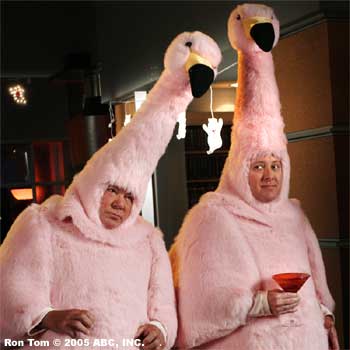
I won't lie: I hated the show. As much as I enjoy William Shatner (where do you think the nickname "Flamingo" comes from?), and as much as I appreciate Josh Halpern's story as a Geek WIN, the episode we watched embodied everything that is sad, old, and irrelevant about network television. Here they had an opportunity to tap into a built-in audience that has been steadily abandoning their medium, and they've blown it by serving up the kind of warm BLEEP that drove us away in the first place.
What would I have done differently?
Well, for one thing, I would have built the series around the central character of that twenty-something guy forced to move back in with his dad, and made it into a one-camera exploration of his life. Show the guy struggling with his problems and using Twitter as an outlet. Show the family reacting and trying to understand what the buzz is all about. Show the ways this unexpected fame changes his world.
There is a lot of risk in making a half-hour comedy like that, but it has been done well before. This show could have been Arrested Development - instead, it was Silver Spoons. I can't explain Twitter, but I can tell you that it has become popular because we-the-people are intensely interested in ourselves. Shitmydadsays became viral and popular because we are intensely amused by profanity and self-effacement. If you're going to take on the risk of buying a show built on the word "Shit", you should be willing to take on the risk of letting it be good by building on those things that made it strong in the first place.
But I realize it's hard to do that. When you're sitting in the makeup chair, you don't know what your face is going to look like to those in the audience. How much "realism" can you get away with? What should you emphasize, what should you hide? On television, all of that is decided for us, taking the point and the relevance away from us. On the internet, we decide what we want to show and what we want to see - not to mention when we want to see it.
And that is the difference between Bleep and Shit.
Thursday, November 4, 2010
The Party of NOvember
So, the Republicans made historic gains (as was more or less predicted four and two years ago, respectively) and the pendulum swings back to the so-called "right"... like clockwork. And yet, there is still hope in the world. What makes me say that? A few encouraging signs:
Michigan elected a centrist coalition builder to their governor's mansion.
Crazy did NOT win in Nevada or Delaware. (UPDATE: What the Tea Party Cost by David Frum)
The GOP (mostly) didn't gloat.
There are certainly a lot of things we're all going to differ over, but I'm looking forward to having a Speaker of the House who uses Twitter effectively.
And while the Republicans have vowed to waste everyone's time trying to repeal the Health Care Reform bill, I think the fact that so few of the Tea Party candidates got in (and those who did, like Rand Paul, seem to already be co-opted by the Establishment) that there won't be as much danger of that actually happening. In fact, the impression I have from the news I have not been able to avoid is that the nation didn't get yanked as far to the so-called "right" as we were led to believe it would be. It might just be the case that enough of these new Republican representatives will turn out to be ... drum roll... pragmatic moderates who want to get things done! Maybe even some of these things:
I'd like to see Energy dealt with; take the big Government subsidies away from oil exploration and put it toward developing solar panels that don't use rare-earth elements.
I'd love to see Immigration Reform - only this time, it will let good folks who are already integral members of our community "get legal".
I'd love to see our Defense dollars go toward actual training and equipment for our troops and not toward sweetheart deals that pay too much for not enough support.
And since it wouldn't be right to let this go unsaid: which do you think is money spent more wisely? A failed campaign for Governor of California, or the entire budget of the National Endowment for the Arts. (I can tell you which one will last longer.)
Maybe we'll even start to figure out that money isn't the solution to every problem; work, thought, and practical effort are.
Michigan elected a centrist coalition builder to their governor's mansion.
Crazy did NOT win in Nevada or Delaware. (UPDATE: What the Tea Party Cost by David Frum)
The GOP (mostly) didn't gloat.
There are certainly a lot of things we're all going to differ over, but I'm looking forward to having a Speaker of the House who uses Twitter effectively.
And while the Republicans have vowed to waste everyone's time trying to repeal the Health Care Reform bill, I think the fact that so few of the Tea Party candidates got in (and those who did, like Rand Paul, seem to already be co-opted by the Establishment) that there won't be as much danger of that actually happening. In fact, the impression I have from the news I have not been able to avoid is that the nation didn't get yanked as far to the so-called "right" as we were led to believe it would be. It might just be the case that enough of these new Republican representatives will turn out to be ... drum roll... pragmatic moderates who want to get things done! Maybe even some of these things:
I'd like to see Energy dealt with; take the big Government subsidies away from oil exploration and put it toward developing solar panels that don't use rare-earth elements.
I'd love to see Immigration Reform - only this time, it will let good folks who are already integral members of our community "get legal".
I'd love to see our Defense dollars go toward actual training and equipment for our troops and not toward sweetheart deals that pay too much for not enough support.
And since it wouldn't be right to let this go unsaid: which do you think is money spent more wisely? A failed campaign for Governor of California, or the entire budget of the National Endowment for the Arts. (I can tell you which one will last longer.)
Maybe we'll even start to figure out that money isn't the solution to every problem; work, thought, and practical effort are.
Sunday, October 24, 2010
What Really Happened to Calvin & Hobbes
When Bill Watterson retired from writing the Calvin & Hobbes comic strip on December 31, 1995, I was just one of the millions of people who were heartbroken.
In his biography of Watterson, "Looking for Calvin and Hobbes: The Unconventional Story of Bill Watterson and his Revolutionary Comic Strip", Nevin Martell tells us what we already knew: I was not alone in that state. But in reading this book, I discovered something that hadn't ever occurred to me before about Watterson's retirement. This discovery hit me between the eyes as I read about Watterson's life, and saw the interviews recounted by Martell; it wasn't just a discovery about Watterson, or about myself, but about all of us.
What I discovered was what Bill Watterson tried to tell us, both before and after he left us behind and went off to do whatever it is that he's doing now.
Chances are that you found Calvin and Hobbes to be a deeply resonant piece of American art. It wasn't just funny, or "sweet", or merely entertaining - it was important to us. His biographer moans about how difficult it is to "track down" the elusive artist, but Watterson's work gave us everything he wanted to say to us about himself, and we loved it. This comic strip is one of the few things that people say they love that they truly DO feel love for. It's one of those few things that we can all instantly picture or can retell to our friends. I've been an office worker my entire adult life, and of all the comic strips hung on walls or doors, Calvin & Hobbes is the only one I have seen in *every* office (even some where such personalizations were strictly forbidden).
And this is as true in 2010 as it was in 1995... all without much in the way of promotion or marketing.
A lot of people may remember Watterson's position on licensing; for those who don't, I can tell you that Mr. Martell does a great job of conveying it through Watterson's words, and through the words of his publishing syndicate. I know I have always felt a little disappointed that there is no C&H merch to be had anywhere; no key chains, no magnets, no plush toys or plastic figurines. And even before picking up this book, I knew as well as anyone that there were literally millions of dollars to be made from such licensing.
A comic strip "Garfield", by comparison, makes literally Billions of dollars from sales, licensing, endorsements, movies ... the list goes on. Martell talks a bit about that, too, to give us an idea of the level of industry that can be generated around a strip, and to give us an idea of the amount of pressure on Watterson to take this path. All of the "big name" strips have some level of this going on... But when was the last time you bothered reading a Garfield comic strip? Or any of the Brand Name strips, really. Did you laugh? Smile? Remember anything about it after putting it back down?
Watterson tried to tell us how he felt about all of this, and he was nearly universally criticized for it. He told us through interviews, in the strip itself, and in one of the rare speaking appearances he made before going into self-imposed exile. Whether the criticism came from other comics writers snubbed by his words, or from would-be marketers wishing he'd let Calvin hawk cereal or allow Hobbes's face on a line of kid's underwear, or even from casual fans like myself who thought they'd look witty and cool with Calvin's class photo pictures on a t-shirt - no one really understood that Watterson had a very clear idea of the gift he wanted to give to us. More importantly (and more to the point of posting this blog): no one understood what he wanted in return.
Bill Watterson only wanted to write his comic strip, and be successful enough at it to support his family.
But, you will argue, why couldn't he do that AND give permission so we could have all the stuff, too? The answer to this is the epiphany I had reading this book. I have written before about how the internet is changing our economy, and have spoken privately to my friends about the ways in which I feel our hyper-marketing "free" market system destroys the very things we find to be of value.
Some of you have heard me talk anecdotally about how hard it is for us to find products that we can all eat (due to allergies) or fruit juices that have actual fruit in them. There are multiple movies and books available to describe the ways the food industry corrupts the products we try to buy in the name of efficiency and "broad appeal". And we all know how often (and awfully) it happens in the entertainment business - do I need to queue up some Disney sequels or the Star Wars Christmas Special?
It was Watterson's personal and professional integrity and his complete focus on and control over his strip that made it what it was. And he was right that industrializing it would have destroyed it.
Our obsessions with celebrity are not news. The desire of industry to exploit that obsession is not news. Even the story of someone trying to avoid the corrosive influence of fame and money is not news. Kurt Cobain put a shotgun in his mouth in 1994 for the same reasons that Bill Watterson cited when he walked away from his world renowned comic strip, and many of us shrugged and said, he's just another spoiled rock star. So where's the "so what" in this? What's the big lesson?
The lesson is that it can be done. Watterson did exactly what he wanted to do with his life: he gave us 10 years of top-notch art, in daily 3-panel and weekly 9-panel installments. He changed us; he affected us; and, as friends often do, he moved on to do something else.
Bill Watterson achieved the real American dream. He did it with class and grace, said thank you, and then walked away. He never exploited us, nor has he allowed anyone else to do so. And when the world sat at his feet begging him to take millions of dollars more to keep going - he knew that doing so would be a lie and a cheat. It wasn't what he wanted to do, and I have no doubt that if I sat at my desk sticking pens into my Hobbes(tm) pencil sharpener, I would not be any happier than I am when I find a copy of "Something Under the Bed Is Drooling" tucked under my kid's pillow.
There are two ways to lose your dream. One is to try and fail; the other is to succeed so wildly that you destroy everything you wanted in the process. I'm glad that Bill Watterson got his dream; and I'm grateful for the 3,160 dreams that we got from him.
We need to learn to be happy with enough.
In his biography of Watterson, "Looking for Calvin and Hobbes: The Unconventional Story of Bill Watterson and his Revolutionary Comic Strip", Nevin Martell tells us what we already knew: I was not alone in that state. But in reading this book, I discovered something that hadn't ever occurred to me before about Watterson's retirement. This discovery hit me between the eyes as I read about Watterson's life, and saw the interviews recounted by Martell; it wasn't just a discovery about Watterson, or about myself, but about all of us.
What I discovered was what Bill Watterson tried to tell us, both before and after he left us behind and went off to do whatever it is that he's doing now.
Chances are that you found Calvin and Hobbes to be a deeply resonant piece of American art. It wasn't just funny, or "sweet", or merely entertaining - it was important to us. His biographer moans about how difficult it is to "track down" the elusive artist, but Watterson's work gave us everything he wanted to say to us about himself, and we loved it. This comic strip is one of the few things that people say they love that they truly DO feel love for. It's one of those few things that we can all instantly picture or can retell to our friends. I've been an office worker my entire adult life, and of all the comic strips hung on walls or doors, Calvin & Hobbes is the only one I have seen in *every* office (even some where such personalizations were strictly forbidden).
And this is as true in 2010 as it was in 1995... all without much in the way of promotion or marketing.
A lot of people may remember Watterson's position on licensing; for those who don't, I can tell you that Mr. Martell does a great job of conveying it through Watterson's words, and through the words of his publishing syndicate. I know I have always felt a little disappointed that there is no C&H merch to be had anywhere; no key chains, no magnets, no plush toys or plastic figurines. And even before picking up this book, I knew as well as anyone that there were literally millions of dollars to be made from such licensing.
A comic strip "Garfield", by comparison, makes literally Billions of dollars from sales, licensing, endorsements, movies ... the list goes on. Martell talks a bit about that, too, to give us an idea of the level of industry that can be generated around a strip, and to give us an idea of the amount of pressure on Watterson to take this path. All of the "big name" strips have some level of this going on... But when was the last time you bothered reading a Garfield comic strip? Or any of the Brand Name strips, really. Did you laugh? Smile? Remember anything about it after putting it back down?
Watterson tried to tell us how he felt about all of this, and he was nearly universally criticized for it. He told us through interviews, in the strip itself, and in one of the rare speaking appearances he made before going into self-imposed exile. Whether the criticism came from other comics writers snubbed by his words, or from would-be marketers wishing he'd let Calvin hawk cereal or allow Hobbes's face on a line of kid's underwear, or even from casual fans like myself who thought they'd look witty and cool with Calvin's class photo pictures on a t-shirt - no one really understood that Watterson had a very clear idea of the gift he wanted to give to us. More importantly (and more to the point of posting this blog): no one understood what he wanted in return.
Bill Watterson only wanted to write his comic strip, and be successful enough at it to support his family.
But, you will argue, why couldn't he do that AND give permission so we could have all the stuff, too? The answer to this is the epiphany I had reading this book. I have written before about how the internet is changing our economy, and have spoken privately to my friends about the ways in which I feel our hyper-marketing "free" market system destroys the very things we find to be of value.
Some of you have heard me talk anecdotally about how hard it is for us to find products that we can all eat (due to allergies) or fruit juices that have actual fruit in them. There are multiple movies and books available to describe the ways the food industry corrupts the products we try to buy in the name of efficiency and "broad appeal". And we all know how often (and awfully) it happens in the entertainment business - do I need to queue up some Disney sequels or the Star Wars Christmas Special?
It was Watterson's personal and professional integrity and his complete focus on and control over his strip that made it what it was. And he was right that industrializing it would have destroyed it.
Our obsessions with celebrity are not news. The desire of industry to exploit that obsession is not news. Even the story of someone trying to avoid the corrosive influence of fame and money is not news. Kurt Cobain put a shotgun in his mouth in 1994 for the same reasons that Bill Watterson cited when he walked away from his world renowned comic strip, and many of us shrugged and said, he's just another spoiled rock star. So where's the "so what" in this? What's the big lesson?
The lesson is that it can be done. Watterson did exactly what he wanted to do with his life: he gave us 10 years of top-notch art, in daily 3-panel and weekly 9-panel installments. He changed us; he affected us; and, as friends often do, he moved on to do something else.
Bill Watterson achieved the real American dream. He did it with class and grace, said thank you, and then walked away. He never exploited us, nor has he allowed anyone else to do so. And when the world sat at his feet begging him to take millions of dollars more to keep going - he knew that doing so would be a lie and a cheat. It wasn't what he wanted to do, and I have no doubt that if I sat at my desk sticking pens into my Hobbes(tm) pencil sharpener, I would not be any happier than I am when I find a copy of "Something Under the Bed Is Drooling" tucked under my kid's pillow.
There are two ways to lose your dream. One is to try and fail; the other is to succeed so wildly that you destroy everything you wanted in the process. I'm glad that Bill Watterson got his dream; and I'm grateful for the 3,160 dreams that we got from him.
We need to learn to be happy with enough.
Saturday, October 9, 2010
A Decent Man I Happened to Disagree With
A few weeks ago, a Facebook friend described George W. Bush to me as "a decent man you just happen to disagree with politically."
I would tend to describe just about anyone in our elected government that way - though their "decency" may be a fragile thing at times. But her dismissal of the very real problems that I had (and still have) with the Bush Administration bothered me, and I wanted to find a way to address them without being snarky or simply argumentative. Contrary to the picture some of my friends like to paint of me, I never "hated" George W. Bush. I think it's important to remind people of that, but it's hard to separate my strong disagreement with the things he did from the man himself.
Today, that same friend posted this video, which gave me something direct to address:
Since Mr. Bush laid out the points that he seems to think are most important, and capture the best snapshot of his terms in office, I'd like to address them - Point by point:
Quitting drinking at age 40 - this is, of course, an admirable thing to do. It shows a strength of character, and he clearly relied on his strong relationship with his wife and his faith in Jesus to make this change and make it stick. From where I sit, I can see that he essentially replaced the crutch of alcohol with the crutch of his relgion.
That's fine in and of itself - I'm a big proponent of letting damaged people use the tools they need to use to overcome their shortcomings. I also disagree with those who say that a President should not wear his faith on his sleeve the way Mr. Bush often did; if it is truly a part of you, your faith should not be something you hide or avoid mentioning. My only "disagreement" with Mr. Bush's religion is that it is not right for me, and there are other Points where it affected his Decisions in ways that it should not have done.
Running for President - When Mr. Bush ran for President, I was a tired, shift-working burnout serving in the USAF in England. As a distant ex-pat grappling with how I felt about Libertarianism, and wearied by years of anti-Clinton rhetoric, I wasn't ready to vote for the Republican party's theory of "reducing government", but I figured that it would either be a) successful, and therefore worthy of consideration, or b) a failure which might prod the country in a more Centrist direction.
Later, I read about Karl Rove's underhanded tactics (told from John McCain's POV in David Foster Wallace's "Up, Simba" essay), and the cutthroat dishonesty that Mr. Bush engaged in to get the GOP nomination; it was an illuminating discovery, but by then, of course, the damage was done. None of it was, technically, "illegal", but it was dodgy, and I recognized enough of the same in 2004 to be doubly angry at our so-called "two party" system.
But you can't deny that the American populace finds the idea of an affable "good ol' boy" to be appealing, and W. was thoroughly qualified to play that part.
Selecting senior staff - I allowed myself to be optimistic in 2001 when Gen. Colin Powell was added to the Bush team. Never mind that he was one voice among a dozen others that included already-discredited former Defense Secretaries Donald Rumsfeld and Dick Cheney (an essay for another day, I'm afraid). Never mind that Karl Rove was already known as "Bush's Brain" and that Grover Norquist - the man who said "My goal is to cut government...down to the size where we can drown it in the bathtub. " - was planning the destruction of the American government from within.
After Gen. Powell's UN speech and Mr. Cheney's dishonest tactics in coralling U.S. Congressional votes, it became clear which "half" of the staff was in charge of these important Decision Points.
Education reform - "No Child Left Behind" is often touted as the Bush Administration's one success. Holding teachers accountable for their students' performance and breaking the Unions' death grip on any reform effort are both admirable goals, in my opinion. But as a single "success" it is hardly compelling.
Over the years, I have asked everyone I find who liked and supported Mr. Bush to tell me what else he accomplished. So far, no one has come up with an answer.
Stem Cell research - This is not a debate I enjoy. Finding a legal precedent for the beginning of human life is emotionally wrenching, and the impact of the decision on other lives is horrifying, no matter which way it falls. The only thing in this debate - like the debate over the legality of abortion - which seems certain is that the law must either trust individual doctors and women to make the right decision in each case, or must arbitrarily decide in advance what that "right decision" is, and find a way to intrusively enforce it.
It's a lose-lose situation.
9/11 - There was a moment after the attacks when all Americans were on the same page, and felt the same way. For me, that ended on 9/15/2001, when Defense Secretary Rumsfeld announced (without any evidence) that he intended to get revenge on Saddam Hussein for the attacks. I can't find a reference to that speech, but CBS dug up notes that were more revealing in 2002.
The following points Mr. Bush mentioned in his video all stem from bad decisions made at the urging of his most trusted advisors. Going into combat was debatably the correct move in Afghanistan, but not in Iraq. The lasting debacle that is Homeland Security is a testament to the kind of "big government" that Mr. Bush was elected to bring down, and while in the context of "winning" (an idea that was never defined or given a tangible goal) in Iraq the Troop Surge was the right decision, it would not have been necessary if not for the earlier mistake of invading Iraq in the first place.
Re-election - 2004 was a frustrating time for me. Everything I had seen the Bush Administration do to that point told me that the next four years would be equally, if not more awful. And yet, when the Democrats handed us the turd sandwich that was John Kerry, and the American people failed to demand a third option that wasn't on the menu, I began grasping for hope. In the debates, Kerry dismantled Bush point by point, while perversely making him look like the better candidate; Bush spoke of love for each other and our fellow man, and actually gave me a glimmer of hope that his second term would be marked by humility and compassion.
It wasn't.
Tax cut plan - When we got our check - which my lovely bride still refers to as our "Dirty Bush money" - we had to ask: where does this money come from? Did it come out of the welfare checks that would have gone to the "welfare queens" that conservatives hate so? Nope; they're still ahead of us in line at the grocery store buying foods we can't afford. Did it come from subsidies that we shouldn't be paying for "oil exploration" or for small farmers - like ConAgra?
Apparently it came from all of those places where you don't see spending happening; roads, bridges, schools, state and local services, and infrastructure.
At least we got a big screen TV out of the deal, right?
Global AIDS initiative - This really does seem to be a success; at least the 1.7 million Africans benefiting from it might think so. What I find interesting is that no one seems to think of it when they talk about Mr. Bush's successes. Obviously, his opponents wouldn't want to admit that it's a Good Thing(tm)... but it's worth wondering why his supporters wouldn't tout it more loudly.
Unless it simply goes against everything they believe in; tax dollars going to save the lives of brown people in foreign lands without any discernable profit to the U.S.
Mr. Bush: I applaud you for this success.
Then there are the areas where Mr. Bush regrets his failings:
Social Security - I've written and spoken many times about how I agreed with Mr. Bush's approach to this, and how it bears a more rational look from all sides.
Immigration - This, too, is often overlooked as part of the Bush Administration's plans. A real Comprehensive Immigration Reform which would welcome those who want to become a legitimate part of our Dream, and find ways to secure our border against criminals, thugs, and smugglers is still needed. I still hope that we'll be able to look past our racist and nationalistic instincts, and past our petty desire for some kind of "justice" against those who have committed a relatively minor crime, and come up with a solution.
Katrina - This was a difficult issue for everyone. On the one hand, the U.S. President doesn't control the weather, and obviously can't be expected to anticipate every emergency that crops up. Personally, I ignored a lot of the criticism of the immediate response from the White House because so much of it seemed to come from political animosity and misdirected fear; at the same time, there were a lot of bad things that happened or didn't happen because the government was unable to perform its mission.
I saw Katrina as a symptom of the success of Grover Norquist's goal to reduce the government to something that could be drowned in a bathtub. New Orleans showed us that a bathtub is the least of our worries. If we don't invest in public infrastructure, and ensure that the organizations that oversee its maintenance are kept up to date and efficiently managed, we could all end up in a similar situation. There is no way to know in advance whether it will be a hurricane, an earthquake, wildfires, or some other disaster. Global Climate Change scientists have been warning for decades that storms and weather patterns will become more severe AND more unpredictable. Without good government, we will be unprotected.
Katrina did not show me that the Bush Administration was "bad"; it showed me that good government is important.
"...Putting ideology aside" during 2008 economic crisis - This is a point where I agree with Mr. Bush. I agree with him wholeheartedly that the ideology he espoused did not have the answers needed to protect us from the economic crisis. He may not be willing to admit it - his GOP successors certainly don't - but the ideology of "unregulated financial products" that he championed throughout his presidency caused the crisis, just as clearly as uncontrolled speculation caused the 1929 crash.
Thanks to Annie for posting Mr. Bush's video. I intend to read his book, and if moved to do so, may write about it. But I am grateful that Mr. Bush was able to lay out the points that are important to him. It gave me what I have long needed to help define his presidency, and to rationally describe my reaction to it.
I would tend to describe just about anyone in our elected government that way - though their "decency" may be a fragile thing at times. But her dismissal of the very real problems that I had (and still have) with the Bush Administration bothered me, and I wanted to find a way to address them without being snarky or simply argumentative. Contrary to the picture some of my friends like to paint of me, I never "hated" George W. Bush. I think it's important to remind people of that, but it's hard to separate my strong disagreement with the things he did from the man himself.
Today, that same friend posted this video, which gave me something direct to address:
Since Mr. Bush laid out the points that he seems to think are most important, and capture the best snapshot of his terms in office, I'd like to address them - Point by point:
Quitting drinking at age 40 - this is, of course, an admirable thing to do. It shows a strength of character, and he clearly relied on his strong relationship with his wife and his faith in Jesus to make this change and make it stick. From where I sit, I can see that he essentially replaced the crutch of alcohol with the crutch of his relgion.
That's fine in and of itself - I'm a big proponent of letting damaged people use the tools they need to use to overcome their shortcomings. I also disagree with those who say that a President should not wear his faith on his sleeve the way Mr. Bush often did; if it is truly a part of you, your faith should not be something you hide or avoid mentioning. My only "disagreement" with Mr. Bush's religion is that it is not right for me, and there are other Points where it affected his Decisions in ways that it should not have done.
Running for President - When Mr. Bush ran for President, I was a tired, shift-working burnout serving in the USAF in England. As a distant ex-pat grappling with how I felt about Libertarianism, and wearied by years of anti-Clinton rhetoric, I wasn't ready to vote for the Republican party's theory of "reducing government", but I figured that it would either be a) successful, and therefore worthy of consideration, or b) a failure which might prod the country in a more Centrist direction.
Later, I read about Karl Rove's underhanded tactics (told from John McCain's POV in David Foster Wallace's "Up, Simba" essay), and the cutthroat dishonesty that Mr. Bush engaged in to get the GOP nomination; it was an illuminating discovery, but by then, of course, the damage was done. None of it was, technically, "illegal", but it was dodgy, and I recognized enough of the same in 2004 to be doubly angry at our so-called "two party" system.
But you can't deny that the American populace finds the idea of an affable "good ol' boy" to be appealing, and W. was thoroughly qualified to play that part.
Selecting senior staff - I allowed myself to be optimistic in 2001 when Gen. Colin Powell was added to the Bush team. Never mind that he was one voice among a dozen others that included already-discredited former Defense Secretaries Donald Rumsfeld and Dick Cheney (an essay for another day, I'm afraid). Never mind that Karl Rove was already known as "Bush's Brain" and that Grover Norquist - the man who said "My goal is to cut government...down to the size where we can drown it in the bathtub. " - was planning the destruction of the American government from within.
After Gen. Powell's UN speech and Mr. Cheney's dishonest tactics in coralling U.S. Congressional votes, it became clear which "half" of the staff was in charge of these important Decision Points.
Education reform - "No Child Left Behind" is often touted as the Bush Administration's one success. Holding teachers accountable for their students' performance and breaking the Unions' death grip on any reform effort are both admirable goals, in my opinion. But as a single "success" it is hardly compelling.
Over the years, I have asked everyone I find who liked and supported Mr. Bush to tell me what else he accomplished. So far, no one has come up with an answer.
Stem Cell research - This is not a debate I enjoy. Finding a legal precedent for the beginning of human life is emotionally wrenching, and the impact of the decision on other lives is horrifying, no matter which way it falls. The only thing in this debate - like the debate over the legality of abortion - which seems certain is that the law must either trust individual doctors and women to make the right decision in each case, or must arbitrarily decide in advance what that "right decision" is, and find a way to intrusively enforce it.
It's a lose-lose situation.
9/11 - There was a moment after the attacks when all Americans were on the same page, and felt the same way. For me, that ended on 9/15/2001, when Defense Secretary Rumsfeld announced (without any evidence) that he intended to get revenge on Saddam Hussein for the attacks. I can't find a reference to that speech, but CBS dug up notes that were more revealing in 2002.
The following points Mr. Bush mentioned in his video all stem from bad decisions made at the urging of his most trusted advisors. Going into combat was debatably the correct move in Afghanistan, but not in Iraq. The lasting debacle that is Homeland Security is a testament to the kind of "big government" that Mr. Bush was elected to bring down, and while in the context of "winning" (an idea that was never defined or given a tangible goal) in Iraq the Troop Surge was the right decision, it would not have been necessary if not for the earlier mistake of invading Iraq in the first place.
Re-election - 2004 was a frustrating time for me. Everything I had seen the Bush Administration do to that point told me that the next four years would be equally, if not more awful. And yet, when the Democrats handed us the turd sandwich that was John Kerry, and the American people failed to demand a third option that wasn't on the menu, I began grasping for hope. In the debates, Kerry dismantled Bush point by point, while perversely making him look like the better candidate; Bush spoke of love for each other and our fellow man, and actually gave me a glimmer of hope that his second term would be marked by humility and compassion.
It wasn't.
Tax cut plan - When we got our check - which my lovely bride still refers to as our "Dirty Bush money" - we had to ask: where does this money come from? Did it come out of the welfare checks that would have gone to the "welfare queens" that conservatives hate so? Nope; they're still ahead of us in line at the grocery store buying foods we can't afford. Did it come from subsidies that we shouldn't be paying for "oil exploration" or for small farmers - like ConAgra?
Apparently it came from all of those places where you don't see spending happening; roads, bridges, schools, state and local services, and infrastructure.
At least we got a big screen TV out of the deal, right?
Global AIDS initiative - This really does seem to be a success; at least the 1.7 million Africans benefiting from it might think so. What I find interesting is that no one seems to think of it when they talk about Mr. Bush's successes. Obviously, his opponents wouldn't want to admit that it's a Good Thing(tm)... but it's worth wondering why his supporters wouldn't tout it more loudly.
Unless it simply goes against everything they believe in; tax dollars going to save the lives of brown people in foreign lands without any discernable profit to the U.S.
Mr. Bush: I applaud you for this success.
Then there are the areas where Mr. Bush regrets his failings:
Social Security - I've written and spoken many times about how I agreed with Mr. Bush's approach to this, and how it bears a more rational look from all sides.
Immigration - This, too, is often overlooked as part of the Bush Administration's plans. A real Comprehensive Immigration Reform which would welcome those who want to become a legitimate part of our Dream, and find ways to secure our border against criminals, thugs, and smugglers is still needed. I still hope that we'll be able to look past our racist and nationalistic instincts, and past our petty desire for some kind of "justice" against those who have committed a relatively minor crime, and come up with a solution.
Katrina - This was a difficult issue for everyone. On the one hand, the U.S. President doesn't control the weather, and obviously can't be expected to anticipate every emergency that crops up. Personally, I ignored a lot of the criticism of the immediate response from the White House because so much of it seemed to come from political animosity and misdirected fear; at the same time, there were a lot of bad things that happened or didn't happen because the government was unable to perform its mission.
I saw Katrina as a symptom of the success of Grover Norquist's goal to reduce the government to something that could be drowned in a bathtub. New Orleans showed us that a bathtub is the least of our worries. If we don't invest in public infrastructure, and ensure that the organizations that oversee its maintenance are kept up to date and efficiently managed, we could all end up in a similar situation. There is no way to know in advance whether it will be a hurricane, an earthquake, wildfires, or some other disaster. Global Climate Change scientists have been warning for decades that storms and weather patterns will become more severe AND more unpredictable. Without good government, we will be unprotected.
Katrina did not show me that the Bush Administration was "bad"; it showed me that good government is important.
"...Putting ideology aside" during 2008 economic crisis - This is a point where I agree with Mr. Bush. I agree with him wholeheartedly that the ideology he espoused did not have the answers needed to protect us from the economic crisis. He may not be willing to admit it - his GOP successors certainly don't - but the ideology of "unregulated financial products" that he championed throughout his presidency caused the crisis, just as clearly as uncontrolled speculation caused the 1929 crash.
Thanks to Annie for posting Mr. Bush's video. I intend to read his book, and if moved to do so, may write about it. But I am grateful that Mr. Bush was able to lay out the points that are important to him. It gave me what I have long needed to help define his presidency, and to rationally describe my reaction to it.
Subscribe to:
Posts (Atom)