Monday, February 4, 2019

Badass Abolitionists

When I was a kid, I had the whole set of ValueTales books - a series that paired up historical figures with a cartoon sidekick and told their life story in a way that emphasized values, like "Determination" or "Respect."

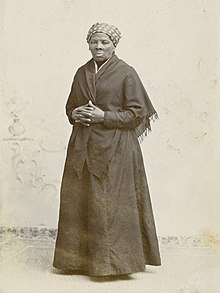
The figure they chose to highlight the value of "Helping" was Harriet Tubman. If you don't already know her story, she was an escaped slave who became a "conductor" on the Underground Railroad. After serving as a soldier, spy, cook, and nurse in the Union Army during the Civil War, she continued to fight for equal rights and for women's suffrage until her death in 1913.

Tubman, c. 1855
(Wikipedia)
Because I knew Harriet's story at an early age, I was proud and excited to learn about my own family's connection to the Underground Railroad - even though Great-Uncle George's farm was nowhere near where the famous "Moses" led her people out of the South.

Of course, I also noticed from an early age how wrong it sounded whenever someone would talk about Abraham Lincoln "giving the slaves their freedom." Nobody gave freedom to Harriet Tubman - she fought for it. As did thousands of others. Sojourner Truth, Frederick Douglas - enough amazing people to keep a blog like this going for centuries, if we wanted to tell every individual story.

The truth was that Lincoln himself was a reluctant late-comer when it came to the ending of slavery. And without the decades of hard work and resistance of people like Harriet Tubman, before and after his famous proclamation, who knows how long it would have been perpetuated?


Harriet Tubman is featured on Black History Flashcard #22, from Vol. 2: Women of Urban Intellectuals' series of educational flashcards. You can help support my writing AND the mission to give educators better tools for teaching kids about these important people from our history if you visit Urban Intellectuals and get a set (or four) of flashcards for yourself!

Vol. 2: Women also features Sojourner Truth (Flashcard #47) and 50 other amazing women of color. I'll be featuring more of my personal favorites during the month of February.


Friday, February 1, 2019

Me and Black History


In 1974, when I was barely two years old, my mother bought a record: the soundtrack to the motion picture The Sting. I grew up hearing that music, particularly the movie's theme song, The Entertainer, by Scott Joplin. I would argue that with the possible exception of B.J. Thomas's Oscar-winning recording of Raindrops Keep Falling On My Head* (from Butch Cassidy and the Sundance Kid), The Entertainer was my "first song."

When you're a kid, you don't know how significant the things in your life really are, because to a kid, every new thing is significant. I didn't know that my foundational musical experiences were being shaped by Paul Newman/Robert Redford buddy-movie soundtracks. I just knew I liked these songs, and it made my mom happy when I sang them and tried to play them on a plastic toy guitar.

As I grew up, of course, I learned what "ragtime" was. I began to study music and the history of music, and of course, I picked up on the ways the music I loved most was based on traditions and ideas that came from black people. I remember learning about the ways that black musicians - particularly blues musicians - found their music being borrowed, "sanitized," and turned into the multi-billion-dollar juggernaut that is Rock-n-Roll without getting anywhere near the recognition or financial reward that their white imitators got. I suppose that pattern came up often enough that when people talked about ragtime and the music of Scott Joplin, I just assumed that his was that same kind of story.

Since his music was associated in my mind with Paul Newman, Robert Redford, and B.J. Thomas, it was easy for me to assume that Scott Joplin had taken black music and popularized it, as others have done time and again. It just never occurred to be to be curious about who Scott Joplin was or what his story was, because his name and his music had been in my head for as long as language and memory could take root.

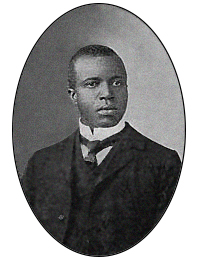
So last year, when the subject of Ragtime came up in my History of Music in the U.S. class, it was an odd sort of shock to see a picture of Scott Joplin for the first time:


Until I was in my forties, I did not know that Scott Joplin was black.

Knowing this changes nothing about how I feel about the music. In a world that was as egalitarian and democratic as ours claims to be, this demographic note would probably not register as an important detail. But for me, the fact that I made it through more than forty-five years without knowing this plain fact about one of the first composers I was exposed to was a revelation about representation and visibility.

The concept of erasure - or, as the New York Times Magazine defines it, "the practice of collective indifference that renders certain people and groups invisible" - is something I've always been half-aware of. It's that indifference that keeps people from speaking up when some guy at a party claims that the reason there aren't more female comedians is because women aren't funny. It's that indifference that allows an elected official who thinks that only white people should be credited with the success of Western civilization to be re-elected.

Countering that kind of claim is not hard to do, assuming you have the least amount of curiosity in the subject being spouted off about. If someone tried to claim that black people have made no contribution to Western Culture it wouldn't be hard for me to poke huge holes in that claim even without citing Scott Joplin, but it says something about the larger trend of our cultural experience that even someone like me - a very curious person with a history of scholarly inquiry into these matters - can fall victim to that collective indifference.

The shock I felt upon learning Joplin's ethnicity came from realizing that I had been so incurious about Scott Joplin, I effectively rendered one of my earliest cultural influences invisible. I want to reverse that trend.

To that end, I've planned out a small series of posts like this one that will talk about specific people from marginalized groups who have been important to me, personally. I'm launching this during Black History Month because this past holiday break was the first time I had a chance to work on this, and this seemed like the kind of thing that Black History Month was created for! (I'm sure it's just a coincidence that the tradition is about the same age as me.)

Some of these stories will be about people who, like Scott Joplin, affected me in my childhood; some will be about people I've only discovered because I'm actively seeking them out now. Some will be heroes, some will be villains, and some will be people I don't like. (The Venn diagram of those three groups may be different for you than they are for me.)

My agenda here is not to call anyone out or make anyone feel bad about not knowing these things. Quite the opposite: it's to show how flawed I am, and to make a public attempt to address the flaws.

More than anything else, my hope is to introduce you to something that gives me joy - the joy of being curious.

Thursday, July 12, 2018

On A Mission From God

This past semester, I took History of Music in the U.S. with Dr. David Cosper at Towson University. For your enjoyment, here is my final argument essay from that course. 


The setting is Maxwell Street, on the near West Side of Chicago, a street long known for its open-air markets and for being the birthplace of Chicago Blues. During the 1930s and 1940s, many black musicians arrived in Chicago from the segregated South and found that their traditional instruments were not loud enough to be heard over the crowd and the street noise. They began to adopt electrically amplified instruments, powered by extension cords provided by local business owners keen on attracting the business of people coming to hear the blues music being played on their street (Smith).

The scene shows an older black man with an electric guitar and a deep, powerful voice, performing with his band for an admiring crowd. Two white men, one tall and one stout, both wearing black suits, black hats, and dark sunglasses, stop and watch for a moment. The tall one says simply, “Yep,” before exchanging a nod with the singer and moving on with his brother into the restaurant behind them.

The white men were Jake and Elwood Blues, the Blues Brothers, played by John Belushi and Dan Aykroyd in the 1980 film of that name. The guitar player leading the street band (billed as the “Maxwell Street Musicians”) was John Lee Hooker, who made his name in the 1950s and 1960s by developing his own style of boogie-woogie rhythm based on the country Delta Blues he grew up with.

The scene consists almost entirely of Hooker’s performance and runs less than 3 minutes within a two and a quarter hour long movie. The dialogue is both minimal and completely unnecessary to the plot of the film, but that moment encapsulates the intended spirit of The Blues Brothers. Aykroyd, whose love of blues music was described as “somewhere between encyclopedic and monomaniacal,” wrote the movie, and introduced the music to Belushi, with whom he created the act (Vanity Fair). It was Aykroyd who said of the blues musicians who inspired him and the clubs that featured them, "I want people to fill their showrooms and bars and buy their records. That's my mission" (Newbart).

Upon its release in 1980, the film met with a now-familiar mix of criticism and enthusiasm. Critics panned some of the excessive and disorganized elements of the plot while praising some of the individual performances. Pauline Kael criticized the casting of Cab Calloway as a janitor, Aretha Franklin as a waitress in a soul food restaurant, and James Brown as a preacher who tears the church apart with his sermonizing and dancing as “some-what patronizing.” And Jim O'Neal, who founded Living Blues magazine in Chicago in 1966, said that while the movie "was one of the factors that contributed to a blues boom" in the 1980s, it also contributed to the “image of blues bands to many people [as] two white guys in hats” (Newbart).

The harshest criticism suggests that the Blues Brothers act is a form of blackface minstrelsy, in which white performers make money by mimicking black people. Adam Gussow, an English graduate student at Princeton University studying post-Civil War American culture contends that the Blues Brothers’ act played up the idea that “blues is good-time party music." Gussow says, "They were responsible for re-creating blues as that. Blues has always been partly good-time party music for the black community -- but that was for the weekend, after a week of working hard under extreme duress” (Knopper).

Defenders of the Blues Brothers tend to argue that Aykroyd’s intentions were to revive the careers of his idols, and they point to the success of the film and albums as evidence that he did so. This defense is difficult to support objectively, at best. Subjectively, Sam Moore, of Sam and Dave, said that the Blues Brothers' chart hit cover version of "Soul Man" did "not a thing" for the original performers. "If anything, believe it or not, it buried us," he said, arguing that people remember the newer version, not the 1967 original (Knopper). And while the film gave John Lee Hooker and Aretha Franklin their first appearances on the big screen, Mike Kappus, Hooker's agent at the time, said Hooker greatly appreciated the high-profile appearance, but "the impact of the movie on his career was almost nonexistent” (Newbart).

Perhaps a better way to frame a defense of the Blues Brothers would be to acknowledge the problematic history of minstrelsy, and to consider the way the individual artists and band members involved in the project were treated, how they felt about their roles, and how their characters were represented in the context of the film. It is also worth considering responses to other projects where prominent white artists hire or feature black artists.

Later in the decade, similar criticism was leveled at Sting when he hired several renowned jazz musicians to play on his first solo album: saxophonist Branford Marsalis, drummer Omar Hakim, bassist Darryl Jones and keyboardist Kenny Kirkland. Marsalis’s brother, trumpeter Wynton Marsalis, accused Branford of selling out and called Sting’s project a stain on jazz; and The Village Voice went so far as to dismiss the album as “Sting Sings With Negroes” in its review (Brogan). According to Sting, “The band made a decision to play with me, and it wasn't just because I was paying well. I think these guys are of such personal and musical stature, they wouldn't want to play with me if they didn't think it was worth doing. I don't see them as my back-up band. ...I felt it was a band.” It would seem that despite the criticism, the musicians agreed on that point. In particular, Kenny Kirkland continued to play on Sting albums until his death in 1996, indicating that he appreciated the collaborative spirit of the work.

In that light, The Blues Brothers could probably be viewed as another form of collaboration, and judged according to how the artists involved felt about it. Since the plot of the movie revolves around “getting the band back together,” it is worth noting the pedigree of the musicians in the band. The core of the rhythm section included Steve Cropper and Donald “Duck” Dunn, both alumni of the Stax record company, which was notable for being an integrated company in Memphis during the 1960s, and for producing and promoting black artists. Cropper and Dunn were members of Booker T and the MGs, as well as regular session players during the first half of Stax’s heyday (Maultsby & Burnim, 136). With Matt Murphy on guitar and Willie Hall on drums, the band was racially integrated, and firmly rooted in a Memphis sound, though with the addition of a New York horn section, and arrangements done by Paul Shaffer, the band had a distinctly upbeat, pop sensibility to it. Aykroyd described them as “a Chicago, electrified, urban blues band, fused with the Memphis Stax/Volt movement” (Kenney, 13:06).

With the band in place behind two white frontmen, the project still had plenty of room for more black performers. The four big stars featured with both speaking cameos and musical numbers backed by the Blues Brothers Band were Cab Calloway, Ray Charles, James Brown, and Aretha Franklin. All four have published autobiographies, as well as having official biographies; it is worth comparing their own thoughts with those of their biographers.

Ray Charles had already published his autobiography the year before the Blues Brothers began filming. His legacy was well-established, and he only briefly referenced the film in the 1992 re-issue of the autobiography. However, his biographer, Michael Lydon, described the 1980s as a low point in which “his invisibility as complete as it would get” (341). The film shoot was an “enjoyable few days” on the South Side of Chicago, in which Aykroyd and Belushi put Charles at ease and romped through his musical number. As the blind proprietor of a music shop who stops a shoplifter with a well-placed pistol round, Ray is portrayed as savvy and in control of his establishment, but generous enough to extend credit to the band so they can pay for their instruments. A fair assessment of the experience might be to say that Charles enjoyed this appearance as important, but considered it a small part of the resurgence of his career that he would stage over the following decade.

James Brown and his biographer agree that his career was also at a low point in 1979 when Brown decided to sue his record company and stage a comeback. Brown concisely stated his opinion about the film and the filmmakers: “People who criticized John and Danny were confused. They didn’t understand that the Blue Brothers were actors pretending to be R&B performers. I know Danny and John themselves weren’t confused about it, and you could tell from the respect they gave the real R&B performers on the movie that they knew what they were doing. They were there for every take I did, and they treated me fantastic” (256).

Brown’s biographer, R.J. Smith, was less generous, quoting Pauline Kael’s line about the casting being “some-what patronizing,” and elaborating that “The script left you wondering if they understood the culture they professed to admire” (328). He also quoted Brown’s bandmates regarding their impressions of the change in their audience that came with the boost from appearing in The Blues Brothers. Trumpet player Hollie Farris noted that “Whites knew who he was, but then they saw him in that movie and decided they wanted to see more of him.” He further commented that “in 1975, it was ninety-nine percent black audiences. And then it started to change, and before you knew it, it was mostly white.” Guitarist Ron Laster joined Brown’s band in 1979, and after playing for a crowd of 54 at New York’s Beacon Theater before the film’s release, he noted that after the film came out, “We would destroy these places because they were so packed, and the girls so close to you. We used to love it, I said love it” (330).

Aretha Franklin was pleased with her role, as were the critics. According to Franklin’s autobiography, she “was relaxed and ready to go. [She] played the part of a loving but agitated wife whose husband is about to abandon her for the Blues Brothers band” (182). Pauline Kael said of Franklin’s performance that “she’s so completely there and so funny as she sings ‘Think’ that she transcends the film’s incompetence.” There was even talk of her being considered for a “Best Supporting Actress” Academy Award nomination (Berg 184).

This talk of an Academy Award may seem far-fetched in the context of a project that is essentially a two-hour Saturday Night Live sketch, but it is worth noting that Franklin’s role seems to call back to one of the original themes of blues music: the woman who is abandoned by her man to fend for herself. Rather than wilting or breaking down, Franklin is shown as strong and able to fend for herself. It is also significant that she is the owner of the restaurant that Matt works in, even if the film’s critics tend to reduce her role there to that of “a waitress” and describe the place as “a greasy coffee shop” or a “hash house.” While it would be wrong to claim that her character breaks with any common stereotypes, the subtexts in the script and her performance combine to present her as a real black woman in a position of relative power and respect in her community. And despite making a firm plea to keep Matt at home with her, she demonstrates both independence and tolerance after he leaves. Later in the film, when the children of the orphanage are deployed by Curtis to hand out signs advertising the show, she rolls her eyes but takes the poster.

Curtis, played by Cab Calloway, is the most interesting character of the four to examine when considering The Blues Brothers as a modern example of “blackface minstrelsy.” From Calloway’s first appearance onscreen, it is clear that Aykroyd is trying to establish some legitimacy for his character by showing Curtis in the same black suit and hat that Jake and Elwood wear. Elwood explicitly says to Curtis that “you and the penguin [the nun who runs the orphanage] are the only family we got, and you’re the only one who was ever good to us” and reminisces about hearing Elmore James records as a kid growing up in the orphanage. It is clear both that Elwood truly reveres his elder influences and that Aykroyd reveres his, and wants to claim their mantle of authenticity.

Calloway, even more so than Ray Charles, had already had a long and storied career. His autobiography was published in 1976, and he described himself as being in “semi-retirement,” stating, “I’m still an active entertainer, but I pick my spots” (244). Calloway had a closer relationship than anyone involved in the Blues Brothers to actual minstrelsy, having originally become a star during the Cotton Club era of the 1920s and 1930s. By 1979, his career had followed the trends to the point that he was performing a disco version of his classic “Minnie the Moocher.” The astounding reception of his classic performance of that song in The Blues Brothers convinced him to abandon the disco version. That success may have had something to do with Calloway’s statement that “The Blues Brothers is the best role I’ve ever had” (Shypton 174).

Yet, as a professional black performer for more than five decades, it is impossible to suggest that Calloway did not recognize the built-in insult of his role in the film. Quoting David Denby in New York Magazine, Calloway’s biography says, “These vaudeville musicals...often featured jazz musicians or black singers and dancers who would never get to star in a movie of their own. ...things haven’t changed that much in 45 years... The great old Cab Calloway...sings “Minnie The Moocher” in white tie and tails, in front of a huge audience, killing time for an impatient crowd while the boys are being chased by the police. Calloway’s smile— the seal of a great entertainer’s joy in giving pleasure— shows up Aykroyd and Belushi’s sullen “cool” for the sophomoric thing it is. Yet what an insulting context for Calloway’s triumph— as a fill-in!” (Shypton 176).

The question this raises is whether Calloway considered what Aykroyd was doing to be respectful or not. Does the fact that he went along with it somehow signify that Calloway considered the project to be one that promoted black artists instead of exploiting them? It may be impossible to say that in an absolute way, but it is certain that Calloway was a pragmatist when it came to race and his career. “I’ve always accepted the fact that I’m Negro. I don’t know anything else. I’ve been kicked in my ass all my life because of it, and, hell, I’ve come through it and become a star. Everybody has got to endure a certain amount of ass kicking to make it. People will step on you as you move along and there’s no way to avoid it. The only difference between a black and a white entertainer is that my ass has been kicked a little more and a lot harder because it’s black.” In the end, whether he was too classy, too kind, or too grateful, Calloway would probably never openly criticize the project--and that says a lot about the perceived power differential between even a beloved black entertainer and the white, mainstream of Hollywood.

Perhaps the best defense of the movie is to compare the black and white characters overall. In general, black people who appear in the movie, whether as characters or extras, are “normal.” They have jobs, they are part of their community, and even when they get pulled into a dance number, they are part of an average, every day, integrated Chicago. Representation of minor characters can be seen in the recurring Chicago police officers with speaking roles who are played by both black and white actors. And as mentioned before, Franklin, Charles, and Calloway are all normal people with real jobs, just trying to get by.

By contrast, it is the white characters who are played for laughs, as silly villains or faceless and violent rubes. The country band that Jake and Elwood hoodwink (The Good Ole Boys) and the Illinois Nazis are played for foils, often coming to violently over-the-top ends. The Blues Brothers themselves are not exactly held up as role models, despite the supposed nobility of their mission. Their interactions with the wealthy (white) patrons of the fancy restaurant are played as a low rent class rebellion against the snooty well-to-do.

It seems clear that Aykroyd and Belushi had the best of intentions, and that they succeeded in creating a platform through which a few of the black artists they admired could--and did--reach a broader audience. None of the criticism leveled at them seems to offer a better way to attempt a project like this that would avoid the problematic history of minstrelsy. But perhaps the best we can hope for is that individuals like Aykroyd will continue to pay the most honest homage possible to their roots and that whether those roots are a black or white cultural treasure, we will recognize them as human treasures.

-------------------------

Sources:

  • 2013. "Soul Men The Making Of The Blues Brothers." Vanity Fair, January 01. 72. NewsBank, EBSCOhost (accessed April 6, 2018).
  • Bego, Mark, Aretha Franklin: the Queen of Soul, Da Capo Press, 2001. 
  • Belushi, John, and Dan Aykroyd. Briefcase Full of Blues. The Blues Brothers. Atlantic, 1978, CD. 
  • Blues Brothers. Directed by John Landis. Produced by Robert K. Weiss. By Dan Aykroyd and John Landis. Performed by John Belushi and Dan Aykroyd. United States: Universal Studios, 1980. DVD. 25th Anniversary Edition 
  • Brogan, Daniel. "Branford Marsalis Feels The Zing And The Sting Of Instant Pop." Tribunedigital-chicagotribune. September 05, 1985. Accessed April 06, 2018. http://articles.chicagotribune.com/1985-09-05/features/8502280144_1_branford-marsalis-wynton-marsalis-live-aid. 
  • Brown, James (1933-2006) with Bruce Tucker, James Brown, the godfather of soul; New York : Thunder’s Mouth Press, c1990. 
  • Calloway, Cab, (1907-1994)  and Bryant Rollins. Of Minnie the Moocher & me; with ill. selected and edited by John Shearer; New York : Crowell, c1976. 
  • Charles, Ray (1930-2004) with David Ritz, Brother Ray: Ray Charles’ own story, Da Capo Press, 1978/1992. 
  • Feather, Leonard. "A Fired-up Branford Marsalis Foresees Fun." Los Angeles Times. December 14, 1986. Accessed April 06, 2018. http://articles.latimes.com/1986-12-14/entertainment/ca-2742_1_branford-marsalis. 
  • Franklin, Aretha, with David Ritz. Aretha : from these roots; New York : Villard, c1999. 
  • Kael, Pauline. 1980. "The Blues Brothers." The New Yorker, 1980. 95. Biography in Context, EBSCOhost (accessed April 6, 2018). 
  • KNOPPER, STEVE. 1996. "Impact of "Blues Brothers' debated." The Tampa Tribune, April 03. 6. NewsBank - Archives, EBSCOhost (accessed April 6, 2018). 
  • Lydon, Michael; Ray Charles : man and music, New York : Routledge, 2004. 
  • Making of The Blues Brothers. Directed by Joseph J.M. Kenney. Performed by Dan Aykroyd and John Belushi. United States: Universal Studios Home Video, 1998. YouTube. February 25, 2017. Accessed April 6, 2018. https://youtu.be/rHMzKNR7iWc. 
  • Maultsby, Portia K., and Mellonee V. Burnim. Issues in African American Music: Power, Gender, Race, Representation. New York, NY: Routledge, 2017. 
  • Newbart, Dave. 2005. "Film fueled interest in Chicago blues scene." Chicago Sun-Times (IL), June 22. 9. NewsBank - Archives, EBSCOhost (accessed April 6, 2018). 
  • Smith, R. J. The One: The Life and Music of James Brown. New York: Gotham Books, 2012. 
  • Shipton, Alyn; Hi-de-ho: the life of Cab Calloway, Oxford [U.K.] ; New York : Oxford University Press, 2010. 
  • Smith, Tom. "A Visit To Maxwell Street." Chicago Blues Guide. Accessed May 12, 2018. http://www.chicagobluesguide.com/features/maxwell-street-visit/maxwell-street-visit-page.html. 
  • "Sting.com Discography The Dream of the Blue Turtles." Sting.com Homepage. Accessed April 06, 2018. http://www.sting.com/discography/index/album/albumId/20/tagName/studio_albums.
Saturday, June 16, 2018

Are We Thanos?

Warning: spoilers for Avengers: Infinity War are suffused throughout this post. 

I sat in the theater watching the superheroes of the Marvel Cinematic Universe lose their fight against Thanos, and I noticed dozens of parallels to America's political struggles during the rise of Donald Trump. I watched individual characters fail to stop the story's protagonist as he bulled his way toward his goal. I saw the various heroes aligned against him bickering with each other as they tried to muster their opposition; and as the movie ended, I recognized the stunned disbelief on the heroes faces as they either disappeared in a dissolving fog or bled on the ground watching their friends fall.

The reaction from the audience was stunned, as well. None of us could believe that we had just spent two and a half hours watching the villain of the story win. But as I have said many times in the weeks since, Thanos was the protagonist of this movie--it was his story from the beginning. And the seeds of his story were planted as far back as that first post-credit teaser in which he grinned back at us over his shoulder.

Those parallels are numerous. The primary challengers and Democrats who see themselves as heroes were individually knocked down or knocked out. The Hulk hid inside Bruce Banner, leaving the awkward Banner to trip over his own exoskeleton ("Pokemon go-to-the-polls"). There's even a religious-right figure in Ebony Maw, the cadaverous preacher with telekinetic powers. His lines sound like misquoted scripture, meant to lend a veneer of divinity to the deeply evil goals of the Black Order:

"Hear me and rejoice! You have had the privilege of being saved by the Great Titan. You may think this is suffering. No... it is salvation. The universal scales tip toward balance because of your sacrifice. Smile... for even in death, you have become children of Thanos."
―Ebony Maw

After the 2016 U.S. election, I hated reading all of the think pieces urging "the left" to consider listening to the people who elected Thanos... excuse me, I meant POTUS... as if a) everyone opposing him was "on the left" and b) he represented any coherent political philosophy. The reasons I had opposed him as a candidate were never addressed. It seemed not to bother anyone writing these Op-Ed and urging us to "give him a chance" that he had taken every side of every issue, and had only been consistent on the worst and most vile anti-American positions: Build a Wall, Lock Her Up, and Get That Sonofabitch Outa Here.

But after seeing Infinity War, and thinking for several weeks about how the movie echoed my sense of loss and disbelief since the rise of Donald Thanos ....er, Trump... I saw the insight that some of the writers of those many Op-Eds may have intended: we were focused on defeating the Mad Titan, and not paying enough attention to his core idea.
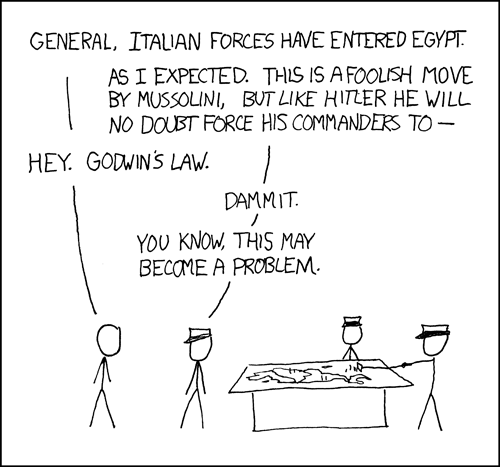
Regarding Mussolini (XKCD #261)

In America, the press and the populace have been guilty of accepting a big lie. The press calls it "balance." It is built out of false equivalence and "whataboutism."

It is this false notion that objectivity in reporting means never calling out a lie as a lie, or condemning bad ideas like racism, segregation, and human rights abuses for what they are. Americans used to be capable of pointing at the atrocities committed by Nazi Germany during World War II and stating unequivocally that those atrocities were evil. Yes, since the rise of the Internet, it has become common for people to overstate the "evil" of ideas they don't like by comparing them to Nazis - thus the coining of "Godwin's Law." But now we have seen prominent Americans who champion the ideas Hitler championed claiming that it is wrong for those of us who oppose their bad ideas to call them what they are.

The insane evil driving Thanos's story was an idea that he stated several times: "There are not enough resources to support everyone, therefore my plan is to acquire ultimate power and kill half of all life in the universe." Americans have bought into that idea, politically; not just the austerity-loving fiscal conservatives, but centrists and moderate progressives, too. "There are not enough resources to take care of everyone, so we have to make tough choices." We've seen this idea placed at the front of discussions about everything from immigration policy, student loans, and economic recovery to healthcare, military spending, and welfare.

But this past week has shown Americans the fruit that grows from planting that seed as we have learned about the human rights atrocities being committed by Immigration and Customs Enforcement at our southern border. "There are not enough resources for us to take care of everyone," we say, "and therefore we will take children from their parents and put them in cages."

Attorney General Ebony Maw... excuse me, I meant Jefferson Sessions... cited Romans 13 to justify this evil - apparently ignoring Romans 13:10, "Love does no harm to a neighbor. Therefore love is the fulfillment of the law."

The truth is that America has proven that marshaling our resources and using them to do good things is a net benefit to everyone. We literally built up our former enemies up under a Marshall Plan and turned them into two of our biggest trading partners. Meanwhile, the kind of austerity and "common sense" fiscal conservatism that is offered as a counter-balance to those economic policies fail time and again. But people keep making the argument--and keep accepting Thanos's premise that there aren't enough resources, therefore, Atrocity.

We don't have to accept that idea. We should call it out for being untrue. We should point out the flaw in the premise, and resist anyone who tries to harm others in the name of this flimsy and oft-debunked idea.

In the Marvel Universe, we have to wait until next year to see how Thanos will be defeated. That echoes with American politics, as well. We have to live with the unspooling awfulness that we have allowed to take over our government. We have to sit with the rampant corruption, the evil policies, and the chaotic destruction of the peaceful world that our grandparents built out of the ashes of the last world war.

"Oh, but you're just trying to bring down Trump," his supporters will say. "You're just obsessed with hating him, and you think he's Thanos."

No. That's not what I think. I don't think Trump is Thanos. What I do think is that anyone who has bought into a bad idea - "there aren't enough resources, therefore, the 'inferior' must die" or "'Race' is a biological fact, and only our 'race' should survive" - should be kept as far away from the Infinity Gauntlet and its colorful stones as is possible. When the 350 million of us who make up this country allow the worst third of us to wield that power, I worry that we are Thanos.

At some point, it is true that I think we will have to vote to remove Trump from office. That will either happen in the course of the 2020 election or indirectly through an impeachment for one of the many, many crimes that are being uncovered. But like the Avengers discovered, the Mad Titan shouldn't be the focus of our energy: it's the Very Bad Idea driving him and his supporters that we need to fight.

Our world is better off when the people running it are not corrupt. Our world is better off when the people running it are not treating our neighbors like criminals and our criminals like kings.


Sunday, December 3, 2017

The Year Without a President

In January, I wrote a post warning of the kind of monarchical tendencies Donald Trump had already displayed, and I pointed out that by his own standards Trump's presidency was illegitimate before he took office. Those were superficial comments on my part because aside from his behavior and demeanor (which already should have been enough to disqualify him from the job in the minds of voters), many of the deeper reasons for finding his presidency illegitimate were yet to be revealed.

Few things in this world are ever straightforward and easy to understand. To see the big picture, you have to do some homework. You have to consider several stories that seem unrelated, and which have unfolded since the early 2000s.

Below, I've provided a "reading list" of seven articles and interviews that can give you the outlines of that Big Picture. I trust that you will arrive at your own conclusions, or at least come up with your own questions about what all of this means for our country. For me, the story here is that after the fall of the Iron Curtain, America tried to befriend the former Soviet Union, and did some massive damage to the new Russian Federation in the process. Our captains of (financial) industry swooped in and essentially taught Russia how to rip itself off.

In 2001, President Bill Clinton pardoned a U.S. financier named Mark Rich on his last day in office. Rich had fled the U.S. in 1983 to avoid tax evasion charges, and Clinton's pardon allowed him to return home. If you remember that story from 2001 (as I do), you probably understand that this event was just the tip of an iceberg which came between the U.S. and Russia over the following decade. If you only remember that story because it became part of the 2016 election, you probably wrote it off as a ploy to harm Hillary Clinton's electoral chances. (And her part in this larger story is one of several reasons I have never been eager to vote for her.)

Rich, whose wife had donated nearly half a million dollars to the Clinton Presidential Library fund, was just one of many U.S. businessmen who tried to make money in Russia post-Soviet chaos. When Vladimir Putin came to power in 1999, he began a campaign of cleaning up corruption and pointed at the Clinton-era relationship with Boris Yeltsin and the later pardoning of Rich as reasons why the Russian economy at the time was doing so badly.

There is likely a lot for you to learn about Putin and Russia that is crucial to understanding today's headlines, but the way I would put it is this: Putin (and because he tells this story constantly through his state-run media apparatus, the Russian population) believes that the U.S. in general, and the Clintons in particular, humiliated Russia in the 1990s. He was a pragmatic communist before communism fell, and in the decades since, he describes himself as believing in "managed democracy," which I have learned bears a striking resemblance to organized crime. His vision throughout the 2000s was to use the booming oil market to rebuild Russia and to restore it to its rightful place of superiority in the world; and now that they have been rebuilt, to knock the U.S. from its position as the "only remaining Super Power."

In other words: Putin wants to humiliate the U.S. the way Russia was humiliated by the U.S.

Bill Browder's story is key to understanding current events because he was in Russia during Putin's early years, and his company is at the center of several of the stories playing out in the news, now. (His testimony to the U.S. Senate is below, and he has a book out called Red Notice that tells the story in greater detail.) He is the reason the U.S. passed the Magnitsky Act in 2012 - the sanctions bill which Russian lawyer Natalia Veselnitskaya tried to discuss with Donald Trump, Jr. - you might remember his famous episode over the summer in which he said she just wanted to talk about "Russian adoptions"? That was because the Russian government barred U.S. citizens from adopting Russian children in retaliation for the Magnitsky Act, and the Russians had apparently not yet figured out that the Trump people were too stupid to know anything about these issues.

But all of this is just the backdrop to the Big Picture. Here are the seven promised links for you to go and start doing your own "homework":
  1. The Vital Questions on Trump and Russia - The Guardian, by Tom McCarthy (30 Oct 2017)
  2. All the Trump Administration Ties to Russia (That We Know About) - Esquire magazine, by Jack Holmes (1 Dec 2017)
  3. Bill Browder's Testimony to the Senate Judiciary Committee - The Atlantic, by Rosie Gray (25 July 2017)
  4. Journalist Explains How Panama Papers Opened Up The World's Illicit Money Networks - NPR Fresh Air (transcript + audio) interview with Jacob Bernstein (20 Nov 2017)
  5. Paradise Papers: Offshore Trove Exposes Trump-Russia Links And Piggy Banks Of The Wealthiest 1 Percent - published by the International Consortium of Investigative Journalists (5 Nov 2017)
  6. Journalist Investigating Trump And Russia Says 'Full Picture Is One Of Collusion' - NPR Fresh Air (transcript + audio) interview with Luke Harding of the Guardian (21 Nov 2017)
  7. How Trump Walked Into Putin's Web - Luke Harding, the Guardian (15 Nov 2017)
Now, once you put all of that together, you may have some concerns. I know I do.

But consider that list of people - like Wilbur Ross, and Paul Manafort - whose names appear in multiple places in this Big Picture story. Think about how many top positions in our government the Trump Administration has left unfilled; and then think about how lucky we are that they remain empty. Think about how incompetent those who are in office are, even according to Trump supporters.

In many ways, 2017 has been a year without a president. The man in the office is possibly the least qualified we have seen in living memory and is certainly the least trustworthy to hold the responsibility of the U.S. nuclear arsenal under his control. And whether you interpret these stories to mean that he has been knowingly compromised by Vladimir Putin, or simply that he has been a useful idiot of the Russian president, it is abundantly clear that Moscow is getting what it has long wanted: a weakened and humiliated United States.


Monday, August 14, 2017

Love Is Not For Cowards

This is for my daughter.

My daughter is angry, scared, and disappointed. She is disappointed because in the first U.S. Presidential election she was eligible to vote in, America lost. She is angry because as a young, independent lesbian in a multiracial relationship, she watched as the man who is now the 45th President of the United States ran and won on a platform that overtly targets her, the people she loves, the people she lives with and people she works with.

I am no less angry, scared, or disappointed. I'm disappointed (but not at all surprised) that so many of the people I've spent my career serving and serving with have turned out to be okay with what is happening every week at the highest levels of our government. I'm devastated (but again, not surprised) at how many former friends and family are making excuses for what happened on the street in Charlottesville.

In every way possible, I'm right there with my daughter, fighting through the anxiety and dread, and trying to do what is right; not only for her, because she's my daughter, but for everyone around me. They deserve better than they are getting.

And that's why I have to call something out. My daughter reposted this today, and it is something that I know a lot of her friends and mine are feeling - but it is wrong:

Can we stop the bullshit liberal rhetoric of "love trumps hate" and "post cute puppy pics to spread love instead of hate"? You probably think that prioritizing love makes you better then the nazis and white supremacists that spread hate. But guess what? It is a thinly veiled excuse to be passive in times of injustice. Your silence and deflection is not an act of bravery, but an act of absolute cowardice. You are naive if you believe that "spreading love" will stop LITERAL NAZIS from believing in terrible and violent ideologies.
It is okay to feel hate towards these people. I HATE NAZIS. I HATE WHITE SUPREMACY. I HATE THE INSTITUTIONS AND THE POLICIES THAT HAVE MADE THEM FEEL COMFORTABLE AND SAFE ENOUGH TO HURT INNOCENT PEOPLE WITHOUT CONSEQUENCES.
So, let's just all stop kidding ourselves and take a stand. Not by spreading love, but by taking action.

Here's what's wrong with that:

Love does not equate to weakness.

I do agree that ignoring what is happening and failing to take action is a mistake - cute puppies won't stop the Nazis. But love is far more than cute puppies and vague, dippy happiness. Love is the thing that makes us better than them.

When my son was going through the worst of his issues in elementary and middle school, there were several years where we struggled to work with the school to get his behavior under control. We were fighting to get his diagnosis documented and recognized, and fighting to get him the assistance he required. There were people in our life who told me that the only way to get through to him would be to "beat his ass." They told me I was weak for not doing it, and that I was a fool if I thought medication and coddling would help.

Instead of listening to them, I chose to love him. We pulled him out of that school, and since he had a problem listening to me, his mom did the heavy lifting of going over his lessons and preparing him for high school. I did my best to support her - finding educational shows like Cosmos and Your Inner Fish for her to use to keep him interested in learning, and making sure her uniforms were ironed at night and ready every morning so she could go to bed on time, and get her rest.

When he tested to go back to school for his freshman year, he tested at or well above grade level, even in the subjects he hated most.

Love won. "Beating his ass" would have destroyed him.

The people we are up against now are hoping to spark what they see as a race war. Any violence against them will be used against us - if you can stomach watching Fox News, Breitbart, and the fringe sites that 45 has turned into acceptable mainstream outlets, you can already see that in the way they malign Black Lives Matter and SURJ, and how they're reporting the events in Charlottesville. 

Will we fight them? You can bet on it. But until the moment when we have no choice but to meet violence with violence, we must be patient and use the tools we have: love, law, and patience. We will have to be tougher than they are because love is sometimes a harder tool to use than a weapon.

Love requires character. Love requires you to be for other people, not just against the Nazis. Being against Nazis and Lost Cause Confederates is easy; it's harder to be for the ones in the middle. The ones trying to keep their heads in the sand and pretend that #AllLivesMatter to the Nazis. Those are the ones doing the most damage right now.

But Love insists on being tolerant and forgiving enough that even while someone is hurting you, you can keep a firm hold of their hand.

I know when you're this scared and this angry, what I'm saying sounds insane; but I have lived it. I've only made it through the worst moments of my life because of love and patience. I wouldn't be married to my best friend without both. I wouldn't have the family I have if I had done what so-called Common Sense and my worst instincts had told me to do.

"You probably think that prioritizing love makes you better then the nazis and white supremacists that spread hate." You're goddamned right I think that. Because I am better than them - and so are you. But you're fooling yourself if you think I'm being passive. I'm sure as hell not being silent.

There may come a day when I have to go out in the street and throw things to save my daughter and my family and my neighbors from these awful people, but until that day is here, I will keep taking care of my beautiful general, keep counseling my children, keep encouraging my employees and colleagues to do the right things.

And I vote. Which is something that more people should have done when they saw that the fucking Nazis were supporting the reality show host running roughshod over the "normal" candidates.

I don't know what is just over the horizon for our country, but I am pretty sure that the good and noble outnumber the fascist and bigoted. I know that when the time comes to make a choice, I won't hesitate to finish what my great-great grandparents started in the Civil War and my grandparents tried to finish in World War II. I hope we can finish it with little or no bloodshed.

But until the time comes, don't give up on Love. Love is not for cowards. Love is for the strong, because it is what makes us strong.

Whatever is required of me, Love is what will make me give it.

Sunday, January 29, 2017

"All Things Bright and Beautiful" to my #AtheistEar

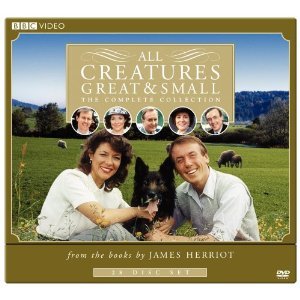
One song from our hymnal happened to have a series of books and TV episodes associated with it. I actually never got to watch this particular TV show when I was a kid, because it was aired in a Sunday morning time slot that put it squarely in the middle of our church services.

But I read the living heck out of the books, and while this wasn't the intent of the author, the lessons I took from his stories planted the seeds of skepticism in my brain.

I can't recall whether any of my choral groups performed this version of the hymn or not, but the John Rutter recording seemed the most familiar (and least cheesy) of those I could find on YouTube.


(Lyrics - and music - are available here.)

Songs like this one, which take the sense of wonder we all feel when we look at the world around us, and attribute that wonder to a concept of God are pretty common, across many cultures. The words bugged me when I was younger, because they focused so heavily on the pretty and charming side of nature, while completely ignoring the inherent danger. That seemed creepy and Orwellian to me, even then.

Nature's red in tooth and claw seems to be as apt a thing to attribute to an omnipotent being as each little flow'r that opens or each little bird that sings. And if we were going to give God credit for all of the sweet, pretty, and delightful things in the world He made, shouldn't he also get credit for making the violent, brutal, and dangerous things, too? When I questioned that, I got uncomfortable and tortured answers, which seemed to indicate that my elders were uneasy with the implication that an omnipotent God should also be held to account for what we call "evil."

It would take me about thirty years to process the cognitive dissonance that this produced. For several years during college, I was obsessed with the musical Jesus Christ Superstar in part because the character of Judas does what he does out of a sense of duty. He thinks he is "the good guy" when he goes to the Pharisees to turn Jesus in; and when he realizes that he was manipulated into doing an "evil" deed as part of God's plan, he is devastated:

Christ!
I know you can't hear me
But I only did what you wanted me to
Christ!
I'd sell out the nation
For I have been saddled
With the murder of you

God I'll never know
Why you chose me for your crime
Your foul bloody crime
You, you have murdered me

taken from: Jesus Christ Superstar - Judas' Death Lyrics | MetroLyrics 

Considering things from Judas's point of view is not generally approved of by the elders, either, by the way. They will remind you (with no sense of irony whatsoever) that Jesus Christ Superstar is fictional. But if you set aside the interesting puzzle of how much of the Jesus story is literally true, you will notice that they are still attempting to pull that sleight of hand wherein God gets all the credit and glory for everything good. The point of this trick is to shift anything evil - even if it was His idea, and necessary to His plot - onto you.

None of that epic philosophical struggle shows up in James Herriot's very popular books about a Yorkshire veterinarian in the 1930s. Instead, you get a lot of amusing stories that reveal the character of the small towns and farms of the English countryside. Herriot certainly doesn't set out to undermine God, here; in fact, I rather think that he would consider the themes in his stories to revolve around how humans misunderstand nature.

Selecting the lyric of that hymn for his title would indicate that he, too, attributes all of the goodness he sees around him to God. If anything, I think his intent was to bring out the good and the noble side of the subjects of his tales, and show that much of what people consider "evil" is better treated as ignorance or fear of the unknown, and that knowing more gives you the power to do more good. I still embrace that hopeful theme.

The TV series I always wanted to watch...
Among the anecdotes about farting boxers and contrary cattle, the stories that I related to most were those that revolved around Herriot's frustration with the science-denying farmers with their terrible "home remedies." In some of these tales, Herriot would contrast attitudes he ran across through several visits to different farmers.

One might have a calf with an easily treated calcium deficiency, but he would treat it with absurd tinctures and potions to avoid a veterinary bill. That farmer would finally give in and call Dr. Herriot, only to attribute the miraculous recovery to whatever arcane ritual had been performed before the good Doctor's arrival.

Another would call the vet right away only to find a deadly and un-treatable condition that required Herriot to put down a "perfectly good animal."

And then - possibly the worst feeling - there would be a case so difficult and mysterious that even after Dr. Herriot thought he would lose the animal. Yet, when he solved the mystery and miraculously saved the animal, the farmer would shrug, unimpressed, and mumble something like, "That's what ye charge so much for, innit?"

Sharing Herriot's affable frustrations over the years primed me to recognize the human animal's susceptibility to fooling himself. Failing to spot the holes in the stories we tell ourselves is widespread, and it's rare indeed that anyone responds well to having those holes pointed out.

I get why people respond so poorly and unpredictably to having their worldview challenged. I get why they would be suspicious of someone trying to change the way they think. It can be terrifying to realize that the core assumptions you've made about the nature of the universe and the benevolence of the God you worship have some internal inconsistencies. Most people who realize that their myths aren't true are going to recoil in horror.

Some may face the dilemma that fictional Judas faced; a deep sense of guilt for acting in a way they thought was good. Some may feel less noble, and simply double down to save face. And if you're the one pointing out the dangerous flaw that threatens their sense of self, their integrity, their nobility? Well, you're probably going to take the brunt of their reaction.

Don't feel bad - that's just nature demonstrating how wise and wonderful it is.